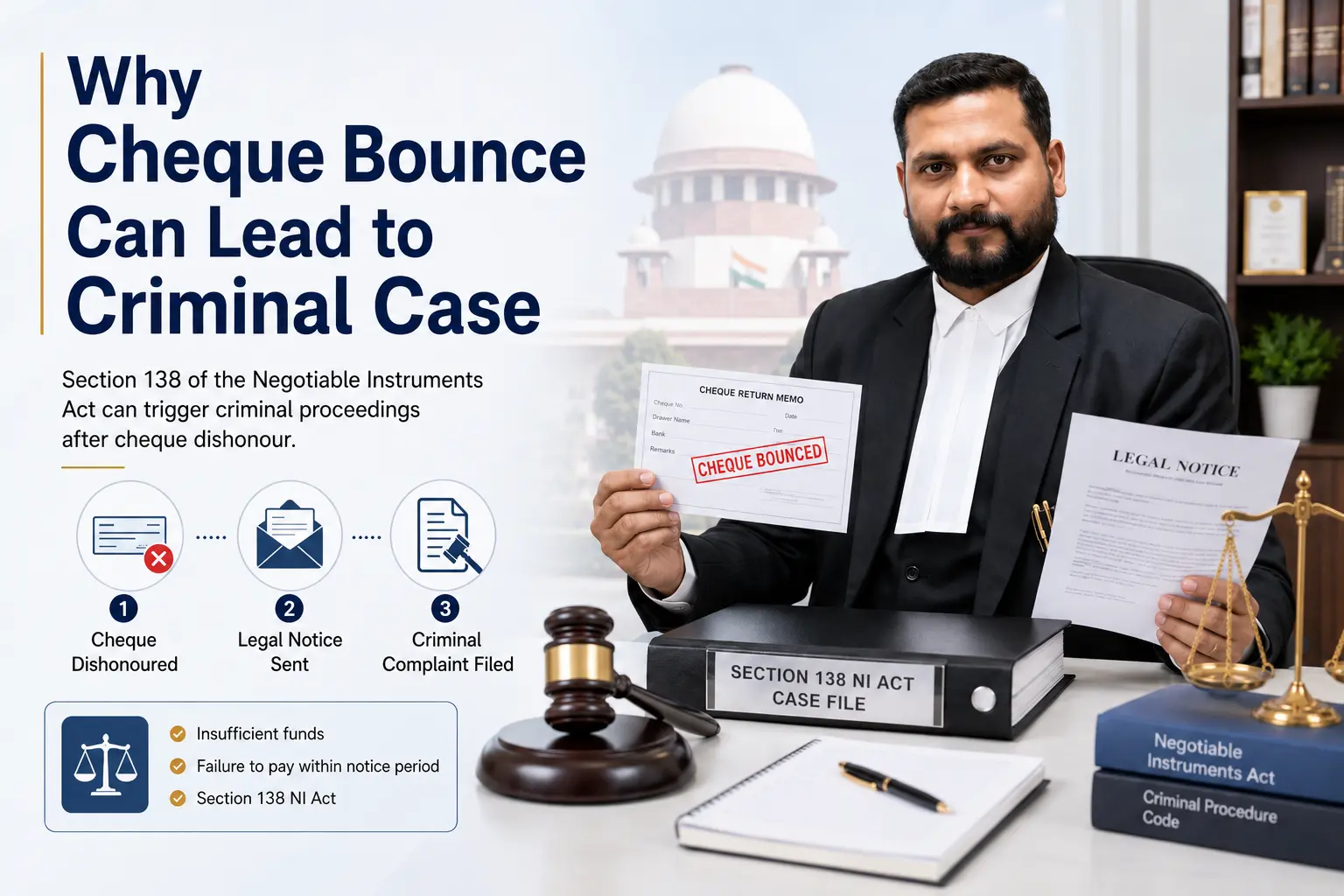
Legal guide on why cheque dishonour may become a criminal complaint in India, how Section 138 NI Act applies, why legal notice matters, what documents are needed, and how Advocate BK Singh and Cheque Bounce Lawyer can assist both payees and drawers. Let’s start with the practical side of cheque bounce. A cheque is not just a casual paper promise. In business, property, rent, loan, settlement and family money transactions, people accept cheques because they carry a sense of trust and banking discipline. When that cheque returns unpaid, the issue does not remain only about money. It can become a legal dispute. In many cases, it can also lead to a criminal complaint under Section 138 of the Negotiable Instruments Act, 1881. In such matters, early legal review by Advocate BK Singh can help a payee understand whether the cheque bounce matter has the ingredients required for criminal action, and it can also help a drawer understand whether the notice or claim is legally defective, exaggerated or wrongly framed. Why can cheque bounce lead to a criminal case? Because Section 138 NI Act treats dishonour of a cheque issued for a legally enforceable debt or liability as an offence when the drawer fails to pay even after receiving a proper legal notice. A bounced cheque can look like a simple payment failure at first. One bank return memo, one message from the accountant, one call from the payee, and suddenly the drawer is not just late in payment. The drawer may face a formal legal notice and, if payment is still not made, a criminal complaint. This surprises many people. They ask: how can a money dispute become a criminal case? The answer lies in the purpose of cheque law in India. Cheques support commercial trust. If a person issues a cheque towards a legally enforceable debt or liability and the cheque gets dishonoured for reasons covered by law, the payee is given a statutory remedy. If the drawer does not pay even after notice, the matter can move toward criminal prosecution under Section 138 NI Act. This does not mean every bounced cheque automatically becomes a criminal case. The law does not punish every banking failure. It punishes dishonour in specific situations where the cheque was issued for a valid debt or liability, was presented within validity, returned unpaid, followed by a valid demand notice, and still remained unpaid after the statutory period. That is why the first legal response after cheque dishonour must be calm, documented and legally correct. You should not rush to the police station. You should not send abusive WhatsApp messages. You should not make public allegations. You should not threaten arrest casually. The legal route under Section 138 NI Act has its own structure. Advocate BK Singh generally checks the cheque, bank return memo, date of dishonour, legal debt background, notice limitation, drawer details and service proof before advising whether the matter can proceed as a criminal cheque bounce complaint. The criminal nature of cheque bounce law comes from the failure to honour a cheque-backed legal liability even after a statutory opportunity to pay. This is why the notice stage is so important. The legal notice gives the drawer one final opportunity to make payment before the complaint route opens. A cheque bounce lawyer knows that courts examine the original cheque, bank return memo, debt documents, legal notice, proof of dispatch, proof of service and complaint timeline. Weak paperwork can damage a genuine claim. Wrong defence handling can also create trouble for the drawer. Here’s a practical guide on why cheque bounce can lead to criminal case, what Section 138 NI Act requires, what documents matter, what mistakes people make, and when to involve a cheque bounce lawyer. This guide is useful across India including Delhi NCR, New Delhi, Noida, Ghaziabad, Gurugram, Faridabad, Meerut, Lucknow, Mumbai, Bengaluru, Hyderabad, Chennai, Kolkata, Jaipur, Chandigarh and other business centres where cheques are still used in commercial and personal transactions. Digital payments have grown rapidly, but cheques have not disappeared from Indian transactions. Businesses still use cheques for vendor payments, rent deposits, loan repayments, property transactions, post-dated arrangements, partnership settlements, professional fee payments and family loan repayments. Cheque bounce matters continue to appear because cheques represent trust. When that trust breaks, the law gives the payee a specific legal route. Business transactions in Delhi NCR often involve parties across different cities. A supplier in Ghaziabad may receive a cheque from a Delhi trader. A property buyer in Noida may give a cheque to a seller in Delhi. A company in Gurugram may issue post-dated cheques to a vendor in Faridabad. When such cheques bounce, the dispute can quickly become serious. Every cheque bounce lawyer in India understands that the criminal complaint risk usually starts with the bank return memo and statutory notice timeline. Advocate BK Singh often advises clients to treat cheque dishonour as a legal timing issue, not merely as a payment reminder issue. The first few days after dishonour are important for preserving documents and calculating limitation. If the payee delays, the right to proceed under Section 138 NI Act may be affected. If the drawer ignores the notice, a criminal complaint may follow. Both sides should therefore treat cheque bounce as a serious legal event. Delayed payments affect business cash flow. For individuals, they create family and social pressure. For companies, they can affect reputation and director-level exposure. Cheque bounce law exists to discourage casual dishonour of cheques issued against enforceable liabilities. A cheque bounce matter can lead to criminal action under Section 138 NI Act when: The cheque should ordinarily be presented within its validity period. Cheques are commonly treated as valid for three months from the date of the instrument. As per Section 142 of NI Act, a complaint under Section 138 must be filed within one month from the date when cause of action arises, subject to the court’s power to consider delay if sufficient cause is shown. Section 147 makes offences under the NI Act compoundable, which means parties may legally settle the matter even after the complaint is filed. For a practical criminal cheque bounce review, Advocate BK Singh checks whether all statutory ingredients are present before advising court action or reply strategy. Cheque bounce does not become a criminal case merely because the cheque returned unpaid. A few legal conditions must come together. The cheque must relate to a debt or liability that the law can enforce. The payee must have received information from the bank about dishonour. The payee must send a legal demand notice within the statutory period. The drawer must fail to pay within 15 days after receiving the notice. Only then does the cause of action mature for a criminal complaint under Section 138 NI Act. This is why the legal notice stage is not a formality. It is the bridge between bank dishonour and criminal prosecution. A cheque is a banking instrument. When a person issues a cheque against a legally payable amount, the recipient relies on that instrument. Dishonour of that cheque can harm commercial trust, disrupt cash flow and create loss. Section 138 NI Act was designed to make cheque payments more reliable by attaching legal consequences to wrongful dishonour. The law gives the drawer a chance to correct the situation. That chance is the 15 day payment period after receiving the statutory notice. If the drawer pays within that period, the criminal complaint route usually does not arise. If the drawer ignores it, the payee may proceed legally. A supplier sells goods worth Rs. 4,50,000 to a dealer in Delhi. The dealer issues a cheque toward payment. The supplier deposits the cheque within validity. The cheque returns unpaid with the bank remark “insufficient funds”. The supplier receives the bank return memo on 5 March. The supplier cannot simply wait for months. The supplier must preserve the bank return memo, verify the transaction papers and send a legal demand notice within 30 days from the date of bank intimation. If the dealer receives notice and still does not pay within 15 days, the supplier may file a complaint under Section 138 NI Act before the competent court. That is how a cheque bounce matter can move from payment default to criminal complaint. No anger. No pressure tactics. Document the transaction, serve notice, wait for the legal payment window and then proceed if needed. Not every cheque bounce automatically proves guilt. The cheque must be connected to a legally enforceable debt or liability. Business dues, loan repayments, rent, professional fees, property payments, settlement money, supply bills and acknowledged debts may fall into this category depending on facts. If the drawer can show that there was no legally enforceable liability, or that the cheque was misused, or that payment had already been made, the defence may become important. Advocate BK Singh reviews the transaction background carefully because the reason behind issuance of cheque often decides whether criminal cheque bounce action is strong, weak or contestable. Cheque bounce criminal cases are primarily governed by the Negotiable Instruments Act, 1881. The most important provisions are Section 138, Section 139, Section 141, Section 142, Section 146 and Section 147. These provisions explain when dishonour becomes an offence, how presumption works, who can be liable when companies are involved, how limitation applies, why bank memo matters and how settlement can happen. Section 138 punishes dishonour of cheque when a cheque issued for discharge of debt or liability is returned unpaid and the drawer fails to pay within 15 days after receiving statutory notice from the payee. This is the provision that gives cheque bounce its criminal character. The cheque should be presented within its validity period. If the cheque is stale or presented too late, the payee may face legal difficulty in using the Section 138 route. The Explanation to Section 138 clarifies that debt or liability means a legally enforceable debt or liability. This point is central because the court will examine whether the cheque had a lawful payment background. When a cheque returns unpaid, the bank return memo records the reason for dishonour. Common reasons include: Each return reason may need different legal review. A template notice should not be used blindly. The payee must make a written demand for payment by sending a legal notice within 30 days of receiving bank information about dishonour. The notice should mention the cheque details, dishonour details, amount due and demand for payment. After receiving the notice, the drawer gets 15 days to pay the cheque amount. This is a statutory opportunity. If payment is made within that time, criminal prosecution usually does not move forward. A cheque bounce complaint must be in writing by the payee or holder in due course. It must be filed within the limitation period after cause of action arises, subject to court discretion in appropriate cases. Section 146 gives evidentiary value to the bank slip or memo showing cheque dishonour. This is why preserving the bank return memo is critical. Section 139 creates a presumption that the cheque was issued for discharge of debt or liability, unless the contrary is proved. This presumption is important, but it does not remove the need for proper documents and legal strategy. If the cheque is issued by a company, firm, LLP or body corporate, persons in charge of and responsible for the conduct of business may face liability if legal requirements are satisfied. Wrongly adding every director or officer without proper averments can create objections. At the same time, ignoring a company cheque notice can expose responsible persons to serious litigation risk. Advocate BK Singh reviews Section 141 company cheque matters carefully because company cheque bounce complaints require correct party identification and responsible officer analysis. This guide is useful for payees, drawers, business owners, vendors, landlords, property sellers, service providers, professionals, companies, authorised signatories, directors and individuals who are dealing with a dishonoured cheque. If you received a bounced cheque, you need to know whether criminal complaint conditions exist. If you issued a cheque and received a legal notice, you need to understand the risk of criminal proceedings and how to respond carefully. The bank return memo is the basic document that proves the cheque was returned unpaid. Do not rely only on SMS or verbal information from the bank. Collect the official memo and preserve it carefully. Under Section 146 NI Act, the court may presume dishonour if the official bank slip or memo is produced. This makes the memo a crucial document in criminal cheque bounce cases. Cheques may bounce due to insufficient funds, account closed, amount exceeds arrangement, stop payment, signature mismatch, account blocked or other technical reasons. Insufficient funds and account closed are classic cheque bounce reasons. Stop payment can also lead to action depending on the debt facts. Technical reasons may require more careful legal review. The most important question is why the cheque was issued. The payee should collect invoices, agreements, loan documents, rent records, settlement papers, bank transfers, WhatsApp messages, emails, delivery proof, ledger accounts and acknowledgments. A cheque bounce lawyer will often ask: “Can you show why this cheque was issued?” Your answer may decide whether criminal cheque bounce action is strong or vulnerable. The payee must send legal notice within 30 days from the date of receiving bank information about cheque dishonour. Do not calculate this casually. A wrong limitation calculation can affect the entire complaint. If the notice is delayed, the accused may raise limitation objections. The legal notice should mention cheque details, bank return details, amount due, transaction background and statutory demand for payment within 15 days. Cheque bounce notice should be firm but not abusive. It should not contain exaggerated threats or confusing facts. Advocate BK Singh can draft cheque bounce notices with proper demand language, limitation reference, cheque details and service planning so the criminal complaint foundation remains stronger. Once the drawer receives notice, he gets 15 days to make payment. If payment is made within that period, the criminal complaint route normally does not arise. If the drawer sends a reply, read it carefully. The reply may contain admissions, denials, payment history, security cheque defence or misuse allegations. If the drawer fails to pay within 15 days of receiving notice, cause of action arises. The payee may then file a criminal complaint under Section 138 NI Act within the prescribed time. The complaint should be supported by cheque, return memo, legal notice, dispatch proof, service proof and transaction documents. Cheque bounce cases can settle at different stages. Section 147 NI Act makes offences under the NI Act compoundable. Settlement should be written, clear and properly recorded. Payment schedule, default consequences and final settlement terms should not be left vague. Criminal cheque bounce cases depend heavily on documents. Poor paperwork can weaken a genuine claim. A drawer with a genuine defence also needs documents to explain the transaction history. Before sending notice or replying to notice, both sides should organise records properly. Documents for defending cheque bounce complaints vary based on facts. Common documents include: Unlike ordinary payment disputes, cheque bounce criminal cases require transaction documents, banking documents and legal notice documents to be examined together. Advocate BK Singh uses this document review to assess whether a payee has a strong criminal cheque bounce case or whether a drawer has a legally sustainable defence. People delay cheque bounce action because they believe promises. The drawer says payment will come next week. The payee waits. The accountant follows up. The family gets involved. The bank memo remains unused. Meanwhile, statutory limitation keeps running. Cheque bounce criminal action depends on dates. Missing one deadline can create serious legal difficulty. Do not confuse the 30 day notice period with the 15 day payment period. These are separate legal stages. Do not confuse the date of cheque bounce with the complaint filing date. Cause of action arises after notice is served and payment is not made within the statutory period. In reality, many clients approach lawyers late because the parties keep talking. “I will pay next Monday,” says the drawer. Then another Monday comes. After two or three weeks, the payee suddenly realises that the 30 day notice period is close to expiry. This is where legal rights get compromised. Sending a cheque bounce legal notice does not kill settlement. In many cases, it makes the drawer take the matter seriously. The payee can send notice and still remain open to payment, instalments or settlement. The drawer can also respond through counsel and propose lawful settlement if the claim is genuine. Advocate BK Singh generally keeps settlement possibilities open while ensuring that limitation and notice requirements are not ignored. A cheque bounce matter may look simple, but the payee and drawer stand in very different legal positions. The payee wants recovery and legal pressure. The drawer wants protection from false, exaggerated, time-barred or wrongly filed claims. The payee should check whether the cheque was issued for a legally enforceable liability, whether the cheque was presented within validity, whether the bank return memo is available, whether the notice can still be sent in time and whether the drawer’s correct address is available. The drawer should not ignore the notice. The drawer should check whether the claim is genuine, whether payment has already been made, whether the cheque was misused, whether the cheque was only security, whether the notice amount is wrong and whether the legal notice was sent within time. Advocate BK Singh assists both sides by examining dates, documents, transaction background and settlement possibility before the matter becomes more complicated in court. Ordinary recovery cases focus mainly on getting money back through civil remedies. Cheque bounce cases are different because the law gives a quasi-criminal route when statutory conditions are satisfied. The criminal complaint is not filed only because money is unpaid. It is filed because the drawer issued a cheque, the cheque was dishonoured, a lawful demand was made and the drawer failed to pay within the statutory notice period. This is why cheque bounce cases require careful drafting and document review. A weak notice, wrong amount, wrong address or unclear debt story can create avoidable objections. A drawer who ignores cheque bounce notice may face criminal complaint. Even if there is a defence, silence can create practical pressure later. A payee who waits only because the drawer promises payment may lose valuable limitation time. WhatsApp messages demanding money are not a substitute for statutory cheque bounce notice under Section 138 NI Act. Wrong amount in notice may create disputes. Cheque amount, part payments and balance dues should be reviewed carefully. Improper address can create service objections. Known residential, business, registered office and email addresses should be checked properly. The bank memo is a vital document. Losing it or relying only on a poor photograph can create practical hurdles. Business supply, loan repayment, property payment, rent cheque, security cheque and company cheque matters require different factual handling. In company cheque cases, responsible persons should be identified carefully. Blindly adding every director may weaken the complaint. Cheque bounce under Section 138 follows complaint procedure before the competent court. Routine police pressure is not the correct first approach. Verbal settlement can create future disputes. Payment schedule, settlement amount and default consequences should be recorded clearly. Advocate BK Singh focuses on avoiding these mistakes because one careless action can affect either prosecution strength or defence strategy. If you are the drawer, ignoring a cheque bounce notice can be risky. The payee may file a criminal complaint under Section 138 NI Act if statutory conditions are satisfied and payment is not made within the notice period. If the court takes cognizance and issues summons, the drawer may have to appear, defend the case, file appropriate documents, consider settlement, face evidence, arguments and possible judgment. The matter can affect reputation, business dealings and personal peace. If the cheque was issued by a company, directors, authorised signatories and persons responsible for business conduct may face litigation if conditions under Section 141 are properly made out. If you are the payee, ignoring the dishonour is also risky. Delay can weaken your Section 138 remedy. You may still explore civil recovery depending on facts, but missing the statutory notice timeline can reduce pressure and complicate recovery. Family relationships can suffer too. Cheque bounce between relatives, friends, neighbours and business associates can turn hostile quickly. Legal clarity often preserves dignity better than emotional argument. The danger from court increases once notice is served and payment is not made. A drawer should respond carefully. A payee should proceed within limitation. Both sides should avoid casual handling. You should speak to a cheque bounce lawyer immediately if a cheque has bounced or if you have received a cheque bounce legal notice. The best response to cheque bounce notice is not an angry reply. It should be fact-based, document-supported and legally careful. For both payee-side and drawer-side matters, Advocate BK Singh can assess limitation, transaction records, notice defects, criminal complaint risk and settlement possibility before the dispute becomes harder to control. Legal issues require timely intervention. Clerical errors waste time. With cheque bounce matters, a missed deadline, vague notice, wrong address, incomplete complaint or careless reply can create serious legal difficulty. Our law firm assists in cheque bounce legal notices, cheque dishonour notices, Section 138 complaint drafting, legal replies to cheque bounce notice, settlement agreements and recovery-focused legal action through court. Advocate BK Singh can review your cheque, bank return memo, transaction documents, limitation status, notice service details and complaint readiness. The first goal is to secure the legal timeline. After that, the matter can be assessed for notice, reply, complaint, settlement or civil recovery support depending on facts. Clients in Delhi NCR benefit from local court knowledge, jurisdiction review, bank branch assessment and document planning. Clients in other Indian cities can seek remote consultation to organise documents, understand notice risk and coordinate with local counsel where filing is needed. Cheque bounce can lead to a criminal case because Section 138 NI Act treats dishonour of a cheque issued for a legally enforceable debt or liability as an offence when the drawer fails to pay even after receiving a proper demand notice. No. Every bounced cheque does not automatically become a criminal case. The cheque must relate to a legally enforceable debt or liability, the notice must be sent within time, and the drawer must fail to pay within the statutory period. Cheque bounce under Section 138 NI Act is a criminal complaint of a quasi-criminal nature. Civil recovery remedies may also be available depending on facts, but Section 138 has a separate statutory notice and complaint route. The payee must send a cheque bounce legal notice within 30 days from receiving information from the bank that the cheque has returned unpaid. The drawer gets 15 days from receipt of notice to pay the cheque amount. If payment is not made within that period, the payee may file a complaint under Section 138 NI Act within limitation. Section 138 NI Act provides penal consequences if guilt is established. The actual result depends on facts, evidence, defence, settlement, court findings and applicable law. A security cheque may still lead to legal dispute depending on whether a legally enforceable liability existed when the cheque was presented. These matters require careful document review. Yes. NI Act offences are compoundable under Section 147. Parties can settle, but settlement terms should be recorded clearly in writing. A drawer should not ignore a cheque bounce notice. If the notice is false, exaggerated, time barred, wrongly addressed or already paid, a careful legal reply may help protect the drawer’s position. You should consult a cheque bounce lawyer if the amount is large, limitation is running, the cheque was issued by a company, the transaction is disputed, or you have received a legal notice. Advocate BK Singh can review the cheque, memo, notice and transaction documents before advising the next legal route. Advocate BK Singh can help clients understand whether a cheque bounce matter has criminal complaint risk, whether notice requirements are satisfied and whether settlement or defence strategy should be considered.Why Cheque Bounce Can Lead to Criminal Case
Top Questions Answered
Understanding Why Cheque Bounce Can Become Criminal
Why Cheque Bounce Still Matters in India in 2026
Quick Facts Box: When Cheque Bounce Can Become Criminal
When Does Cheque Bounce Lead to Criminal Case?
Why the Law Treats It as an Offence
Practical Example
Legal Debt or Liability Is the Core
Legal Framework Behind Criminal Cheque Bounce Cases
Section 138: Dishonour of Cheque
Cheque Must Be Presented Within Validity
Explanation to Section 138
Bank Return Memo Records Dishonour
Notice in Writing Within 30 Days
Drawer Has 15 Days to Pay
Section 142: Cognizance and Limitation
Section 146: Bank Memo as Evidence
Section 139: Presumption in Favour of Holder
Section 141: When Company Cheques Are Involved
Broad Legal Route After Cheque Dishonour
Who Should Read This?
Documents and Evidence Checklist
Documents to Prepare as Payee
Documents for Drawer or Defence Side
Timelines, Practical Delays and Decision Windows
Critical Timelines Every Cheque Bounce Litigant Should Know
Stage Legal Timeline or Practical Importance Cheque presentation Cheque should be presented within its validity period. A stale cheque can weaken the Section 138 route. Bank return memo Collect the memo immediately and preserve the original record safely. Legal notice Notice must be sent within 30 days from receiving bank information about cheque dishonour. Drawer’s payment window Drawer gets 15 days from receipt of notice to pay the cheque amount. Criminal complaint Complaint filing should happen within one month from the date when cause of action arises, subject to law. Settlement Settlement can be explored, but terms should be recorded in writing. Delayed Cheque Cases: Trapped in Promises
Protect Legal Rights While Keeping Settlement Open
Payee Side and Drawer Side Need Different Legal Strategy
For Payees
For Drawers
Why Cheque Bounce Is Not Always Treated Like Ordinary Recovery
Common Mistakes That Lead to Criminal Risk
Risks of Ignoring Cheque Bounce Notice
When to Consult a Cheque Bounce Lawyer?
Payees Should Consult a Lawyer If:
Drawers Should Consult a Lawyer If:
How Cheque Bounce Lawyer Can Help You?
FAQs on Why Cheque Bounce Can Lead to Criminal Case
1. Why can cheque bounce lead to a criminal case?
2. Does every cheque bounce become a criminal case?
3. Is cheque bounce a civil case or criminal case?
4. What is the 30 day notice rule in cheque bounce cases?
5. What happens after cheque bounce notice is received?
6. Can cheque bounce lead to jail?
7. Can a security cheque bounce lead to criminal case?
8. Can cheque bounce case be settled?
9. Should drawer reply to cheque bounce notice?
10. Should I hire a cheque bounce lawyer?
There's no reason for concern. There is no difficult-to-understand legalese.
Someone who has helped many people with the same problems gives you clear, honest advice. We want to make the legal process easy to understand and use for everyone.