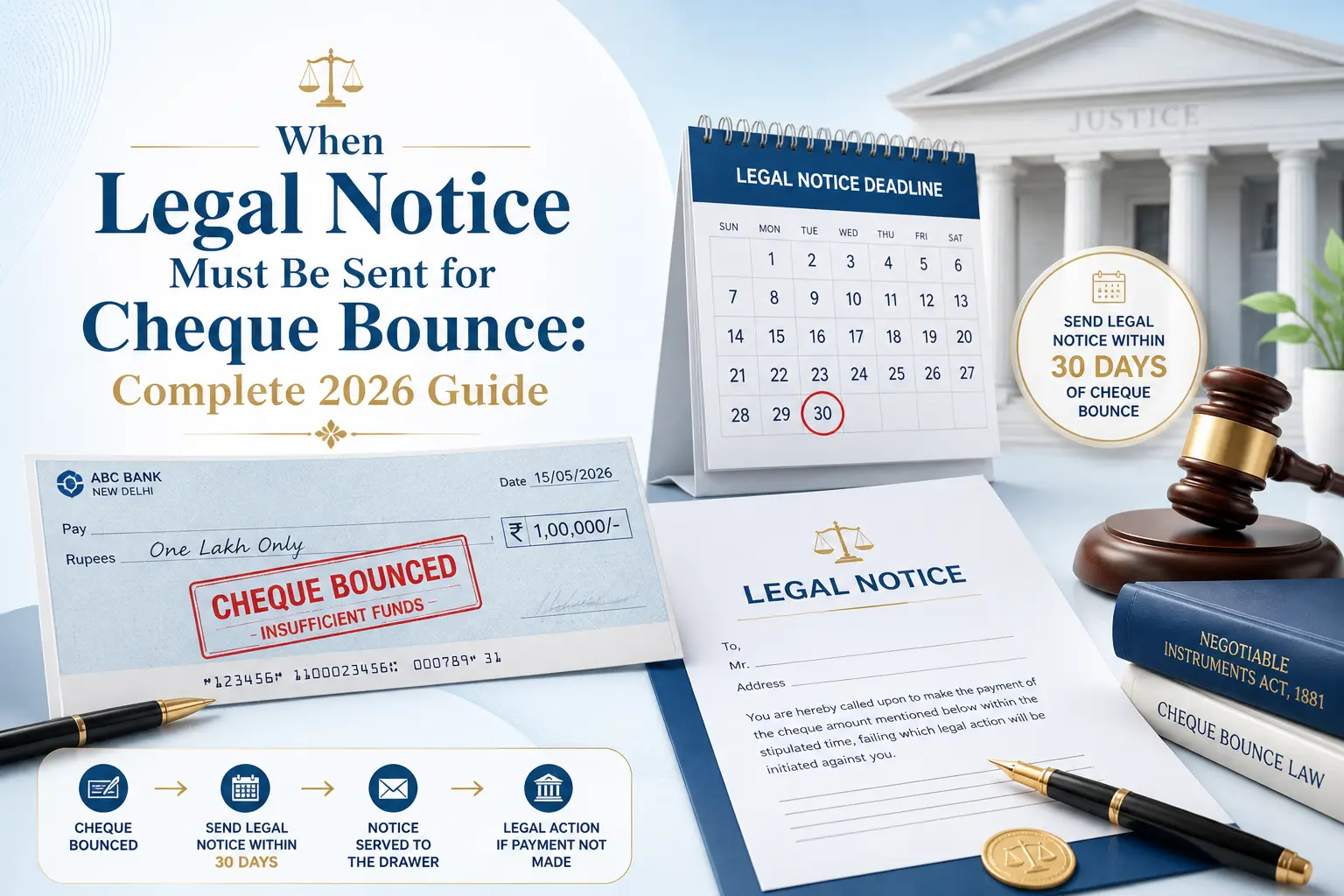
Cheque Bounce Legal Notice While the cheque bounce process may seem simple on paper, missing one date can fatally weaken your case. That’s why clients repeatedly ask me this question: The simple practical answer is: not too late. Under Indian law, if you are pursuing a cheque bounce matter under Section 138 of the NI Act, you should send the legal demand notice to the drawer within 30 days from when you receive information from your bank that the cheque has bounced. Typically, that’s when you get the cheque return memo from the bank. Once the drawer receives your cheque bounce notice, he has 15 days to pay. If the drawer does not pay within those 15 days, you may move toward filing a cheque bounce complaint under Section 138. Unfortunately, many delay sending the notice because they think of cheque bounce as “just another banking problem”. They make calls to the drawer. Wait for “next week”. Try settling on WhatsApp. Before you know it, weeks have passed. By the time you consult a lawyer, your cheque bounce legal notice time limit may be weeks away from expiring. As a lawyer, I’ve represented business owners, landlords, suppliers and contractors who made this mistake. Even employees, consultants and families delay sending cheque bounce legal notices. Don’t fall into that trap. Not sending the cheque bounce notice or delaying it past the prescribed timeline can harm your legal rights under Section 138 NI Act. A cheque dishonour legal notice is the first step toward a criminal complaint. It documents your demand, preserves the transaction evidence, validates the drawer’s liability and affords the drawer an opportunity to make payment as per law. Please read this entire guide if you want to know WHEN to send the legal notice for cheque bounce. Read how to send legal notice for cheque bounce for a more concentrated discussion on drafting and sending the legal notice. Cheque bounce is not really a “city-wise” problem. From Delhi NCR to Mumbai, Chennai, Bangalore and Kolkata, cheque bounce disputes happen across cities as long as businesses trust cheques for payments. Delhi NCR, Ghaziabad, Noida, Gurugram, Faridabad, Meerut, Mumbai, Pune, Bengaluru, Hyderabad, Chennai, Kolkata, Ahmedabad, Jaipur and Chandigarh – all see cheque bounce matters because businesses rely on cheques in dealings. Cheque bounce happens in rentals. Business supply transactions. Friendly loans. Professional fees. Construction payments. Advance for property. Corporate dealings. But why does this matter in 2026? Cheque bounce is still common despite UPI, NEFT/RTGS and emerging digital payments. Many people receive cheques because they are exchanging cash. Or continuing an old payment habit. The real issue isn’t always the cheque bounce itself. It is what happens after the cheque bounce. People receive cheque return memos on Monday and wait until Friday. Suppliers allow clients to default repeatedly because “the company is good”. Landlords wait because the tenant says he needs time till salary arrives. Consultants write legal letters but avoid filing because the client politely requests time. Careless delay hurts. Cheque bounce litigation has specific timelines under Section 138 NI Act. If you wait too long to send the cheque bounce legal notice, you automatically lose the right to file a Section 138 complaint based on that particular bounced cheque. Under Section 138 of the NI Act, 1881, the payee or holder in due course must send the drawer a demand notice for payment within 30 days of receiving bank information about cheque return. The drawer gets 15 days from receipt of that notice to pay. Sending a cheque bounce notice can impact your money, reputation, business dealings and future transactions. A small business may suffer salary delays, vendor payments and compliance issues because of one cheque bounce. A family may suffer because their needed funds are stuck in legal process. A company may inadvertently signal to other defaulters that they can delay payments. A cheque bounce notice is a written communication sent by the payee or holder in due course to the drawer of the cheque. The notice demands payment of the cheque amount after the cheque got returned unpaid by the bank. Why must you send a notice anyway? Section 138 NI Act does not treat every bounced cheque as an offence. Before you start a criminal complaint, law allows the drawer an opportunity to make payment. Sending the cheque bounce legal notice fulfills this condition. Because when you send the notice, you inform the drawer that his cheque was dishonoured and you expect payment. You also give the drawer the statutory opportunity to cure the deficiency by making voluntary payment. Some cheques are returned because the account has no balance. Some cheques are returned because the account was closed. Cheques may bounce due to stopped payment by drawer, signature mismatch, stale cheque, alteration, mismatch in details, irregularities in crossing or other reasons that lead the bank to return a cheque. The drawer may have a valid defense for some reasons. However, not every cheque dishonour is a “for sure win” if you file a Section 138 complaint. The facts, date of return memo, enforceability of debt, cheque validity, date of notice, proof of notice and complaint timing all influence your chances of conviction and punishment. For further reading on why sending a notice is mandatory under Section 138 NI Act, you can read why legal notice is required for cheque bounce. Remember this: The cheque bounce date is just one date on the timeline. What’s more important is when the payee receives information from the bank that the cheque has been dishonoured. The law is kind enough to allow you 30 days from this receipt of information to send the notice. If you dispose of the return memo or bank message carefully, this timeline doesn’t become a guessing game. For legal notices, we refer to the law that mandates the notice. Section 138 gives the right to send a legal notice. Sections 139 to 142 govern related provisions. The main laws governing cheque bounce notices are mentioned below: Normally, a cheque bounce notice must satisfy these elements: Only after the drawer fails to make payment within 15 days does cause of action arise to file a complaint. Section 142 further states that the court can’t take cognizance of an offence under Section 138 except on complaint in writing by the payee or holder in due course. Such complaint must be filled within one month from the date when cause of action arises. For current criminal procedure context, Bharatiya Nagarik Suraksha Sanhita, 2023 and associated new criminal laws came into effect from 1 July 2024 across India, subject to notified exceptions. Cheque bounce matters remain governed by the special NI Act procedure with the referenced criminal procedure applied where appropriate. Most importantly, businessmen should read this because they receive cheques from defaulters. Clients should read this so they know when to move toward sending you a notice. Family members should read this. Friendly lenders should read this. Individuals who trust cheques as payment should read this. Plainly speaking, if you have a cheque that bounced from a drawer, this guide will help you learn whether you should wait, try calling the drawer or send the legal notice. Every recipient of a dishonoured cheque faces this decision. Send the legal notice with help from your lawyer. The notice can be sent by you or your advocate. Navigate this page to learn more: Find out who can legally send notice for cheque bounce matter. Send the legal notice within 30 days from the date when the payee or holder in due course received information from the bank that the cheque has been returned unpaid. The law does not obligate you to send the notice on day 1. Neither does it compel you to send it on day 29. Ideally, collect the return memo as soon as the bank posts it to your branch. Verify drawer details and cheque facts. Send the notice within a reasonable period. Yes. There is no law that says you must wait till the 29th day to issue notice. Once you know the cheque has bounced and you have the documents in hand, write the notice and send it. Notice sending is not mandatory before filing a cheque bounce complaint, but your ability to initiate complaint rests on whether you can issue notice within the prescribed 30-day limit. Sending the notice early helps you preserve time for preparing the complaint. This happens when you deposit the cheque into your bank account through regular banking channels. It can also be presented by the bank branch where the cheque is drawn. However, it must eventually be returned by the drawer’s bank as unpaid. If the cheque gets returned, the bank will issue a return memo mentioning the reason for the dishonour. Cheque return memo is an important document. But the notice should mention and refer to the underlying transaction that caused the drawer to issue the cheque. That means you must keep proving your claim. Timing matters in cheque bounce notices. Triple check the date when you (or your bank branch) received information from the bank about cheque return. Some cheques may have been presented more than once. Re-presentations create their own questions about timings. Get a lawyer to review before sending notice. If your lawyer accepts the facts and finds no issues with timing, he will draft the cheque bounce notice. A good lawyer will ask you questions about transaction background. He will ensure the notice: Instead of general language like “your cheque was dishonoured, kindly pay”, the lawyer will carefully word your notice. A good lawyer builds your case with the notice itself. Send the notice to the address mentioned on the cheque. You can also use email if the fact situation justifies it. Preserve evidence of dispatch and delivery. Upon receipt of notice, the drawer can pay. If he does, you normally allow the matter to rest. If he doesn’t make payment in 15 days, you may proceed toward filing a cheque bounce complaint. Learn more about formats here: legal notice for cheque bounce format Cheque bounce notice is the first step in a legal process. Before you spend money on notice drafting and sending, ensure you have these documents in place. Refer to this collection: Timeline is everything in cheque bounce. Let me simplify the deadlines. Cheque bounce complaints can only be filed in a court within whose jurisdiction the bank branch is situated where the cheque was delivered for collection. If the cheque was presented for payment through the accounts maintained by the payee or holder in due course, then the complaint will be filed where the bank branch is located through which the account is maintained. However, if the cheque is presented otherwise, then the complaint will be filed in the court having jurisdiction where the bank branch is situated through which the cheque was presented. Need help with cheque bounce complaint? You can read Section 138 complaint Sending the notice within the statutory period is not optional. If you fail to meet the 30-day deadline, the drawer can object to the complaint that you file later. He will tell the court that you never afforded him the statutory chance to make payment. That does not end all recovery. You can still recover civilly or send a fresh cheque when it is still valid. You can try negotiating a settlement or getting a written acknowledgement from the drawer. Hope for friendly guarantees, but don’t rely on oral promises. You may also think of other legal recovery methods. But the shortcut to quick criminal remedy under Section 138 fails if you miss the notice deadline. Courts look at conditions precedent very seriously. You must show that you didn’t just have a claim, but you also complied with statutory conditions before deciding to file complaint. If the cheque is still valid and your facts allow re-presentation, you may present the cheque again. But if it bounces again, the law grants you a new notice period. Consult a lawyer before deciding what to do if you miss the deadline. Asking for repeated oral promises. Waiting. Hoping that the cheque will clear next month. These are the biggest mistakes. Aside from these, people make the following mistakes regarding cheque bounce notices: drawers make similar mistakes after receiving notices. You may read reply to cheque bounce legal notice and how to respond to cheque bounce notice in India . The drawer risks legal action,court summons, embarrassment and recovery. The payee risks losing his legal remedy. Don’t ignore cheque bounce notices. They matter more than you think. Here’s why you shouldn’t ignore cheque bounce law: Section 138 NI Act guide for comprehensive view of offence and legal proceedings. Sure. Anyone can send a legal notice. But it is usually done by a lawyer. Also, representing yourself in cheque bounce complaints is generally not advised. Consult a lawyer at least once. A decent lawyer will review your cheque, return memo and advise whether you can send a notice. If yes, he will tell you whom to send it to and the court where you may later file complaint. The first step is to review your documents. Please call or contact us to begin assessment. The simple answer to “when should a cheque bounce legal notice be sent?” is “within the prescribed time”. Send notice within 30 days of receiving bank information about cheque return. Let the drawer have 15 days from receipt of notice to pay the cheque amount. If the drawer fails to pay within 15 days, prepare to file the cheque bounce complaint within one month from when cause of action arises. Cheque bounce litigation favours those who watch the timeline. Triple check dates. Keep documents safe. Monitor limitation. Send proper legal notice. And don’t ignore cheques that don’t clear immediately. Sending legal notice may start the recovery process. If you received a cheque bounce notice today and don’t know what to do, contact me. You can also browse our site to learn more about: Need help finding the right lawyer? Read our tips on how to find the best lawyer for cheque bounce cases. Within 30 days from receiving bank information that your cheque was returned unpaid. The drawer gets 15 days from the date of receipt of cheque bounce notice to pay the cheque amount. A cheque bounce complaint must be filed within one month from when cause of action arises. For cheque bounce, cause of action arises when the drawer fails to pay within 15 days of receiving notice. Yes. Sending a legal notice is mandatory under Section 138 of the NI Act. A cheque bounce complaint cannot be filled without first sending a statutory demand notice. Yes. The drawer gets a chance to make payment within 15 days of receipt of the notice. If drawer pays within those 15 days, you normally would not continue with cheque bounce proceedings for that transaction. Look at the cheque return memo provided by the bank. It mentions the date when the bank received the cheque. Don’t email the notice. Use traditional modes like Speed Post or Registered Post. Electronic modes are allowed, but service proof becomes crucial. Every lawyer is different. To know how we decide our fees, click here. Absolutely. You can negotiate, allow time to pay or try sending a reminder after the notice. But don’t forget the law has granted you 30 days to begin with. You can present it again. If the cheque bounces again, you get another chance to send notice. Disclaimer: This Article is to be used for general information purposes only and not for providing any legal advice. For any specific or legal advice, kindly contact a lawyer directly. Also note that information, advice or strategies mentioned on this website may not be suitable for your specific situation. Please contact a lawyer for advice on your specific circumstances. Past results do not guarantee future outcomes.Cheque Bounce Legal Notice: Timing Guide for 2026
“When legal notice must be sent for cheque bounce?”
Why This Issue Comes Up in India, Delhi NCR & Major Cities in 2026
Emotions don’t matter here. Time does.
Quick Facts Box
Understanding the Timing Issue
What Law Applies to Cheque Bounce Notice?
Section Description Section 138 NI Act This section penalises cheque dishonour due to insufficiency of funds or when cheque amount exceeds arrangement with bank. Section 139 NI Act This section creates presumption in favour of holder. Section 141 NI Act This section extends liability to company persons. Section 142 NI Act This section talks about complaint filing and jurisdiction. Section 147 NI Act This section makes offences under NI Act compoundable. Essential Conditions for a Section 138 Cheque Bounce Notice
Who Should Read This?
Who Can Send Legal Notice for Cheque Bounce?
Timeline: When to Send Legal Notice for Cheque Bounce?
For most people, reasonable means within first 7 days. You have 30 days. Use them wisely.
Can I Send Notice Immediately After Cheque Bounce?
Sending Cheque Bounce Legal Notice: Step-by-Step Process
1The cheque gets deposited or presented to bank for payment.
2The cheque gets returned unpaid with reasons stated on the return memo.
3Collect the cheque image/cheque, return memo, bank statement and supporting documents.
4Review the limitation for sending legal notice.
5Draft the cheque bounce notice.
6Send the legal notice through Speed Post / Registered Post / courier or other verifiable modes of transmission to the drawer.
7Drawer has 15 days from the date of receipt of the notice to make payment.
Documents Required for Cheque Bounce Notice
Timeline: Dates, Delay & Decision Windows
Stage Practical Meaning Legal Significance Cheque returned unpaid Bank returns the cheque with reasons on memo Don’t lose the return memo Notice Send notice within 30 days of bank informing you about return Delay weakens your case Payment Drawer has 15 days from receipt of notice to pay File complaint normally after this expires Complaint File complaint within one month when cause of action arises Court fixes first date based on your complaint What If I Miss the Notice Sending Deadline?
Cheque Bounce Notice Mistakes to Avoid
Risks of Sending a Notice Too Late (or Not At All)
Can You Send a Cheque Bounce Notice Yourself?
Conclusion
FAQs
1. When should legal notice be sent for cheque bounce?
2. When does drawer has to pay after receiving notice?
3. How much time does the payee have to file cheque bounce complaint?
4. Is sending legal notice mandatory?
5. Does the drawer get a chance to pay after receiving notice?
6. Where to find bank’s date of receiving returned cheque?
7. Which mode is best to send legal notice for cheque bounce?
8. What is the proper lawyer fee to send legal notice?
9. Can I negotiate after sending cheque bounce notice?
10. What should I do if cheque is still valid but bounced?
Table of Contents
Related Topics
There's no reason for concern. There is no difficult-to-understand legalese.
Someone who has helped many people with the same problems gives you clear, honest advice. We want to make the legal process easy to understand and use for everyone.