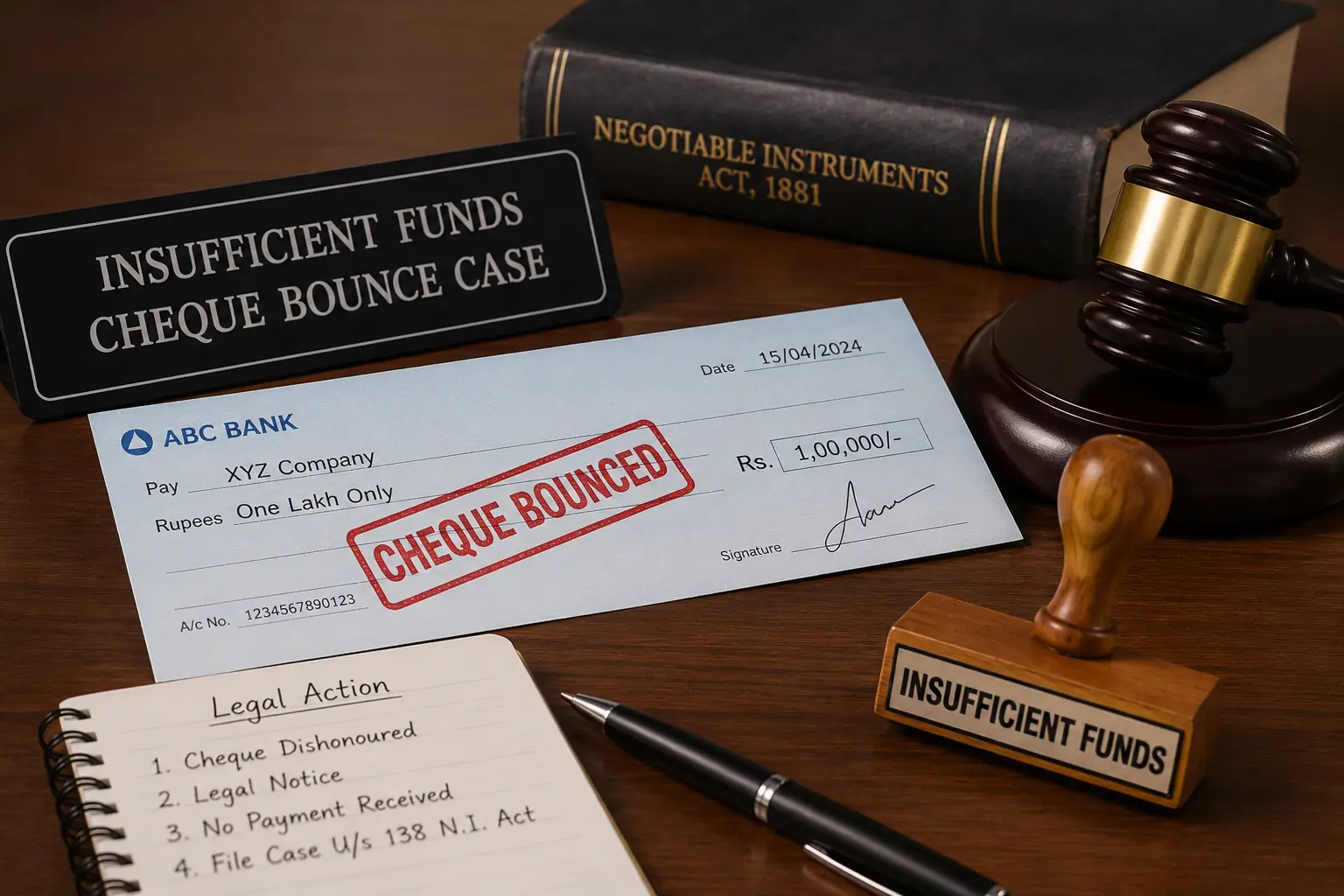
A practical, document-focused legal guide for cheque bounce disputes, Section 138 NI Act notices, settlement, defence and court-stage support. How worried should you be if a cheque you issued bounces because there were “insufficient funds”? Cheque bounce disputes can disrupt a family in one morning. They can create issues in a business account. An agreement between property buyers and sellers can break. Loan repayment plans get affected. Vendor relations might suffer. The cheque issuer might think it is “just a bank problem”. But the cheque receiver often sees it as breach of trust. An Insufficient Funds Cheque Bounce Case can arise when the drawer’s bank refuses to honour the cheque because the account has insufficient funds to meet the demand. In India, this triggers potential legal action under Section 138 of the Negotiable Instruments Act, 18 81 if certain conditions are met. Some people panic after seeing the bank return memo. Others receive a legal notice, court summons, or demands from the other side. Business owners fear loss of reputation. Salaried persons fear criminal court cases. Families feel embarrassed because most cheque bounce issues involve friends, relatives, landlords, money lenders, vendors, employers or known associates. At Cheque Bounce Lawyer, Advocate BK Singh sees one mistake almost too often: people panic too soon or too late. A cheque bounce matter is serious. But it is also driven by documents. Understand Timing | Documents play a far bigger role in cheque bounce disputes than emotions. This article discusses the Insufficient Funds Cheque Bounce Case. Advocate BK Singh tries to keep the language simple. TheBlogify readers come from India, Delhi NCR, Delhi, New Delhi, Ghaziabad, Noida, Greater Noida, Gurugram, Faridabad, Meerut, Hapur, Lucknow, Kanpur, Prayagraj, Varanasi, Agra, Jaipur, Chandigarh, Mumbai, Pune, Bengaluru, Hyderabad, Chennai, Kolkata, Ahmedabad and other cities with high reader demand. Here is what to know: An Insufficient Funds Cheque Bounce Case still matters in India in 20 26. Why? Because Indians still write cheques for business payments, rent, security deposits, loan amounts, buying property, committing to settlement amounts, vendor invoices and personal loans. Digitalisation has made cashless payments more common. But a cheque comes with legal heft. And commercial weight. Clients tell me their neighbourhood in Delhi NCR or city in India has seen many cheque bounce disputes start over one returned cheque. They then expand into legal notices, negotiations, fears of police misuse, anxiety over criminal cases, demands to recover civil amounts and threats about CIBIL score or business reputation. One dishonoured cheque can ruin relations between: But the damaging piece of paper is not the bank return memo. It comes later. The risk begins when the payee sends a cheque bounce legal notice within prescribed timeline. And the cheque issuer ignores it or replies wrongly. If the cheque amount is not paid within the statutory limit after receiving the notice, the payee/complainant can file a case with the appropriate court. Going by messages and calls that Landmark Lawyers receives, many residents in Delhi, Ghaziabad, Noida, Gurugram and Faridabad look for last-minute lawyer options. Because court summons may be quickly issued if a settlement is not reached. Companies in Mumbai, Pune, Bengaluru, Chennai, Hyderabad, Ahmedabad and Kolkata also face cheque bounce cases. And often against multiple cheques at once. Small businesses feel cornered because cash-flow is low but legal pressures are high. Simple legal advice: whether you are on the receiving end of an insufficient funds return memo or you have received a legal notice from a cheque holder, treat every notice and bounce as a legal alert. Don’t panic. But don’t be casual. What you do next depends on if you issued the cheque or received the cheque. An Insufficient Funds Cheque Bounce Case is mainly about two issues: The law considers the documents, dates of cheque issuance and receipt, existence of debt, sending of legal notice, adherence to conditions and conduct of parties after cheque bounce. Clients often tell me that their friend, landlord, vendor or supplier issued a cheque that bounced because he did not have money in his account. They think this means the same thing as a late payment. It does not. When a cheque is issued and given to the payee for deposit, that cheque represents a promise to pay. If the bank dishonours that cheque for “insufficient funds”, the law has created a new record of the transaction. If the cheque was issued because of a debt, outstanding invoice, loan amount due, rent payable, business transaction or settlement discussion between the parties, the cheque holder can use the dishonour as grounds to initiate legal action. Technically, a cheque bounce issue is not like getting an FIR registered with police. It doesn’t hit you like a call from the police. Section 138 of NI Act starts a criminal case based on a financial transaction gone wrong. The complainant, usually the person who received the bounced cheque, will file a complaint before the relevant Magistrate court only after following the prescribed conditions about sending a legal notice. The court then looks at the complaint, documents and legal requirements before issuing summons to the person who issued the cheque. If you received the cheque, your primary issue is recovering the due amount with legal pressure. If you issued the cheque, the issue is how to defend yourself, negotiate, pay part or full amount, challenge liability or protect yourself using procedural rights. Both cheque issuer and cheque holder need to understand the nuances of their positions. Remember that a cheque can bounce for many reasons. The return memo can say insufficient funds, account closed, stop payment issued, signature mismatch, drawer’s mandate not met or technical reasons from bank. While each return memo has to be examined for facts, insufficient funds is one of the clearer reasons to begin any analysis. This is because when the bank returns the cheque and issues a memo saying insufficient funds, it has essentially placed on record that the issuer did not have money in the bank account. Indian law on Insufficient Funds Cheque Bounce Case is primarily Sections 138, 139 and related provisions of the Negotiable Instruments Act, 18 81. Section 138 punishes issuing a cheque when there are insufficient funds or the amount exceeds what the drawer arranged with the bank. Section 139 creates presumption that cheque was issued for liability or debt. Section 138 does not penalise every cheque that gets returned by the bank. Several conditions have to be met. For example, the cheque must have been issued for a legally enforceable debt or liability. It must have been presented within the period it was valid. The cheque must have been returned by the bank unpaid. The payee must have issued a legal notice within a given timeline. The drawer must fail to make payment within the stipulated period after receiving notice. Civil courts have jurisdiction to try cases under Section 138. As a rule, the courts within the local limits where the bank branch is situated where the cheque was presented for payment by the payee have jurisdiction. However, this depends on facts. In Delhi NCR, cheque bounce cases can get filed in Delhi, Ghaziabad, Noida, Gurugram, Faridabad or other jurisdictions depending on where the cheque was deposited for payment and the banking details. While the complaint holder needs to prove certain facts, the drawer can raise defences. For instance, there was no legally enforceable debt or liability, cheque was only given as security, the cheque amount had been paid earlier, the notice was not drafted correctly, the complaint is barred by limitation, the suit was filed against the wrong person, there is some defect in company liability, cheque was materially altered or signature was not authorised. Companies, partnership firms and proprietorship businesses become slightly more technical for legal purposes. If a company issued the cheque, it is necessary to properly name the company and its responsible persons in the complaint. The law does not allow dragging company directors for somebody else’s wrong unless the directors are connected to the misconduct legally. Advocate BK Singh advises most clients that Section 138 should not be taken lightly. While cheque holders need to send a correctly drafted notice, the drawer needs to understand what he receives. One small drafting error in the legal notice, complaint letter, company authorisation, naming of parties or supporting documents can weaken an otherwise genuine complaint. On the other side, if the drawer ignores the notice, sends an emotional reply or misses from court after the case is filed, it can cause unnecessary hardship in many cases. For comprehensive help with cheque dishonoured by bank due to insufficient funds, readers can visit Cheque Dishonour due to Stop-payment or Insufficient Funds services page. Anyone who has issued or received a cheque that bounced should read this guide if the bank memo says insufficient funds as the reason for return. The bounced cheque amount could be ? 100 or ? 2 lakhs. Legal consequences depend on documents, facts and timelines. It does not matter. Business owners read this because when you deal with supply contractors, place orders, receive credit bills from vendors, start a franchise business, become a dealer for a brand or enter into service contracts, cheques will come into the picture. One bounced cheque can cause trouble and start legal actions. Working professionals should read this because if you have taken a personal loan, deposited rent for apartment or housing society, bought a vehicle on EMI, arranged school fee payments, asked a friend to lend you money or entered into an EMI-related settlement, chances are high that you have written or received a cheque. Many times, you may write a cheque when your own funds are pending or salary is due. If your employer delays salary, or your own funds do not come, your cheque can bounce. Startup and small business owners should read this because your business cash-flow is likely to experience dry spells. You may confidently issue cheques to suppliers, builders, landlords or freelance contractors. Once that cheque bounces, the lawyer and police calls may become personal if the complainant decides to mention you as the company or directors (in case of authorised signatories) in the complaint. Family will also face cheque bounce disputes. When you know each other for long, many loans are given informally except by way of a cheque. Later, the payer says it was a loan. The payee says it was only security. Cheques without agreement become a question of: who can prove what in court? Judge tends to see conduct, messages and whats probable. Cheque holders should read before sending a cheque bounce notice. Cheque issuers should read this as soon as they get a cheque dishonoured bank memo or receive a legal notice. Both cheque receiver and issuer should not destroy documents. Avoid admitting on WhatsApp without thinking about legal consequences. The process in an Insufficient Funds Cheque Bounce Case is straight forward. But facts can alter legal strategy. It starts with cheque presentation and can end in payment, settlement, compounding, trial, conviction or acquittal. Cheque is deposited into bank for payment. If drawer’s bank finds insufficient funds in that account, it returns the cheque with a memo. Second, the payee should assess whether the cheque was given for a legally enforceable debt. If yes, and the cheque was for payment of genuine invoice, loan, rent arrears settlement amount or an admitted balance, your position is stronger. If it was a blank cheque given as security, analyse carefully. Third, send the statutory notice within prescribed period. A legally weak notice can come back to haunt you. Notice should mention cheque details (attach copy), amount, bank memo, underlying transaction and demand payment. Do not lie or threaten illegal action. Read Section 138 Complaint Guide for detailed help with drafting notice or filing complaint. Fourth, drawer has opportunity to pay after receiving notice. Many cases settle after notice because sensible people act wisely. Drawer may choose to pay full amount. Or may ask for time to pay. He can agree to pay some part if he disputes rest of the amount. Drawer can submit documents if he has evidence to support his claim. Fifth, if drawer does not pay within stipulated time after receiving notice, complainant can file complaint before the Magistrate court having jurisdiction. Complaint should contain cheque, bank return memo, notice and other documents mentioned in Section 138. Postal receipt, tracking number helps prove notice was delivered. Sixth, court analyses whether to summon the accused. Accused appear in court and learn about bail, show cause notice, pleading, cross-examination, evidence and final arguments. Court may encourage settlement or compounding. Seventh, parties can settle at any stage. Lawyers can record settlement. If money is paid in instalments, it should mention dates, consequences of default, terms of withdrawal or compounding and whether civil recovery claim remains or not. Key advice from Advocate BK Singh: discipline matters whether you want to win your cheque bounce case or defend against one. Date of cheque, date of receipt, date of notice and documentary evidence matter. Cheque bounce is a paper-driven dispute. Both while filing and defending, gather all records before you take your next step. While cheque holder should safely store these 7 items, drawer should focus on acquiring proof he has repaid, cheque was given as security, bank statements showing payments and any correspondence about misuse. Do not modify messages. Courts can look into conduct of parties. It is better to have clean chat history than a clever narrative broken by indiscrete messages. BCS Advocate generally asks clients to put down dates before meeting him. It saves time and helps identify limitation, liability and decision to settle. Timelines are critical in Insufficient Funds Cheque Bounce Case. If limitation period is lost, genuine cheque bounce case dies. If legal notice is ignored, you can lose a defensible position. Once payee gets information from bank about cheque dishonour, he needs to assess the receipt date and issue a legal notice within prescribed timeline. Drawer gets chance to pay after receiving notice. If drawer does not pay within statutory period after notice, cause of action for filing cheque bounce complaint arises. Delayed happenings are important too. Cheque holders need to know that postal delivery takes time. Tracking shows refused, unclaimed, delivered, or returned. Each has different meanings dependent on facts. If drawer decides to avoid legal notice, do not hope the matter goes away on its own. Courts in different states/cities take different time to list cases. Courts in Delhi, Ghaziabad, Noida, Gurugram, Faridabad, Mumbai, Bengaluru, Kolkata, Chennai, Hyderabad and other metros have varying hearing speeds as per our experience. Some cases settle early. Others go to evidence and trial. Best window to act if you hold the cheque is immediately after return memo is received. Best window to act if you issued the cheque is immediately after you get the legal notice. Once summons are received, options reduce. If you want to settle the matter, begin early. Friendly negotiated settlement saves time and cost. Delayed settlement is still possible but stress, money and court procedures are high. Ignored bank memo. Many drawers think the cheque can simply be presented again. Presenting the cheque again may be an option in certain cases. But not when limitation gets over or if it affects sending of legal notice. Sent a wrong legal notice. I see this mistake too. A badly drafted notice with incorrect cheque details, wrong amount and vaguely mentioning liability amounts invites objections. Replies impact court case later. Reply emotionally. Some drawers send angry one-liners to cheque holders saying do what you want. Or telling the other side that “I will not pay a single rupee”. Use emotions carefully. Think that if I gave a security cheque, Section 138 won’t apply. Security cheque can get disputed in court. But it is not true that Section 138 never applies to security cheques. See cheating reasons above. Facts and documents decide. Think that because I paid some amount, case is automatically settled. Write it down. Get proof. Payment promises orally do not count. Write down even if you are paying in parts. What if other party denies later? Missed court date after getting summons. Panicking and ignoring court summons is mistake number 7 on every cheat sheet I see. Attend court. Don’t create avoidable problems. Mixed up civil recovery options with criminal cheque bounce process. Threatened police complaint. Sued in civil court. Started arbitration. Filed consumer complaint. Understand differences. Each has a purpose. Hidden documents from lawyer. Every lawyer handles weak facts professionally. But surprise facts can trouble your advocate. Accepted money and did not record the settlement. Oral settlements are risky. If money exchanged hands, record it. Can be via email or SMS. Try to have bank trace of money paid/received. Copied cheque bounce notice from Google and sent it. Cheque bounce notices have standard elements. But each case must be reviewed for limitation, jurisdiction of court and liability. Focus on cheques and documents. Remember what BK Singh says: Don’t over-react. Don’t delay. Consult a lawyer and take appropriate action. Every person who issues a cheque that gets returned due to insufficient funds should read this before ignoring it. There are legal, financial and reputation risks if you ignore the bank memo. The drawer of the cheque can get summoned to court, put through bail process, face trial and pay compensation if the cheque holder files a complaint and proves his case. There is no criminal conviction until the court holds otherwise. Businesses risk vendor trust, supply cut-off and partnership issues if they ignore cheque bounce disputes. In business circles, one bad cheque can become common knowledge quickly. Individuals fear the summon at home. Or the call from the other side. Family pressures to explain. Friends asking about criminal record. Cheque bounce matter hits a salaried person, student or small borrower the hardest because he is unsure what to tell others. From payee side, delay affects your recovery tactics. If limitation is lost, defence can ignore your complaint. If you fail to prove delivery of notice or file in wrong manner, you may affect your chance to win. Since cheque is a financial document, other civil and commercial disputes can also be connected. There may be a parallel civil suit. Or arbitration clause. Some businesses discuss loan settlement when cheque bounce is initiated. Or police complaints are made. Cheque problems can get linked to account reconciliation or insolvency by the other side. Don’t let one mistake affect the other. Solution: Consult a lawyer on time. Don’t panic. Don’t delay. Take action. Honestly, meet your lawyer after receiving bank memo when cheque is returned. Why wait for something to happen? You can always decide to send notice, re-present cheque or negotiate. Talk to a lawyer after receiving legal notice. Reply to legal notice requires proof, drafting skills and legal knowledge. Read our guide to learn how to analyse cheque bounce notice. Cheque drawers should consult a lawyer after receiving summons. You do not have to jump at police station. But courts are not informal chats. Learn about bail, notices, pleadings and negotiation skills. Cheque holders should speak to a lawyer before filing the complaint. This is the last chance to avoid court. If your cheque bounce case meets criteria for filing complaint under Section 138, a lawyer can help draft, verify documents and meet court deadlines. Legal companies need legal counsel when sending or receiving notices because board resolutions and proper authorisation may be needed in certain cases. Speak to a lawyer sooner. Book a free initial consultation with Advocate BK Singh to get started. BK Singh can help clients understand Insufficient Funds Cheque Bounce Case and work towards filing, defending, negotiating or documenting their position with respect to Section 138. We are not here to harass people without justification. We are here to present facts to court legally and competently. If you hold the cheque and want to file a case, we can review cheque, return memo, timeline, transaction background, cheque details, limitation, notice draft and complaint filing. If you issued the cheque and received a notice, we can review defects in notice if any, prove your liability was not enforceable or legally dispute cheque was given as security with proof of repayment, banking records, correspondence and statements. Strategy matters. Some complaints need to be filed strongly. Some legal notices deserve a well drafted reply. Some cases should settle early. Others involve disputes where liability is challenged and require trial defence. Learn more about Cheque Bounce Case – Defences. Visit Cheque Bounce Legal Blogs to read specific articles on topics related to cheque dishonour. Talk to us about your case on the Contact Us page. Only include relevant facts, dates and documents. Know the person who will handle your case: Advocate BK Singh. When cheque amount is not paid by the drawer’s bank because the account lacked money to honour it, the cheque holder can initiate legal action against the issuer. This is called cheque bounce case. For cheque bounce under Section 138, the cheque must have been issued for a legally enforceable debt or liability. Drawer getting notice and failing to make payment within the stipulated time is key. No. The cheque holder must issue notice. Drawer must fail to pay after receiving notice. And cheque must be linked to legally enforceable debt or liability. Facts and documents are important. Calm down. Read notice carefully. Note date of receipt. Verify cheque details. Confirm claimed amount. Collect your bank records and speak to a lawyer. Sending an emotionally-charged or indifferent reply can hurt your chances later. Advocate BK Singh recommends talking to a lawyer before replying. Yes it can. Depending on facts and timing, cheque bounce matters can be settled or compounded. But if you agree to pay or receive money in instalments, write it down. Clearly mention amount, due dates, default terms and what happens if case is withdrawn or money paid. Also mention whether civil recovery remains for balance (if any). Cheque given as security can become disputed in court. But it is not true that security cheque is immune from Section 138 proceedings. Important question is whether there was legally enforceable debt or liability on date of cheque presentation. Each case turns on its own evidence, documents and transaction history. Company can be sued if cheque was issued by company. And complaint is drafted properly. Individuals who signed on behalf of the company can also be sued if conditions are met. Advocate doesn’t suggest sending notices against company directors mechanically. Legal formalities need to be checked. While complaint requires cheque, bank memo, legal notice and supporting documents. Drawer or defence side should have cheque, bank records, proof of payments (if any), messages showing misuse and any defence document. Remember each party requires different documents. Cheque holders should keep these 7 documents safe. Issuer of cheque may gather above documents to prove his side of story. Part payment is relevant. But does not end the matter on its own. Unless there is written settlement, dispute can continue. Preserve evidence of payment and communication. Local lawyers know city courts faster. Cheque bounce cases go to criminal court. So you need a lawyer who practices criminal law and knows cheque laws. Cheque bounce complaint can be filed in court within whose jurisdiction the bank branch falls where cheque was deposited for payment. As per rule, the cheque holder files complaint where cheque was presented for payment. But there are exceptions. In Delhi NCR or any city, choose lawyer who knows local courts. BK Singh and team can help you understand cheque bounce laws whether you hold the cheque or have received notice. We help clients review cheque, return memo, transaction history, limitation period for notices, analyse cheque bounce notice received, draft or reply to legal notice and decide whether complaint can be filed or case can be defended. Exact approach depends on your role in transaction. Whether you issued cheque or received it. Hope this helps readers in India understand Insufficient Funds Cheque Bounce Case. See related guides above. You can take informed decision about consulting a lawyer. An Insufficient Funds Cheque Bounce Case should never be treated casually. For the payee, it may be a lawful recovery route if the cheque was issued against a real liability. For the drawer, it can become a serious court matter if ignored. Good legal handling starts early. Preserve the cheque record, bank memo, notices, replies, payment proof and transaction background. Avoid threats. Avoid false promises. Avoid silence. Advocate BK Singh and Cheque Bounce Lawyer assist clients across India with practical legal guidance for cheque bounce notice, complaint, defence, settlement and court-stage support. The right step depends on your side of the dispute, your documents and the timeline. This blog provides general legal information only and does not constitute legal advice.Insufficient Funds Cheque Bounce Case FAQ
Table of Contents
Why This Issue Matters in India in 2026
Quick Facts Box
Understanding the Core Issue
Legal Framework for Insufficient Funds Cheque Bounce Case
Who Should Read This?
Step-by-Step Process in Insufficient Funds Cheque Bounce Case
Documents You Should Gather
Document
Why You Need It
Original cheque/black and white cheque photocopy
To show cheque details
Bank return memo
To prove cheque was dishonoured and reason for dishonour such as insufficient funds.
Legal notice sent by payee
To show that statutory demand was made and to understand case theory
Postal receipt and tracking number Printout
To prove notice was dispatched and delivered.
Evidence about underlying transaction
Typically can be invoice, loan document/agreement or any other record showing debt/liable amount was legally enforceable.
Whatsapp, Email or SMS conversation
May help prove admission, dispute, promise to pay or settlement.
Bank statement of drawer showing balance/PAYMENTS made in that account
Cheque holders should not ask for this. Drawer can gather this on his own to prove his defence about repayment. In some cases, misuse complaints are raised against cheque holders.
Authorization of complaint
If complainant is company or partnership firm.
Reply sent by drawer to notice.
Each side needs different documents.
Timelines Decide Responses and Options
Common Mistakes in Insufficient Funds Cheque Bounce Case
Can You Ignore the Cheque Bounce?
Whats the Last Possible Stage to Consult a Lawyer?
Structered Filing Help Available Here
Avoid Generic Information by Consulting a Lawyer
Frequently Asked Questions
1. What is Insufficient Funds Cheque Bounce Case?
2. Do all insufficient funds cheque bounce become criminal cases?
3. What should I do if my cheque bounces because of insufficient funds and I receive legal notice?
4. Can an Insufficient Funds Cheque Bounce Case be settled?
5. Can I issue a cheque as security and still face a cheque bounce lawsuit?
6. Can a cheque bounce case be initiated against me if my company issued the cheque?
7. What documents are required for filing an Insufficient Funds Cheque Bounce Case?
8. Can I defend myself if I already made a payment against the cheque?
9. Which lawyer should I consult for an Insufficient Funds cheque bounce?
10. Which court deals with Insufficient Funds Cheque Bounce Case?
11. How can Cheque Bounce Lawyer help me with an Insufficient Funds cheque bounce?
Final Thoughts
Disclaimer
There's no reason for concern. There is no difficult-to-understand legalese.
Someone who has helped many people with the same problems gives you clear, honest advice. We want to make the legal process easy to understand and use for everyone.