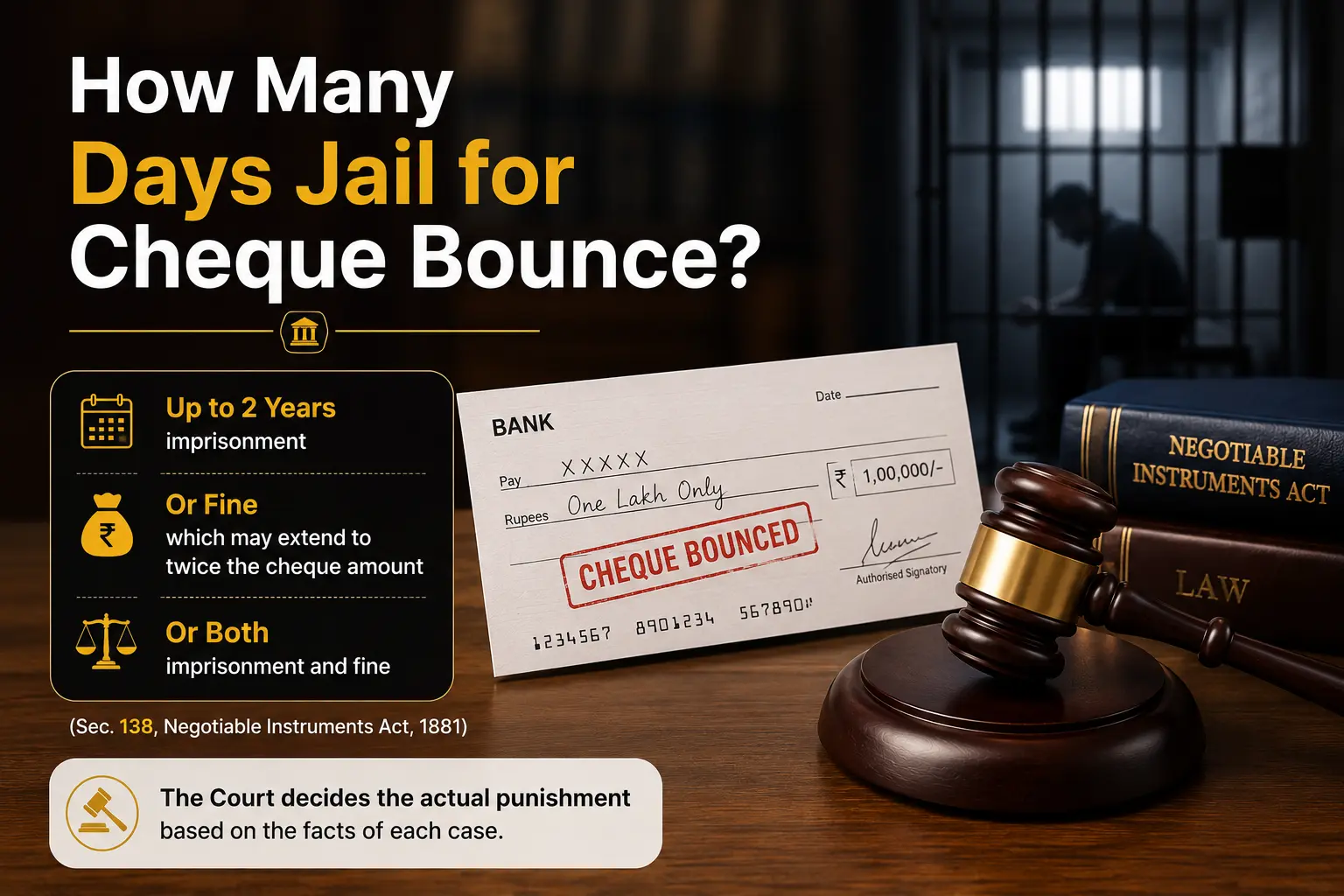
People fear cheque bounce cases because their immediate question is not about the law. It is about jail. Will I be arrested? Borrowers panic about police. Business owners panic about reputation. Salaried employees panic about office gossip. Traders worry that one unpaid cheque can change into follow-up court dates, non-bailable warrants and harassment by the opposite party. Here is the short answer: In one cheque bounce matter under Section 138 NI Act, 18 81, the jail punishment can extend up to two years maximum. Courts can also impose fine on the offender for up to twice the cheque amount or both fine and imprisonment after conviction. Since Indian law talks about years, instead of calculating days, jail duration for “how many days jail for cheque bounce” depends on many facts, evidence, behaviour of parties, settlement intentions and final order of that particular court. This does not mean that every cheque bounce results in jail. Most cases settle. Some fail because legal notice was defective. Some accused persons get relief by approaching appeal court after payment/deposit. Some complainants recover money without forcing imprisonment. Real situations can be more layered than a single-line answer. But people calling me online want a quick number. So here is the straight answer, without Artificial Intelligence (AI) flavour. Advocate BK Singh explains the issue to clients this way: Cheque bounce law should not create panic when you read it on day one. But once you receive a notice or become accused in a cheque bounce case, never ignore it. Written cheques support payments even today. Indians use cheques for loans, business credit, property payments, rent deposits, school fee compromises, supplier dues, friendly loans and post-dated EMI arrangements. In Delhi, New Delhi, Ghaziabad, Noida, Greater Noida, Gurugram, Faridabad, Meerut and other NCR cities, law matters are influenced by local market conditions. One unpaid cheque can ruin family relationships, business trust and market reputation very quickly. Cities like Lucknow, Kanpur, Prayagraj, Varanasi, Agra, Jaipur, Chandigarh, Mumbai, Pune, Bengaluru, Hyderabad, Chennai, Kolkata, Ahmedabad and other high-search-density cities have readers asking this question because they want one thing before consulting a lawyer: Am I going to jail immediately after a cheque bounce? The honest reply will be NO, not immediately and not only because one cheque was dishonoured by the bank. Cheque bounce becomes a jail-worthy offence only after running the prescribed legal process, appearing in trial and getting convicted by the court. There can be additional worries if the accused ignores summons or direction from the court and creates warrant-related issues. Local audience is important because cheque bounce cases are filed in Magistrate Courts. Small differences happen in court practice based on speed of litigation, settlement culture, summons service efficiency and digital adoption. Someone with a cheque bounce matter in Delhi NCR will have to deal with congested court lists. A trader in Mumbai or Ahmedabad might fear commercial reputation loss since business cheques affect credit ratings. A person working on salary in Noida or Gurugram might dread workplace embarrassment if they share their notices with colleagues or employees. Instead of guessing audience concerns, Advocate BK Singh prefers discussing matters personally. The lawyer can understand whether the client has just received a notice, or a complaint has been filed, or court summons have arrived, or evidence stage has started or the matter has progressed to conviction or appeal stage. Each stage carries its own jail-risk analysis. Maximum punishment for cheque bounce under Section 138 NI Act is two years imprisonment after conviction. The Court may also impose fine on the accused that is twice the cheque amount or both fine and imprisonment. Cheque bounce does not result in immediate jail on the dishonoured date Settlement and compounding is allowed in many cheque bounce matters under Section 138. Section 138 allows filing a criminal complaint against a cheque bounce. But remember this complaint is connected to a money-related liability. The law punishes you when you dishonour a cheque that was issued for a legally recoverable debt, or liability. Simple way to understand: the cheque must be issued for a lawful debt or liability. Cheque given as gift, cheque issued without any debt or liability, or cheque given during illegal dealings will not get same benefit as a cheque given for repayment of admitted loan, business transaction or some settlement amount. Everyone misunderstands “jail”. Police will not come on the same day when you get the bank memo saying “sorry! Account closed”. Instead, the complainant needs to send a notice and then file a complaint. The opposite party gets a chance to defend. Witnesses come to court. Evidence is recorded. Only then can the court punish. This takes time. For complainants, this process brings chance to recover money. For accused, it gives chance to raise defences. For both parties, it provides an opportunity to settle if the dispute is genuinely about payment and both sides want closure. Yes, cheating through bounced cheques can invite jail punishment, but Section 138 jail is not automatic. Only after the accused is convicted does the court punish with imprisonment of up to two years. Fine, compensation, actual conduct of the drawer, nature of transaction and many other facts influence the practical outcome. Section 138 reads in relation to cheques that are dishonoured because the bank found “insufficient funds” or “amount exceeds arrangement”. In other words, the cheque was not honoured because the drawer does not have enough money in the account. Additionally, the cheque must have been presented to the bank within its validity period. After dishonour, the holder or payee of the cheque must send a written notice demanding payment within a statutory period. If drawer makes payment within 15 days from notice receipt, then normal course of Section 138 does not apply. Cheque has bounced, notice was served but drawer failed to make payment. The complainant now has the option to file a written complaint before a Magistrate Court under Section 142. It talks about cognizance of cheque bounce complaint. Notice must have been issued by payee or holder of cheque. The complaint must be in writing and issued by payee or holder in due course. It lists out complaint filing window and appropriate court for cheque bounce cases. Due to its connection to financial transactions, a Section 138 case is called quasi- criminal complaint. Courts use criminal procedures to decide the matter. But punishment is not the primary goal. Many judges focus on compensation, willingness to settle and future compliance. But if the accused has been a repeat defaulter, evades court or shows disrespect, strict actions are possible. Sections 139, 140, 141, 143, 147 and 148 are connected. Section 139 creates presumption in favour of holder. The drawer can rebut this presumption. He can challenge the holder’s claims by asking questions, producing documents and creating doubt based on probabilities. Section 141 puts companies on notice. Company directors, partners or persons in charge of company at the time of offence can become liable too, if certain conditions are met. Section 147 allows compounding of offences. Which means, parties can settle as allowed under law. Know exactly why the cheque was issued, how the notice was served, whether you can prove liability and what has happened in the cheque bounce matter till date. Until you know these facts, discussions about jail days remain abstract. Both sides of cheque bounce disputes need these explainers. One side wants to know how the law can pressurise them to recover money. The other side wants to know whether they can go to jail, if compromise is possible and whether any defence exists in the facts. Small business owners need this guidance because many disputes arise out of supplier cheques, security cheques, post-dated cheques and settlement cheques. One bad cheque can impact GST-invoices, ledger entries, delivery proof, future credit lines and market trust. Startup founders and small companies in Bengaluru, Hyderabad, Pune, Delhi NCR and Mumbai struggle with this situation when their cash flow stops but cheques they issued keep getting dishonoured. Individual customers also ask this question. Because people don’t understand “how many days jail”, they fear smallest cheques when recovered money is substantial. Friendly loans, delayed marriage payments, outstanding rent, school fees collected by parent committees, purchase consideration for vehicles and genuine transactions between families & businesses often end up at lawyers’ offices with a cheque bounce notice. Cheque issued by companies worry customers because bigger money is involved. If the bounced cheque was drawn from a company account, the complaint will name the company first and directors or officers next. Do not treat summons as a press-release. Every director will not be liable in every case. Courts decide based on pleadings, position of the director in company, control over finances and facts. Advocate BK Singh asks every client to bring these documents before he gives any closing advice. The same cheque bounce can look scary or irrelevant based on what documents you have to prove your story. A cheque bounce starts when a cheque is deposited and bank sends it back unpaid. Start from bank return memo and move step-by-step. Follow this explained guide: File cheque bounce matters require lots of paperwork. Keep good documents if you have genuine claim or defence. Courts decide merit, not emotions. Every cheque bounce case has limitation deadlines. Complainant may have strong case but lose legal heat if notice or complaint is delayed. The accused may have solid defence but destroys it if he ignores summons or court orders. Cheque gets dishonoured by bank. Payee sends notice within legal window. Drawer has 15 days from notice service to pay. No payment = complainant files written complaint before proper court within prescribed time window. Each window starts from date when event happened, not estimated or presumed dates. Actual court delays are different from legal deadlines mentioned in the NI Act. Some courts in Delhi NCR, UP, Maharashtra, Karnataka, Telangana, Tamil Nadu, West Bengal, Gujarat and other states take more time. Reasons include delay in summons service, court insisting on mediation, recording evidence date or heavy court workload. You may settle earlier too or watch the case travel from trial to appeal. Timing decisions are important. Clean-up settlement is better done at notice stage. Realistic negotiation at summons stage because both parties now understand risks of court. Evidence stage requires more focussed legal action from lawyers. Discussions change after conviction because now judge has spoken about sentence, compensation, appeal window and deposit conditions. I review each timeline before deciding how to assist clients. Checking whether notice was sent in time, service is provable, complaint was filed within limitation and complainant approached the right court helps build these explainers. This also helps decide whether I charge clients money or offer initial free consultation. Emotions worsen cheque bounce cases. Anger, fear and ego. Solution is reading less and talking more to the right lawyer. Guys panic immediately after their cheque was dishonoured by the bank. They rush to settle without checking limitation, liability or documents. Ladies laugh-off the cheque notice because “it’s just a cheque matter, we can deal”. Both reactions cause problems. Many reply to notices without proper legal review. Accidentally admits-liability, tells half-truth story or promises to pay without conditions. Result: suffer later during trial. If-payment-is-due, promise-to-pay-but- protect-yourself approach works better. Cheque composers also commit mistakes. Send notices even when it’s past the prescribed deadline. Claim wrong cheque amount. Mention wrong address. Claim amounts more than what cheque was issued for without careful drafting. File complaint before wrong court. Any big-negative can defeat otherwise strong case. Businesspersons often settle just by talking. Accept half-payment without writing terms, send back cheque without asking for receipt, forget to record balance amount and then fight about the same later. Cheque given for settlement bounce = new dispute based on poor documents. Company-issued cheques cause another mistake. Complaint drafts that every director as accused. Cheque was company cheque. Yes. But every director will not be liable. Courts look at pleadings, role of director in negligence and control over conduct. Blaming everyone is not strategic. But ignoring summons definitely is. Some people use wrong address while communicating with bank or respondent. Notice cannot be served because address was written carelessly. Case gets delayed. The accused changes address to avoid summons. Court issues warrant. Delaying-cheek-legal-help until conviction stage is common mistake. Paying penalty after sentence is better than not paying at all, but chances of settling or reducing punishment diminish over time. Advocate BK Singh sees many clients when its already too late. Cheque bounce matters get complicated when any side ignores the problem. Amount you recover or lose could be small compared to summons received from court, warrant stress, legal expenses, need to travel and attend hearings, damaged reputation and repayment pressure after conviction. Ignoring hurt prospects more when you are the accused because you lose opportunity to explain your side properly, appear before court on time and settle the matter early. Miss summons = coercive court action. Ignore evidence stage = high-risk of conviction. After conviction = judge can order imprisonment up to two years along with fine or compensation. For complainants, ignoring spells loss of opportunity. Sending notice late =cheque bounce complaint gets defeated. Documents missing or not preserved =opposite party can attack your complaint. Being too late weakens a creditor and can eliminate realistic settlement value. Ignoring blotches reputation. Cheque bounce matters are common in business neighbourhoods. They do not forget easily. Future supplier may reduce credit. Landlord may not trust you for next deal. Banks, investors and diligence teams will ask questions when you apply for loans or become party to legal agreements. Cheque bounce is a criminal complaint connected to financial default. Family and employers may disturb your peace too. Loan recovery, unsettled business dues and genuine commercial transactions turn into emotional-nightmares for many families. Small business faces public chatter when someone files a cheque bounce case within trade circles. Panic is normal but can be reduced with correct legal advice. Should you consult a lawyer immediately after your cheque bounces? No. Should you consult a lawyer once you have received cheque bounce notice or court summons? Yes, consult. Is it too late to consult when trial has started or even after conviction? Consult Advocate BK Singh before taking any further action. Delaying-lawyer-help is the last mistake in this list. The lawyer, your law firm or service providers like Cheque Bounce Lawyer can help by understanding the cheque, return memo, legal notice, documents proving liability, limitation dates applicable and current stage of the case. Only after understanding essential details, a lawyer will suggest a practical path forward. Someone has bounced your cheque and recovery is goal. Lawyers can help by reviewing notice you send, preparing complaint if needed, assisting with court evidence presentation, following up on summons and court orders, documenting settlement or exploring appeal options. Lawyers know what documents court want to see. File prepared well quicker disposal. Someone has bounced your cheque. You owe money and want to avoid harassment. Lawyers can help by reviewing notice you received, advising on notice reply, suggesting bail and appearance strategy if summons received, exploring your defence, negotiating settlement or compounding and even helping with appeal against conviction. Advocate BK Singh is guided by principle of practical assessment. No client should be given false-assurance about their case. If settling is better option, you will hear that from me too. If your notice is defective, i will point defects. If convicting accused is easy based on facts/documents, i will tell client that too. Litigation risk is real. Panic is not solution. Have a question about “how many days jail for cheque bounce”? Ask in comments. One of us will try to respond. Maximum imprisonment for cheque bounce under NI Act can be extended up to two years. Courts use legal language, not calculate sentence in days. But jail is not guaranteed in every cheque bounce case. Conviction depends on facts, evidence, documents, conduct of parties, willingness to settle and final order of the court. No. One does not get jailed because bank returned a cheque unpaid. Complainant must issue a legal notice (if he wants to file cheque bounce case), allow time for drawer to pay and then file a legal complaint. After notice and complaint, accused must be proven guilty by complainant before magistrate. Cheque bounce comes into “jail-risk zone” only after conviction or after accused start ignoring court process. Cheque bounce case under Section 138 is filed through a criminal complaint but arises from a financial liability. This is why many people refer to cheque bounce as quasi-criminal complaint. Courts can punish accused on conviction but most cases settle before conviction. Therefore compensation and practical recovery are common outcomes. Courts may impose fine that is twice the cheque amount under Section 138. Courts can also award compensation depending on facts and stage of case. Each case different. Stop guessing penalties and ask a lawyer after explaining facts and sharing documents related to your cheque bounce case. Yes. Many cheque bounce disputes settle after payment, payment in instalments, mediation or compounding. Refer to section 147 NI Act for law about compounding of offences. Avoid accepting entire payment upfront. Write clear terms so that everyone understands payment dates, consequences of default and terms of closure. Cheque given as security can still create liability on certain conditions. Cheque must have been issued for legally enforceable debt at the time when cheque was presented to bank by the payee. That being said, every cheque given as security requires separate analysis based on transaction, documents and communication. Consult lawyer before you decide to ignore or reply to cheque bounce notice. Advocate BK Singh can help decide whether notice reply should deny-liability, offer-settlement or seek supporting documents from complainant. Sending inappropriate reply will harm your defence later. Don’t panic. Cheque composers should focus on collecting bank memo, verifying cheque validity period, preparing legal notice for cheque amount and preserving proof of notice service. Cheque return memo waits for 15 days. If drawer does not pay during this time, prepare your complaint with all supporting documents. Yes. Directors or officers in charge of company at the time of offence can become liable if complaint properly establishes their role and control over company actions. Just because you are director of a company does not mean the court will punish you for offences committed by company. Proving right address play important role in sending legal notice and proving service of summons. If postal address was wrong and notice got returned, delay is certain. If accused is avoiding summons by constantly changing address, chances of getting arrest warrant increases. Answer to “how many days jail for cheque bounce” is yes, up to two years. Jail for cheque bounce is relative. It depends on quality of notice sent, proofs of liability, current stage of case, conduct of parties, settlement discussions and final judgement. One who receives cheque bounce notice should neither panic nor ignore the notice. Complainant should not think that every cheque they deposit will lead to cheque bounce punishment. Do not lose documents because you panic later. Both parties need to focus on strengthening facts, meeting timelines and obtaining practical legal advice. Cheque Bounce Lawyer can assist clients at notice stage by reviewing drafts, advising clients on profitable delay tactics if notice is late or cheque invalid and telling customers what documents to preserve. Complainants also reach out to discuss complaint filing strategy, evidence and court proceedings. Accused can contact Cheque Bounce Lawyer for help at defence stage, evidence stage and even after conviction. Not everyone accused of cheque bounce offence has great defence but everyone deserves a fair review before deciding to fight or settle cheque dispute. Feel free to read more on cheque bounce and reach out with case-specific questions by contacting Advocate BK Singh. Article authored by Advocate BK Singh provides general information about cheque bounce law in India and should not be construed as legal advice for any individual case or scenario.How many days jail for cheque bounce?
Why This Issue Matters in India, Delhi NCR and Major Cities in 20 26
Quick Facts Box
Understanding the Core Legal Issue
What is the legal reply to “how many days jail for cheque bounce?”
Who Needs This Guidance?
Step-By-Step Process
Documents
Why you need it
Original Cheque or bank cleared cheque image
File shows drawer, cheque amount, date, signature, bank details
Bank return memo
It proves cheque dishonour by the bank and reason for dishonour
Legal demand notice
Sends notice within prescribed time window asking for cheque amount
Postal receipt /tracking report / courier acknowledgment or email read receipt
It helps you prove service or attempted service of notice
Loan agreement/invoice/ledger/receipt/settlement papers
It proves legally enforceable debt or liability existed
Bank statement
It supports payment history and nature of transactions between parties
Whatsapp/email or SMS chat history
It can prove admission, dispute, settlement or denial
Company records/board documents or proof of role
The accused is a company-director. Relevant in companies cases.
Documents and Evidence Checklist
Document
Why it matters
Original cheque or bank cleared cheque image
Look at Section 4. Shows cheque details, signature.
Bank return memo
Look at Section 138( 1). Proves dishonour by the bank.
Legal demand notice
Look at Section 138 (2). Required statutory demand notice for cheque amount.
Postal receipt, tracking report, courier proof or email read receipt
Proof that you served or attempted to serve notice. Creates evidence on record.
Loan agreement/invoice/ledger/receipt/settlement papers
Look at Section 138(2). Shows debt or liability existed against cheque. Courts require reliable evidence on this.
Bank statement
Helps prove payment history and transactions between parties.
WhatsApp/email or SMS chats
It’s evidence. Look at Section 65B for technical requirements. Modern courts allow pleadings and evidence via whatsapp and email too.
Company records/board documents or proof that you are a director
Explain your role if the bounced cheque was issued by a company.
Timelines, Practical Delays and Decision Windows
Common Mistakes People Make
Risks of Ignoring the Matter
How Cheque Bounce Lawyer Can Help
FAQs
1. How many days jail for cheque bounce?
2. Can I get jailed immediately after cheque bounce?
3. Is cheque bounce criminal or civil case?
4. What is the fine for cheque bounce?
5. Can we settle a cheque bounce case?
6. My cheque was given as security. Is it still liable for cheque bounce?
7. What should I do after receiving cheque bounce notice?
8. What should I do after my cheque got dishonoured by bank?
9. Can all directors be held liable in cheque bounce filed against company?
10. Do I have to prove my address was correct in cheque bounce case?
Final Thoughts
Disclaimer
There's no reason for concern. There is no difficult-to-understand legalese.
Someone who has helped many people with the same problems gives you clear, honest advice. We want to make the legal process easy to understand and use for everyone.