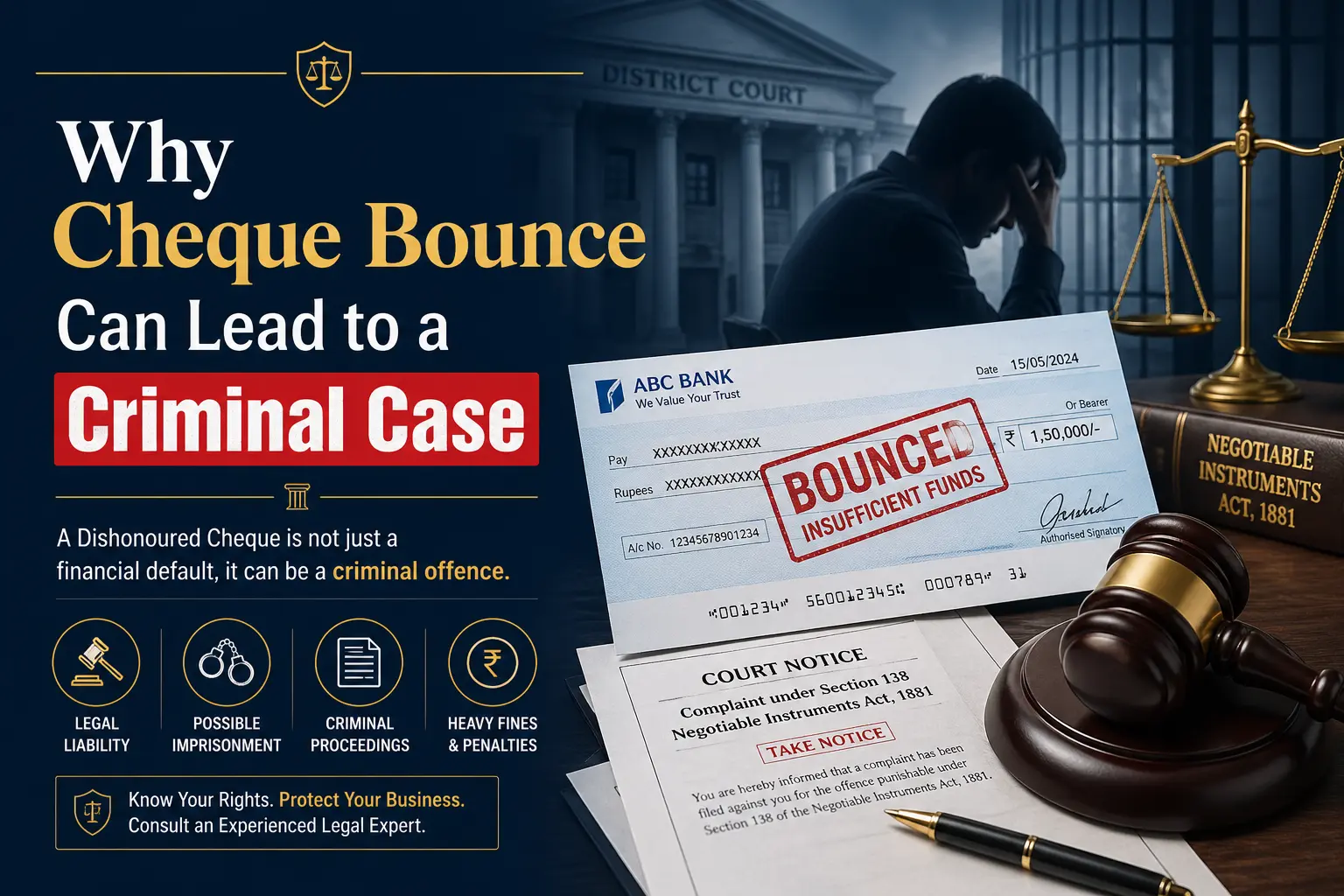
A cheque bounce may look like a simple payment failure, but Indian law treats it seriously when the cheque was issued for a legally enforceable debt or liability. One returned cheque can disturb a business deal, damage trust between families, delay salary or rent payments, and create immediate legal pressure. Many people first think, “I will pay later, so why criminal case?” That is where the misunderstanding begins. A cheque is not just a casual promise. It carries legal weight. If the cheque gets dishonoured and the drawer fails to pay even after a proper statutory notice, the matter can move into a cheque bounce criminal case under Section 138 of the Negotiable Instruments Act, 1881. In practice, I’ve seen clients panic only after receiving court summons. Some ignore the legal notice. Some send a poor reply. Some think “stop payment” protects them automatically. Others assume that a cheque bounce case is only about recovery of money, not criminal liability. These mistakes can become costly. This article explains why cheque bounce can lead to criminal case, what Section 138 cheque bounce law requires, what timelines matter, what documents should be preserved, and when legal advice becomes urgent. It is written for individuals, business owners, professionals, companies, borrowers, lenders, suppliers, service providers, tenants, landlords and general readers across India, including Delhi NCR, New Delhi, Ghaziabad, Noida, Gurugram, Faridabad, Meerut, Lucknow, Mumbai, Bengaluru, Hyderabad, Chennai, Kolkata, Pune, Jaipur, Chandigarh and other commercial centres. Cheque payments still remain common in India, especially in business credit, rent security, loan repayment, settlement amounts, property transactions, supply contracts, professional fees, post-dated payments and family financial arrangements. Even where UPI and banking apps dominate daily payments, cheques continue to appear in larger, delayed or trust-based transactions. A dishonoured cheque can create two problems at the same time. First, the money remains unpaid. Second, the payee may start cheque bounce legal action if the cheque satisfies Section 138 requirements. The official India Code identifies Section 138 of the Negotiable Instruments Act as the provision dealing with dishonour of cheque for insufficiency of funds and related situations. Delhi NCR and other high-volume business regions see frequent cheque disputes because many transactions happen quickly, often with limited documentation. A supplier in Ghaziabad may accept a post-dated cheque from a buyer in Delhi. A landlord in Noida may receive rent security by cheque. A service provider in Gurugram may receive a cheque after months of follow-up. Once the cheque bounces, every message, invoice, bank memo and legal notice begins to matter. The fear is real. Court summons, bail, non-bailable warrant risk, business reputation, family pressure and settlement demand can all come together. That does not mean every cheque bounce automatically results in conviction. The accused may have valid defences. The complainant may have weak documents. The parties may settle. Still, ignoring the matter is rarely wise. A cheque bounce criminal case arises when a cheque issued towards a legally enforceable debt or liability is dishonoured and the drawer fails to pay the cheque amount within the statutory period after receiving a valid demand notice. That definition matters. Not every returned cheque becomes a criminal case. A cheque may bounce due to signature mismatch, account closure, insufficient funds, payment stopped by drawer, technical defects, overwriting, stale cheque issues or bank-related reasons. The legal effect depends on facts. Section 138 cheque bounce law focuses on the idea that a person who issues a cheque towards a real liability should not defeat payment by letting the cheque dishonour and then ignoring the statutory demand. The criminal element does not arise merely because a bank returned the cheque. It arises after the legal conditions mature. For complainants, the key question is whether the cheque connects to a debt, invoice, loan, settlement, agreement, rent, supply, service, professional fee or other enforceable liability. For accused persons, the key question is whether the cheque was misused, issued as security without crystallised liability, time-barred, materially altered, not served with notice, or unsupported by proof. Both sides need documents. Emotion alone does not win these cases. Section 138 of the Negotiable Instruments Act, 1881 is the central law for a cheque dishonour criminal case in India. It deals with dishonour of cheques for insufficiency of funds or situations where the amount exceeds arrangement with the bank, subject to statutory conditions. The commonly relied text of Section 138 also refers to presentation within validity, written demand notice within 30 days of bank information, and failure to pay within 15 days of notice receipt. Section 138 treats cheque dishonour as an offence when the cheque was drawn for discharge of a legally enforceable debt or liability and the drawer does not pay after the statutory notice period. The punishment can include imprisonment, fine up to twice the cheque amount, or both. This is why people say cheque bounce is criminal. Strictly speaking, the law does not criminalise every banking failure. It penalises dishonour of a cheque in the defined statutory situation. For filing assistance, complainants often need careful drafting under the Section 138 framework. A properly prepared Section 138 complaint should connect the cheque, liability, dishonour memo, notice, service record and non-payment clearly. Section 139 creates a presumption in favour of the holder of the cheque. In simple terms, the court may presume that the cheque was received for discharge of debt or liability, unless the accused rebuts it. That does not mean the accused has no defence. It means the defence must be legally meaningful and supported by circumstances, documents, cross-examination or other material. A bare denial may not be enough. If a company commits the offence, Section 141 deals with liability of persons who were in charge of and responsible for the conduct of the company’s business at the relevant time. India Code identifies Section 141 as the provision for offences by companies. Directors, authorised signatories and company officers should not treat company cheque bounce summons casually. Liability depends on role, responsibility, signing authority, averments in complaint and factual defence. Section 142 governs cognizance of cheque bounce offences. India Code identifies it as the provision dealing with cognizance of offences under the NI Act. The complainant must be careful with limitation. Delay in sending notice, delay in filing complaint, wrong jurisdiction assumptions or weak service proof can damage a case. Courts may condone delay in appropriate cases, but no party should depend on discretion as a routine plan. Section 143A deals with interim compensation in certain cases. India Code identifies Section 143A as the provision for power to direct interim compensation. Section 145 allows complainant evidence by affidavit. Section 146 gives importance to bank slips or memos as prima facie evidence of dishonour. Section 147 makes offences under the NI Act compoundable, meaning settlement can legally close the matter in suitable circumstances. Section 148 relates to appellate deposit after conviction in appeal situations. A party facing appeal or post-conviction proceedings should take specific advice. The risk profile changes after judgment, especially where deposit, sentence suspension or appeal strategy becomes relevant. This guidance is useful for anyone who has received, issued, signed, guaranteed, accepted or relied upon a cheque in a financial transaction. The audience is wide because cheque disputes arise in ordinary life as much as in commercial dealings. Business owners need it because delayed invoices often lead to post-dated cheques. Startups and small companies need it because one dishonoured cheque can affect vendor trust. Families need it because friendly loans, marriage-related payments, property advances and personal borrowings often use cheques without proper written records. Working professionals may receive a cheque for salary dues, consultancy fees or refund. Landlords may receive rent or security cheques. Property sellers may accept token money by cheque. Buyers may issue cheques during documentation. Students and parents may encounter cheque disputes in education loans, coaching refunds, hostel deposits or service payments. Accused persons also need guidance. A cheque may have been issued as security. The amount may already have been paid. The cheque may have been misused after a failed transaction. The notice may have gone to the wrong address. A company director may not have controlled daily business. These are not casual excuses. They require structured legal assessment. If summons has already arrived, a person should not delay. Professional help for Section 138 summons becomes important because court non-appearance can create avoidable complications. A cheque bounce case usually starts with a financial transaction and becomes serious after the bank returns the cheque unpaid. The payee then reviews the bank return memo, prepares a demand notice, waits for the statutory period, and files a complaint if payment is not made. The drawer gives a cheque to the payee. The cheque may relate to a business invoice, personal loan, rent, settlement, property payment, service fee, supply bill or other liability. The purpose matters because Section 138 requires a legally enforceable debt or liability. The payee deposits the cheque within validity. The bank returns it unpaid with a memo mentioning the reason. Common reasons include insufficient funds, funds not arranged, account closed, payment stopped, signature issues or technical mismatch. A stop payment instruction does not automatically save the drawer. A cheque dishonour stop payment case depends on why payment was stopped, whether liability existed, and whether the defence appears genuine. The payee sends a written demand notice within the statutory period. The notice should identify the cheque, amount, bank return reason, transaction background and demand for payment. Drafting matters. A vague notice may invite dispute. A clear legal notice for cheque bounce drafting and sending should preserve limitation and avoid unnecessary exaggeration. After receiving notice, the drawer has a statutory window to make payment. If the drawer has a defence, a proper reply may help place the legal position on record. Silence is not always fatal, but it can hurt in practical terms. A reasoned reply to cheque bounce legal notice may be useful where the cheque was misused, liability is disputed, payment already happened, documents are incomplete, or the notice is defective. If payment does not come within time, the complainant may file a complaint before the competent Magistrate. This is where cheque bounce legal action becomes a court case. Professional support for cheque bounce case filing helps align the complaint, affidavit, documents, jurisdiction facts and limitation. Once the court takes cognizance and issues summons, the accused must appear or seek proper legal representation. Missing court dates can lead to warrants. If the accused fears custody, court pressure or appearance complications, advice on bail in cheque bounce cases may be needed. Most cheque bounce matters are handled through court process, but careless absence can create serious trouble. The accused may contest liability, challenge service, rebut presumption, dispute execution, question transaction proof, or pursue settlement. The complainant may push for payment, compensation, interim relief or trial. A structured filing defence under Section 138 NI Act should focus on facts and documents, not emotional denial. The matter may end through payment, settlement, compounding, acquittal, conviction or appeal. If conviction occurs, appeal and sentence suspension issues may arise. Post-judgment matters require care because appellate courts may consider deposit-related directions in appropriate cases. Parties dealing with Section 148 appeal stay deposit matters should act quickly and with full financial clarity. Strong cheque bounce cases are built on paper trails. Weak cases often fail because the party had money truth on their side but poor documentation. For complainants, the record should show why the cheque was issued. For accused persons, the record should show why liability is denied, reduced, discharged or legally unenforceable. A post-dated cheque deserves special attention. Many business and loan matters involve post-dated cheques. If such a cheque bounces, the legal analysis should examine the underlying transaction, date of liability and communication between parties. Guidance on post-dated cheque bounce issues can be useful before taking a rigid position. Time is one of the most dangerous parts of a cheque bounce case. A person may have a strong claim but lose advantage due to limitation. Another person may have a valid defence but damage it by ignoring notice and summons. A basic Section 138 timeline usually involves cheque presentation within validity, demand notice within 30 days from receiving information of dishonour, 15 days for drawer payment after notice receipt, and complaint filing after non-payment within the legally permitted period. Practical delay happens in several places. Courier service may be disputed. The accused may shift address. The company may close office. Bank memos may be misplaced. Settlement talks may continue without written protection. Family matters may become emotional. Business parties may keep saying “next week” until limitation pressure arrives. Do not wait too long. For complainants, the decision window begins the day the bank informs dishonour. For accused persons, the decision window begins the day notice is received. For both sides, the safest approach is to collect documents immediately and take advice before making admissions. If court summons has come and the accused does not appear, the case may move toward coercive process. If a warrant has already been issued, advice on NBW in cheque bounce cases becomes urgent. In some situations, applications for recall of NBW in cheque bounce cases or cancellation of NBW in cheque bounce cases may be required. A cheque bounce notice is not a casual demand letter. It may be the statutory foundation for a criminal complaint. Ignoring it can make the next stage harder. Some replies admit too much, deny too broadly or attack the other side without evidence. A reply should be firm, factual and legally controlled. Stop payment may have a valid explanation, but it does not automatically defeat Section 138. The court will look at liability and surrounding facts. A cheque alone helps, but the transaction background still matters. Invoices, messages, ledgers, bank entries and agreements make the claim stronger. Chats can support a case, but they should not replace formal documents. Preserve screenshots, exports, numbers, dates and context carefully. A delayed notice or delayed complaint may create serious objections. Courts can condone delay in proper cases, but limitation should never be taken lightly. If the cheque belongs to a company, the complaint should be carefully framed. Wrong parties, missing company arraignment or weak role allegations can create problems. Non-appearance can lead to warrants. A small financial dispute can then become a stressful criminal process issue. Payment without a proper settlement memo, compounding terms or case withdrawal clarity can lead to fresh disputes. Cheque bounce matters look simple from outside. Real cases turn on documents, timelines, service, liability, signature, authority and conduct. Ignoring a cheque bounce matter can lead to summons, court appearance, bail concerns, warrant risk, financial pressure, legal costs, reputation damage and possible conviction if the complainant proves the case and the defence fails. For a complainant, delay can reduce bargaining power. A drawer who receives no timely notice may later challenge the case. A missing document can create doubt. A poorly drafted complaint may allow avoidable objections. For the accused, silence creates a different danger. Courts expect parties to respect process. If summons is served and the accused avoids appearance, the court may issue coercive orders. In more serious non-appearance situations, proceedings may move toward proclamation-related consequences. Advice on Section 82 in cheque bounce cases may become relevant where process has already escalated. The emotional cost is also real. Business owners worry about market reputation. Employees worry about job background checks. Families worry about police-like fear, even though Section 138 is usually a complaint case. Senior citizens may feel embarrassed. Professionals may worry about clients discovering the dispute. A cheque bounce criminal offence should not be handled casually merely because settlement may be possible. Settlement is a route. It is not a shield against deadlines. You should consult a cheque bounce lawyer as soon as a cheque is dishonoured, a legal notice is received, summons arrives, liability is disputed, the cheque was issued as security, the drawer is a company, or settlement talks involve large money. Early advice helps both sides. The complainant can preserve limitation and documents. The accused can avoid damaging admissions. Companies can examine director liability. Individuals can understand bail, appearance and settlement options. Legal advice becomes urgent in these situations: A person accused in a cheque bounce matter may need a specific defence against cheque bounce allegations rather than a generic reply. Cheque Bounce Lawyer focuses on practical legal support for cheque dishonour disputes across India, with attention to Delhi NCR and major commercial locations. The work covers complainant-side action, accused-side defence, notice drafting, reply drafting, summons handling, bail concerns, warrants, appeals, settlement and compounding. Advocate BK Singh assists clients in understanding whether the matter is fit for complaint, defence, settlement or appeal. The goal is not to create unnecessary litigation. The goal is to protect legal position, preserve evidence, meet limitation and reduce avoidable risk. For clients who want resolution, settlement and mediation in cheque bounce matters can help structure payment terms, withdrawal steps and court closure in a safer manner. For clients dealing with conviction or adverse orders, appeals against lower court judgments in cheque bounce cases may be explored after reviewing the record, evidence and judgment. Where sentence has been passed, suspension of sentence in cheque bounce conviction may require immediate filing and court attention. Cheque bounce can lead to a criminal case because Section 138 of the NI Act treats dishonour of a cheque for legally enforceable debt or liability as an offence if the drawer fails to pay after receiving a valid statutory notice. No. Every cheque bounce is not automatically a criminal offence. The complainant must satisfy legal requirements such as enforceable liability, valid cheque presentation, dishonour, proper demand notice, non-payment and timely complaint filing. Punishment under Section 138 may include imprisonment up to two years, fine up to twice the cheque amount, or both. Actual outcome depends on facts, evidence, defence, settlement and court discretion. Yes. NI Act offences are compoundable. Parties can settle cheque bounce matters, but settlement should be documented properly and placed before the court where proceedings are pending. A cheque bounce dispute has both financial and criminal law consequences. Recovery of money is financial in nature, but Section 138 creates a criminal complaint mechanism when statutory conditions are met. In many cheque bounce cases, the accused can seek bail or appropriate court protection after appearance. Bail approach depends on summons, warrants, prior conduct and stage of proceedings. You should not ignore it. Review the cheque, alleged liability, bank memo, notice date, service date and claim amount. If the demand is wrong or disputed, send a legally careful reply. Yes, stop payment can still lead to a Section 138 case if the cheque was issued for a legally enforceable liability and other statutory conditions are satisfied. The defence depends on facts. Directors or responsible officers may be accused in company cheque bounce cases if Section 141 requirements are properly pleaded and supported. Liability depends on role, responsibility and facts. Contact a lawyer immediately after dishonour, notice, summons, warrant, settlement talks, conviction or appeal stage. Early advice can protect limitation, defence, documents and court strategy. A cheque bounce case is not just a banking problem. It can become a criminal complaint because Indian law expects cheques issued for genuine liabilities to be honoured or paid after statutory demand. For complainants, the key is timely notice, clean documents and properly drafted complaint. For accused persons, the key is timely reply, court appearance, proper defence and safe settlement where appropriate. Delay helps neither side. If you are facing a cheque bounce legal notice, summons, warrant, settlement pressure or appeal stage, take legal advice before the matter becomes harder to control. Advocate BK Singh and Cheque Bounce Lawyer can assist with practical, legally restrained support across India. This article is for general information only and does not constitute legal advice.Why Cheque Bounce Can Lead to Criminal Case in India
Why This Issue Matters in India in 2026
Quick Facts Box
Understanding the Core Legal Issue
What Is the Legal Framework for Cheque Bounce Criminal Case?
Section 138 NI Act
Section 139 presumption
Section 141 company liability
Section 142 cognizance and limitation
Sections 143A, 145, 146, 147 and 148
Who Needs This Guidance?
How Does a Cheque Bounce Case Move From Dishonour to Court?
Stage 1: The cheque is issued
Stage 2: The cheque is presented and dishonoured
Stage 3: Demand notice is sent
Stage 4: The drawer may pay, reply or ignore
Stage 5: Complaint filing
Stage 6: Summons and appearance
Stage 7: Defence, settlement or trial
Stage 8: Judgment, appeal or compounding
Documents and Evidence Checklist
Document Why it matters Original cheque or cheque image Shows cheque details, drawer, payee, amount and signature Bank return memo Proves dishonour and reason given by bank Loan agreement, invoice or bill Connects cheque to enforceable liability Ledger, account statement or payment record Shows outstanding amount and transaction history Legal notice copy Shows statutory demand Postal receipt, tracking report, courier proof or email proof Helps prove dispatch and service WhatsApp, SMS or email admission May support liability or settlement Company authorisation documents Useful in company cheque matters Reply notice Shows defence or admission Settlement record, if any Prevents later dispute What Are the Timelines, Delays and Decision Windows?
Common Mistakes People Make in Cheque Bounce Matters
1. Treating the notice as a normal reminder
2. Sending an emotional reply
3. Assuming stop payment means no offence
4. Filing without proving liability
5. Relying only on WhatsApp chats
6. Missing limitation
7. Not checking company parties
8. Avoiding court after summons
9. Settling without written closure
10. Thinking online advice is enough
What Are the Risks of Ignoring a Cheque Bounce Matter?
When Should You Consult a Cheque Bounce Lawyer?
How Cheque Bounce Lawyer Can Help
Frequently Asked Questions
1. Why cheque bounce can lead to criminal case in India?
2. Is every cheque bounce a criminal offence?
3. What is the punishment in cheque bounce case in India?
4. Can cheque bounce case be settled?
5. Is cheque bounce case civil or criminal?
6. Can I get bail in cheque bounce case?
7. What if I received a cheque bounce legal notice?
8. Can stop payment cheque bounce become criminal case?
9. Can directors be made accused in company cheque bounce cases?
10. When should I contact a cheque bounce lawyer?
Final Thoughts
Disclaimer
There's no reason for concern. There is no difficult-to-understand legalese.
Someone who has helped many people with the same problems gives you clear, honest advice. We want to make the legal process easy to understand and use for everyone.