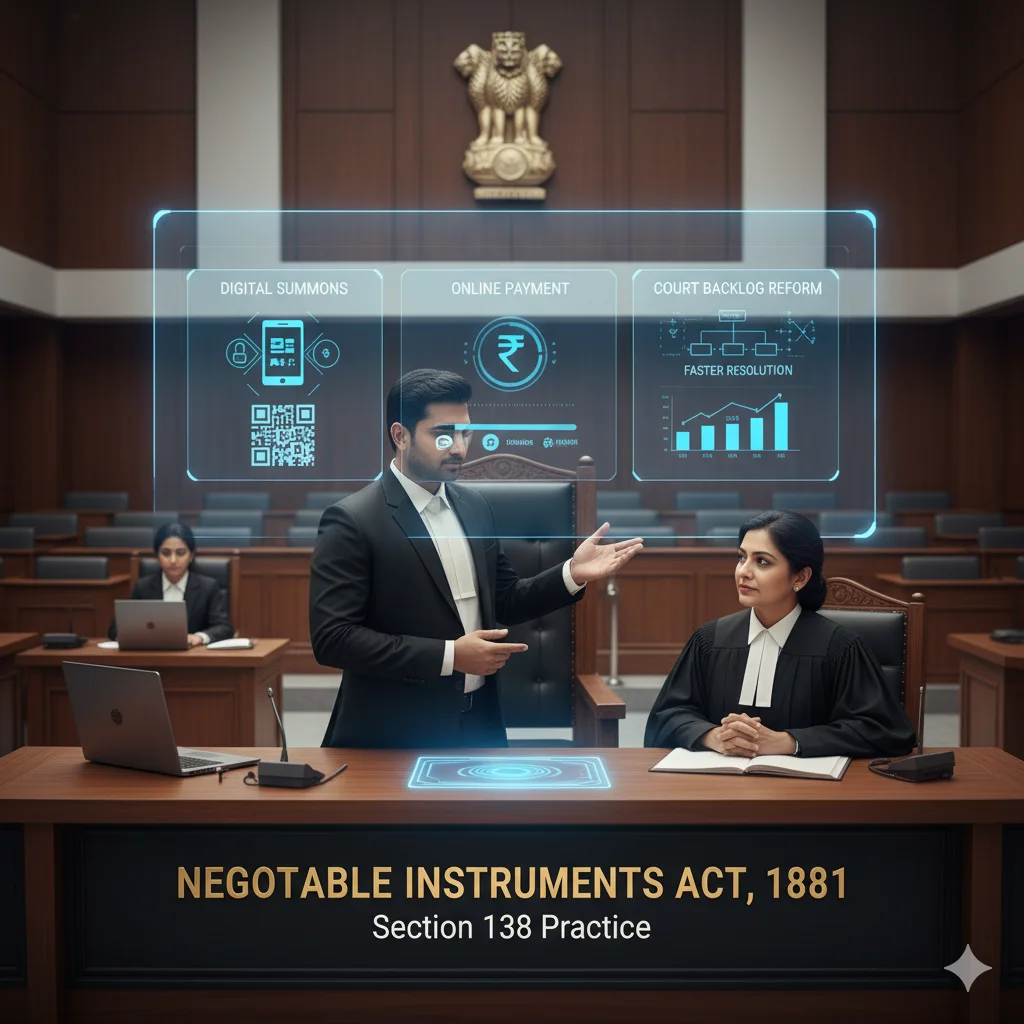
The most recent Negotiable Instruments Act, 1881 Section 138 Practice includes digital summons, online payment, and changes to the court backlog.
India's people and justice system have been dealing with bounced checks for a long time. Indian courts have more than 40 lakh Section 138 cases that need to be heard. A bounced check is no longer just a money issue; it's a long fight in court.
But the way things are done in court and the law have changed recently, which is starting to change how these problems are handled. Digital summons, online payment systems, and compounding reforms all aim to make things faster, clearer, and easier for people who are suing.
Advocate BK Singh is helping clients of Cheque Bounce Lawyer add these new changes to their plans to make sure that things go more smoothly, quickly, and cheaply, especially for middle-class people and small businesses that have trouble getting paid on time.
Reading Section 138 of the Negotiable Instruments Act, 1881
Section 138 of the Negotiable Instruments Act, 1881 (NI Act) says that not honoring a check is a crime.
If a check for a legally binding debt or obligation is returned unpaid, either because there isn't enough money in the account or because the payment was more than what was agreed upon, the person who wrote the check could be charged with a crime and face up to two years in prison or a fine of up to twice the amount of the check.
This part was meant to help people trust each other in business deals for a long time. But over time, the number of cases grew so large that the courts became clogged, which caused long delays that hurt people who need checks for personal or business loans.
1. Digital Summons: The Next Step in Legal Notices
Serving summons in bounced check cases used to take months or even years because they were delivered in old-fashioned ways.
But new orders from the Supreme Court say that you can now send digital summons by email, WhatsApp, and registered mobile numbers. This has saved a lot of time.
Advocate BK Singh worked on a case in Delhi where a small business owner from Lajpat Nagar was able to serve a digital summons in just three days through verified WhatsApp delivery, instead of the previous six-month wait.
Payees and creditors now have more power because of this change, so they are no longer stuck in procedural limbo.
2. Online Payment and Compounding: Making the Process Go Faster
Courts now support online payment systems and adding interest for cases where checks bounce. This is a big step in the right direction.
The focus has shifted from punishment to recovery and making things right. This is good for middle-class people who can't afford to go to court for a long time.
Cheque Bounce Lawyer helped a client from Mumbai settle a check dispute worth ?2.8 lakh in 15 days using an online compounding platform. This saved them months of going to court.
Advocate BK Singh says:
"We want to help our clients get back what is rightfully theirs, not put them through endless legal delays." The new online settlement systems make it easier, faster, and more fair to get what you deserve.
3. Court Backlog Reform: How Technology Is Changing the Way Justice Is Served
The courts have set up special courts, mediation frameworks, and hybrid hearings to deal with the large number of Section 138 cases that are waiting to be heard.
Some district courts in Maharashtra, Delhi, and Karnataka are trying out case clustering, which means putting cases against the same person together to make the process go faster.
This change directly affects small business owners, freelancers, and entrepreneurs who get paid by check. Legal technology has made it possible to finish cases that used to take years in just a few months.
4. Why Middle-Class Customers and Small Businesses Benefit the Most
People in the middle class often don't go to court because they are afraid of how much it will cost and how hard it will be. Law firms like Cheque Bounce Lawyer support these new changes, which make the process less scary and more focused on getting results.
If you own a store in Ghaziabad, work as a freelancer in Pune, or deliver goods in Faridabad, you can now do the following:
Put your cases online and keep track of them.
Get notices or summonses in your email
Instead of going to court all the time, settle your differences online.
Get help that is right for you from experienced lawyers like Advocate BK Singh.
This combination of law and technology makes sure that everyone can get justice, not just the powerful.
5. The Next Step
Digital transformation in cheque bounce litigation is still going on, but one thing is for sure: Section 138 cases will be faster, more digital, and better for clients in the future.
Cheque Bounce Lawyer is still leading the way in this change by helping clients understand new procedures, using technology to speed up settlements, and making sure that procedural issues don't slow down justice.
"I was about to give up hope after waiting a year for my case to move. Advocate BK Singh sent me a digital notice that my check bounced, and the case moved forward in just a few days. I finally got my cash!
Priya Nair lives in Kochi, Kerala.
"The choice to settle online saved me months of worry." The Cheque Bounce Lawyer team made it easy to understand what to do. People who work should definitely do this!
Anil Bansal lives in Pune, Maharashtra.
"Our small business had three checks that bounced from customers. Advocate BK Singh helped us get a quick online mediation and full recovery. A real lifesaver for people who own small businesses.
Suman Yadav From Ghaziabad, UP
"I didn't know you could send summons through WhatsApp until I called Cheque Bounce Lawyer." They are trustworthy, quick, and really care about middle-class clients like us.
Harish Mehta is from Ahmedabad, Gujarat.
"Advocate BK Singh made everything clear by explaining Section 138 and the digital notice process." I felt like I was never alone. Within two months, I got my check back.
?FAQs
Q1. What does the 1881 Negotiable Instruments Act, Section 138 say?
Section 138 makes it a crime to write a check for a legal debt and then not pay it because there isn't enough money in the account.
Q2. What happens when you get a digital summons for a bounced check?
Now, people can send summonses by email, WhatsApp, or SMS to get them to the right people faster.
Q3. Can bounced check cases be settled online in India?
Yes, new rules let people use digital platforms to make payments and settle debts online.
Q4. How long does it take for a check to bounce in 2025?
New reforms make it possible for both sides to finish many cases in just three to six months.
Q5. What happens if you break Section 138?
The person who wrote the check could spend up to two years in jail, pay a fine that is twice the amount of the check, or both.
Q6. How can Advocate BK Singh help people whose checks don't clear?
Cheque Bounce Lawyer helps people write digital notices, settle disputes online, and represent them in court in a smart way.
Q7. Can a small business file more than one case of a bounced check at the same time?
Yes, if one person writes more than one check, courts may let them group them together to speed things up.
Q8. What papers do you need to file a complaint about a check that bounced?
You need a copy of the check, a bank return memo, proof of a legal notice, and papers showing the transaction.
Q9. Can people who are middle class afford to hire a lawyer to help them with bounced checks?
Yes, online filings and digital settlements have made legal costs go down a lot.
Q10. Is mediation necessary if a check bounces?
There's no reason for concern. There is no difficult-to-understand legalese.
Someone who has helped many people with the same problems gives you clear, honest advice. We want to make the legal process easy to understand and use for everyone.