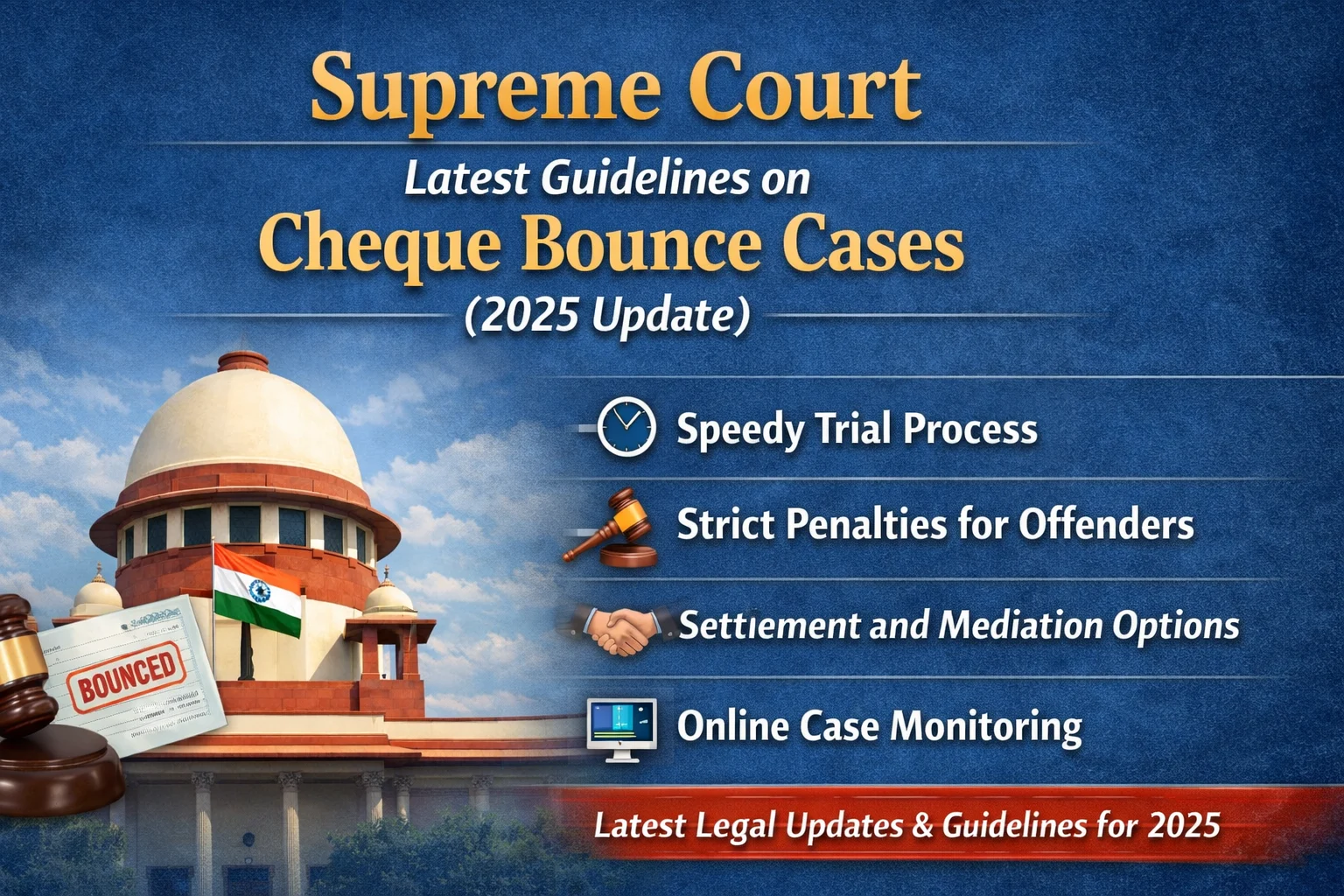
The Supreme Court's most recent guidelines for 2025 in Cheque bounce cases
In cases of bounced Cheques, the section number is often not the worst thing; it's the fear and disruption it causes. A person with a salary is worried about warrants, their job's reputation, and their relationship with the bank. A small business owner is concerned about how much credit they can get, how much money they have coming in every day, and whether they can trust their vendors. A lot of Section 138 cases take years to finish because it takes time to serve the summons, hearings become routine delays, and settlement talks start too late. The Supreme Court's 2025 directions are meant to speed up the process by encouraging faster service, earlier settlements, and stricter case management so that things can be settled more quickly.
These changes are important for middle-class families and small businesses because they change what courts expect from the start. Now, clear addresses, verified contact information, organized paperwork, and making a decision about whether to settle or go to trial early are all more important. Cheque Bounce Lawyer, run by Advocate BK Singh, uses a structured and court-ready method to keep the file consistent from the notice to the hearing. This way, the case doesn't get delayed for no reason.
1. The Supreme Court's goal for 2025 is to fix
The Supreme Court looked at why there are so many Section 138 cases. Service delays, not showing up repeatedly, and weak discipline at the beginning of the process can make a quick process into a long fight. The Court said that the point of the Cheque bounce law is to make sure that payments are reliable and that problems are solved quickly, not to keep putting off hearings. The 2025 directions are meant to make the early stages of the case more strict so that it either settles quickly or goes on a clear trial path.
This is why the 2025 framework works. It talks about how to issue and serve summons, how to make it easier for people to pay early, how to decide if a summary trial is appropriate, and how courts should keep an eye on pending cases. For someone involved in a lawsuit, the message is clear: the file must be clean, the timeline must be stable, and participation must be strict.
2. Faster summons and confirmed contact information
A key step for 2025 is to improve the way summons are served, including dasti service, which means that the complainant can serve the summons along with regular court service. The goal is to reduce the number of months lost while waiting for pending service. Courts are also encouraged to use electronic methods when they are allowed by law.
The Court also said that when filing, an affidavit of service should be filed along with contact information like a mobile phone number and email address. False service statements can lead to action. This makes it less likely that people will make excuses and more likely that they will make progress early on. For people who are accused, it also means that ignoring service is not a safe option and that proof is needed if service is disputed when changing addresses or phone numbers.
3. Early settlement helps with safe online payment methods.
The Supreme Court wanted digital payment options linked to the court so that someone who is accused can pay early in a safe way that the court allows. At the first stage, the summons can mention that payment option. This encourages both sides to work together and end things early so they can avoid stress, costs, and damage to their reputations.
This is especially useful in real-life cash flow situations where the goal is not to cheat but the timing was off. If payment is possible, closing early protects both dignity and the business's ability to keep going. A clear stand and a disciplined defense become more important if payment isn't possible.
4. Summary: trial discipline and the quick use of an interim deposit
The 2025 rules tell courts to decide early if the case should go to a summary trial and to write down important answers and positions in the order sheet. This makes it less likely that things will drift. Section 143A also tells courts to use interim deposit powers as soon as they can.
This can make it harder for people who are complaining to use delay tactics. People who have been accused should plan ahead, either by negotiating a legal settlement or by making a clear defense with consistent documents. This is why careful drafting is important: a weak or changing version raises the risk and lowers the power to settle.
5. Costs that keep adding up and the lesson of taking responsibility early
The Supreme Court changed its mind in 2025 about how to reward people who settle early and punish people who settle after years of fighting. The practical message is that if the parties can agree, they should do it sooner rather than later. Depending on the facts, courts may also use their own judgment when it comes to compounding costs instead of using a strict formula in every case.
This means that early planning saves middle-class clients money and stress. For MSMEs, it means that settling at the right time can help keep good credit and a good business reputation. Advocate BK Singh usually tells his clients to be honest about their capacity, make sensible payment plans, and end the case with court-safe terms instead of vague promises.
6. People are reminding courts to think like the NI Act.
The Supreme Court said that some courts weren't using the NI Act's presumptions correctly and were treating cases like regular civil recovery cases, which makes things take longer. The 2025 approach makes it clear that Section 138 cases must stay on track and be disciplined. That's why it's important to have a clean NI style file with a notice timeline, proof of service, a bank return memo, a liability narrative, and documents that are all the same.
A strong case doesn't use heavy language. It is facts that don't change, the right help, and a timeline that doesn't change. That's the difference between a case that settles quickly and one that takes a long time.
7. Tighter enforcement and monitoring
The Supreme Court also pushed for administrative monitoring, tracking cases in stages, and performance reviews to cut down on pending cases. The main goal is to make disposal measurable and cut down on routine adjournments. Because the system is moving toward outcome-driven handling, it is even more important for litigants to show up on time, file on time, and avoid casual delays.
Cheque Bounce Lawyer sees Section 138 cases as structured financial disputes where being calm and disciplined is more important than being aggressive. Advocate BK Singh's main areas of focus are early case screening, clear drafting, document stability, and realistic settlement planning. The terms of the settlement are written in such a way that they can be enforced, are clear, and will not cause problems in the future. If the case has to go to trial, the defense is based on consistent facts and controlled communication so that the case stays credible at all times.
Reviews from Customers
*****
Rohit Mehta
I was scared because my business needs bank limits and trust from vendors. Cheque Bounce Lawyer helped me settle quickly and end the case in a clean way. Advocate BK Singh took care of everything in a calm way.
*****
Ananya Sharma
I work for a salary and didn't know how serious a summons could be. Advocate BK Singh helped me every step of the way and made sure my documents and stand were always the same.
*****
Faisal Khan
A bounced Cheque almost hurt my reputation with suppliers. The team helped me respond correctly and plan payment terms without getting too worked up. The case didn't take long.
*****
Priya Nair
The other side was using pressure tactics. Advocate BK Singh kept things professional, ready for court, and focused on a safe end, not drama.
*****
Gurpreet Singh
Problems with the service repeatedly delayed my case. The Cheque Bounce Lawyer took care of everything and made sure the case moved along smoothly. It made things easier and less stressful.
?FAQs
Q1. What is the main point of the Supreme Court's 2025 rules for cases where Cheques bounce?
To speed things up, we need to improve how summons are served, encourage early settlement, and make sure that cases are managed in a disciplined way so that they can be closed more quickly.
Q2. Can a bounced Cheque case be settled after it has been filed in court?
Yes. Compounding is allowed, and courts want cases to be settled as soon as possible when the payment terms can be met safely.
Q3. What does "dasti summons" mean?
This means the complainant can also serve the summons to speed up the process.
Q4. Why is verified contact information so important right now?
Because courts expect service records to be accurate, faster service depends on accurate mobile and email details backed up by an affidavit.
Q5. Can the court ask for a temporary deposit?
Yes. Courts can use Section 143A when it makes sense, and early discipline is important for both settlement and defense strategy.
Q6. Is the cost of compounding always the same?
Courts have the power to decide how to deal with compounding costs based on the facts, and settling early is usually seen as better than settling late.
Q7. What papers should I have on hand if I get a summons?
A Cheque and memo, a legal notice and reply, bank statements, proof of transactions, and a clear timeline of events that doesn't change later.
Q8. I'm a small business owner. How does this help me?
When done right, it speeds up results, cuts down on routine adjournments, increases the chances of early settlement, and keeps business going.
Q9. What is the greatest mistake that people who are accused of a crime make?
Ignoring a summons, taking casual breaks, or changing their story between replies and hearings all hurt their credibility and raise the risk.
Q10. Why hire Advocate BK Singh to lead the Cheque Bounce Lawyer?
Because the 2025 framework rewards filing on time, keeping records stable, taking action on time, and planning settlements that make sense. The goal is to have a strategy that is ready for court without adding extra stress.
There's no reason for concern. There is no difficult-to-understand legalese.
Someone who has helped many people with the same problems gives you clear, honest advice. We want to make the legal process easy to understand and use for everyone.