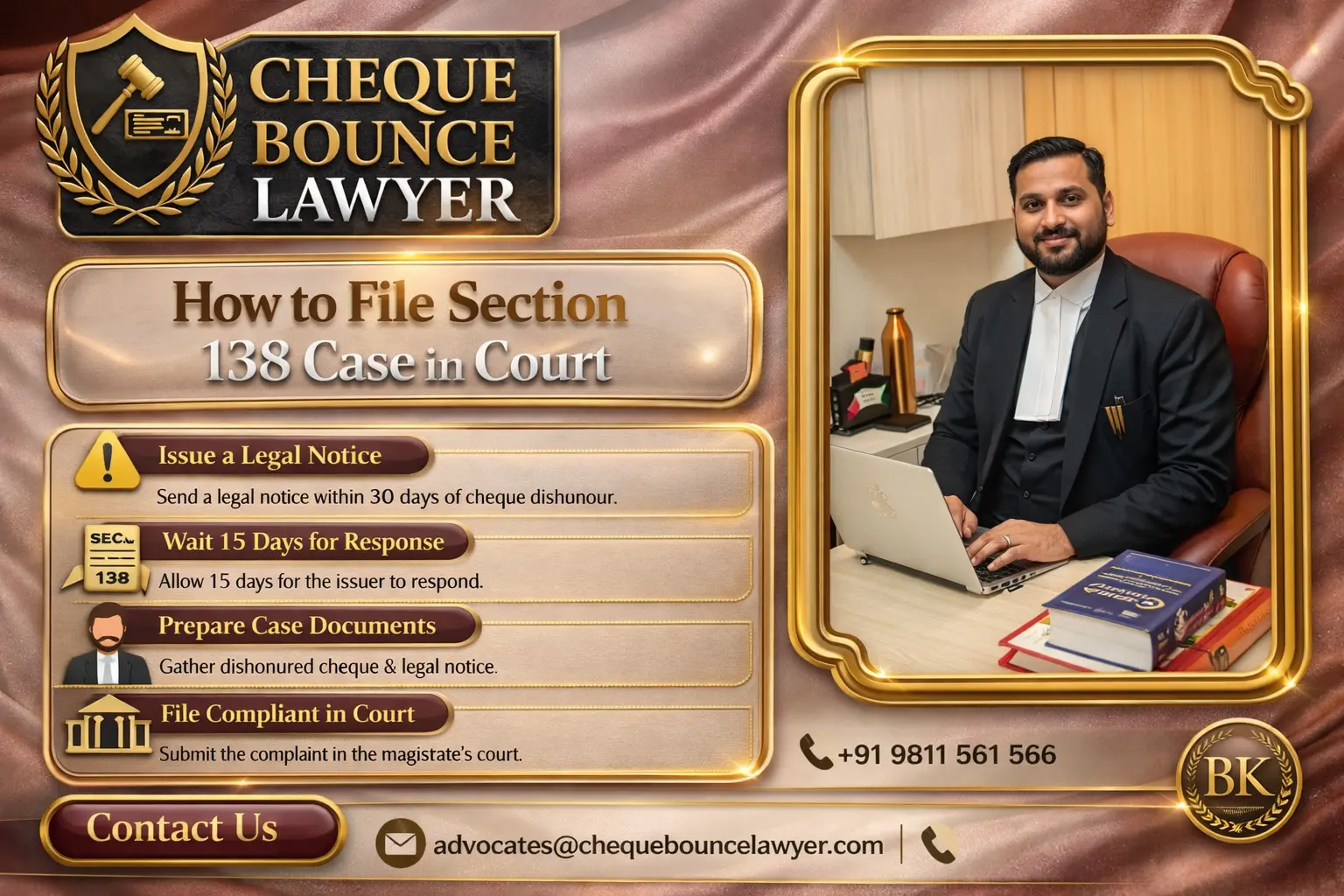
A bounced cheque often creates two problems at the same time. First, money is stuck. Second, trust breaks. For many people, the bigger shock is not the bank memo itself but what follows after it. Calls go unanswered, promises get delayed, and the person who issued the cheque suddenly becomes hard to find. That is where many people begin searching for how to file cheque bounce case in court. In India, cheque dishonour matters are commonly pursued under Section 138 of the Negotiable Instruments Act, 1881, but the law works only when the timing, paperwork, notice and court filing are handled correctly. A legally enforceable debt or liability matters. The cheque must be presented within validity. A written demand notice must go within 30 days of dishonour information. The drawer then gets 15 days from receipt of notice to pay. If payment still does not come, the complaint must ordinarily be filed within one month from the date the legal cause of action arises. These timelines come from Sections 138 and 142 of the NI Act, and the court competent to try the matter must be at least a Metropolitan Magistrate or Judicial Magistrate First Class. This guide explains the subject in a practical way for creditors, business owners, salaried individuals, landlords, vendors, contractors and family-run firms. It does not try to turn a legal dispute into a checklist game. Instead, it helps you understand the broad legal route, the limitation period for cheque bounce case, the documents you should preserve, the court that may have jurisdiction, and the mistakes that weaken otherwise genuine claims. The territorial-jurisdiction framework under Section 142(2) was amended in 2015, and the Supreme Court has since clarified that for account-payee cheque collection through an account, jurisdiction tracks the payee’s bank branch as understood in law, with the 2025 decision in Jai Balaji Industries v. HEG Ltd. adding fresh clarity on the home-branch position. Section 138 is not a general recovery provision for every unpaid amount. It is a specific statutory remedy for dishonour of cheques issued towards a legally enforceable debt or liability. That distinction matters. If the cheque was never meant to discharge a real liability, or the underlying transaction itself is doubtful, the case becomes harder. The law also carries a statutory presumption in favour of the holder under Section 139, though that presumption can be rebutted by the accused. In practical terms, this means documentation still matters even where the cheque exists. For ordinary people, Section 138 matters because it creates pressure backed by law. A cheque bounce dispute is not merely about asking for money again. It can become a formal criminal complaint if statutory requirements are met. That is why many debtors who ignore calls often become more responsive after a properly drafted legal notice. At the same time, many strong claims fail because the complainant delays the notice, files in the wrong court, or relies on incomplete records. Those problems are avoidable. Before anyone discusses filing, the first real question is simple: was the cheque issued for a legally enforceable debt or liability? Section 138 itself uses that concept, and the law does not treat every dishonoured cheque the same way. A cheque issued towards a business invoice, friendly loan, rent dues, repayment commitment, contractor payment, supply transaction, post-dated payment under a settlement, or part discharge of an admitted liability may support a case if the surrounding facts are clear. Now consider the opposite situation. A person says, “I gave the cheque as security only.” Another says, “The amount was blank when I signed.” A company director says, “This was not my personal debt.” None of these lines automatically end the matter, but each one changes the litigation posture. In real cases, courts look at the cheque, the bank return memo, the notice, proof of service, the transaction background, and the conduct of both parties. That is why a cheque bounce case should never be built around the cheque alone. It should be built around the payment story. Most people search how to file cheque bounce case in court immediately after the bank returns the cheque. That is understandable, but legally the path starts a little earlier and a little wider. You need the dishonour record from the bank, a clear understanding of the transaction, and a proper statutory demand notice within the legal window. If the drawer pays within 15 days of receiving that notice, the Section 138 complaint ordinarily does not survive because the statutory cause of action has not matured into a prosecutable complaint. The complaint window opens after the notice period expires without payment, and Section 142 then requires the complaint within one month from that cause-of-action date, subject to condonation if sufficient cause for delay is shown. This timeline is why panic and delay are both dangerous. People who act too casually lose limitation. People who act too fast sometimes send weak notices or file with incomplete documents. A balanced approach works best. Preserve the documents, verify the dates, identify the correct court, and move within time. The limitation period for cheque bounce case is where many otherwise valid matters become defective. The law has more than one relevant time marker, and mixing them up is common. The cheque must be presented within its validity period. While older case extracts and statutory text historically referred to six months, RBI directions reduced cheque validity from six months to three months with effect from 1 April 2012. In practice today, a cheque presented beyond three months is a stale cheque. After dishonour information is received from the bank, the payee must send a written demand notice within 30 days. That is a statutory requirement under the proviso to Section 138. Then the drawer gets 15 days from receipt of the notice to make payment. Only when payment is not made within those 15 days does the legal cause of action under Section 138 mature for filing a complaint. After that, Section 142 requires the complaint to be filed within one month from the date the cause of action arises, although the court may condone delay if sufficient cause is shown. This means the phrase limitation period for cheque bounce case is not just one date. It is a sequence of legally connected dates. A person who counts from the cheque date alone may be wrong. A person who counts from the dishonour date alone may also be wrong. Courts scrutinise the timeline very carefully because Section 138 is a statutory offence with specific preconditions. Suppose a supplier receives a cheque dated 5 January. The supplier deposits it on 20 February. The bank returns it unpaid on 22 February. The supplier receives dishonour information that day. A legal notice is then sent on 10 March. The drawer receives it on 14 March but does not pay. The 15-day payment window expires after that receipt date, and only then does the cause of action for complaint arise. From that cause-of-action point, the one-month filing period under Section 142 becomes important. The example sounds simple, but real disputes become messy because parties often do not preserve proof of receipt, or they use informal WhatsApp messages instead of a structured statutory notice. Many people also forget that delay in the complaint stage can sometimes be condoned, but that is not a substitute for discipline. Courts prefer limitation compliance, not excuse-making. A strong Section 138 matter usually stands on paper before it stands in oral argument. You do not need ornamental paperwork. You need relevant paperwork. The core record typically includes the original cheque, the bank return memo, copy of the statutory legal notice, postal receipt or courier proof, delivery tracking or returned envelope, the transaction documents showing debt or liability, and identity or authority documents of the complainant where needed. If the complainant is a company, partnership or proprietorship, authority documents and business records often become even more important. Sections 138, 139 and 142 together make documentary preparation central to maintainability and credibility. In business disputes, invoices, ledger statements, purchase orders, emails, delivery records, acknowledgments and settlement communications often become more important than people realise. In personal disputes, loan transfer proof, handwritten acknowledgment, bank statement, message exchanges, or previous part-payment records may help show that the cheque was not casual or unrelated. A legal notice in a cheque bounce matter is not decorative legal paper. It is a statutory bridge. If it is badly drafted, sent too late, sent to the wrong address, or disconnected from the actual dishonour and liability, the later case becomes vulnerable. The Supreme Court in SIL Import, USA v. Exim Aides Silk Exporters recognised that what matters is receipt of notice in a legally meaningful sense, and the judgment discusses the start of the 15-day period from the date the notice reaches the drawer. Later jurisprudence has repeatedly treated service and timing as central, not cosmetic. That is why a good notice should clearly identify the cheque, amount, dishonour, underlying liability, demand for payment, and the legal consequence of default, while remaining accurate. Over-dramatic notices often look strong to clients but weak in court. Precision works better than aggression. Yes, during validity, re-presentation can matter. The Supreme Court in MSR Leathers v. S. Palaniappan recognised that dishonour on a later presentation within validity may still support a complaint, and the case is important for understanding that each valid dishonour sequence must still satisfy the notice and timing conditions under Section 138. But this should not be misunderstood. Re-presentation is not a strategy to keep sleeping on the file. It is only a legal possibility within validity. In practice, once non-payment becomes likely, many complainants are better served by getting their documentation and notice handled properly instead of hoping repeated presentation will fix the default. Jurisdiction in cheque bounce matters has generated years of litigation. The current framework primarily turns on Section 142(2) of the NI Act after the 2015 amendment. Broadly, if the cheque is delivered for collection through an account, the court linked to the branch of the bank where the payee maintains the account becomes relevant. The Supreme Court in Bridgestone India Pvt. Ltd. v. Inderpal Singh confirmed the effect of the 2015 amendment and made it clear that the amended jurisdiction regime overrides the earlier obstacle created by Dashrath Rupsingh Rathod. More recently, the Supreme Court in Jai Balaji Industries v. HEG Ltd. explained that, for account-payee cheques, delivery to the payee’s home branch is understood legally even if deposited elsewhere in a commercially convenient manner. Why does this matter for ordinary litigants? Because filing in the wrong court can create delay, objections and transfer complications. If the amount is significant or the parties are located in different cities, jurisdiction should be checked before filing, not after summons. A court is more likely to take a Section 138 matter seriously when the facts show a clean chain. There was a real liability. The cheque was issued in discharge of it. The cheque was presented within validity. The bank dishonoured it. Notice went within statutory time. The drawer did not pay within 15 days. The complaint was filed within limitation or with a defensible condonation application. These are not technical ornaments. They are the backbone of maintainability. Judges also notice conduct. If a complainant keeps changing versions about the amount, the date, the transaction, or the purpose of the cheque, the case weakens. If the accused raises a defence but has no coherent documentation, that defence may remain only an argument. Good cases are usually boring on paper. The dates line up. The amount line up. The documents line up. That is exactly why they work. One common mistake is relying on oral assurances after dishonour and allowing the notice period to slip. People often keep waiting because the drawer says, “Deposit next week” or “I am arranging funds.” Law does not pause because someone sounds persuasive on a call. Another mistake is sending a casual or incomplete notice. A weak notice can trigger unnecessary litigation over service, dates or demand language. A third mistake is poor document preservation. The original cheque, memo and proof of service are basic. Yet many complainants come to lawyers with photocopies, screenshots and partial courier tracking only. A fourth mistake is filing in the wrong court without thinking through Section 142(2) jurisdiction. A fifth mistake is assuming Section 138 automatically guarantees recovery. It is a powerful remedy, but it still requires disciplined pleading and evidence. Not every cheque bounce case comes out of a business invoice. Many arise from personal loans, friendly loans and family commitments. These cases often feel emotionally straightforward to the lender and legally doubtful to the borrower. A brother says he borrowed in urgency. A friend says the cheque was only given as comfort. A relative claims there was no fixed repayment date. In such matters, the cheque alone is not enough emotionally, even if it may carry legal value. The surrounding record becomes crucial. Bank transfer entries, acknowledgment messages, earlier repayment promises, part-payments, and any written admission of debt help show legally enforceable liability. Section 139 creates a presumption in favour of the holder, but real-world litigation still rewards careful record keeping. When the drawer is a company, firm or business entity, cheque bounce litigation often becomes document-heavy. The issue may not be whether the cheque bounced, but who signed it, who was in charge, what liability existed, and what authority the complainant has to file. Section 141 of the NI Act deals with offences by companies, and directors or responsible persons are not dragged in by labels alone. Pleadings and records matter. That is why businesses should avoid last-minute complaint preparation. If the complainant is a company, the court often expects clarity about board authority, authorised representative status, invoices, ledger consistency and transaction history. Businesses that maintain clean commercial records generally have a far better litigation posture than those that depend on informal accounting. From the accused side, some defences appear repeatedly. The cheque was security. The amount was altered. The debt was already paid. The complainant misused a signed blank cheque. There was no legally enforceable liability. Notice was not served. The complaint is time-barred. The wrong court has been approached. The signatory was not responsible for company affairs. Some of these arguments succeed in the right facts. Many fail because they are raised late and without documentary support. A complainant who understands these likely objections can prepare the case more realistically from the beginning. Good filing is not about writing a dramatic complaint. It is about anticipating what the other side will deny. People often think they must choose between settlement and filing. In reality, both can coexist. A strong statutory notice may open the door to payment. A properly filed complaint may encourage a practical settlement. The existence of legal proceedings often changes the seriousness of negotiations. Still, rushed settlement can also go wrong. Many complainants accept post-dated promises again without securing written terms or payment milestones. If you settle, the record should be clear. If you litigate, the record should be clearer. The law rewards promptness because promptness usually signals genuineness. A person who deposits the cheque in time, preserves the dishonour memo, sends the notice within 30 days, and files within limitation appears serious and organised. A person who delays for months and then revives the story after relations sour gives the defence more room to attack the claim. This is especially true where friendly loans and small-business payments are involved. Courts are used to seeing inflated memory, incomplete accounts and emotional exaggeration. Dates and documents cut through that noise. If you want the broad legal route without getting lost in technical detail, the sequence is simple in concept. First, preserve the cheque and bank dishonour proof. Second, have the transaction papers reviewed so the liability narrative is clear. Third, send the statutory demand notice within time. Fourth, track service carefully. Fifth, if payment does not come within the statutory period, prepare the complaint with the correct court, dates and supporting documents. Sixth, stay consistent in your version from notice to complaint to evidence. Sections 138 and 142 make each stage date-sensitive, and jurisdiction under Section 142(2) should be checked before filing. That may sound straightforward, but small mistakes at any one of these points can create unnecessary objections later. This is why experienced drafting matters even when the facts seem simple. You should be ready to answer basic questions with confidence. What was the exact liability? Was it goods supplied, loan advanced, rent due, or settlement amount? Who issued the cheque and in what capacity? When was it deposited? On what date did the bank return it unpaid? What reason appears in the return memo? When was the legal notice sent? Where was it sent? Is there proof of delivery or refusal? Which bank branch did the payee use for collection? Is the complainant an individual or a business entity? Was there any part-payment or acknowledgment before or after dishonour? When clients know these facts cleanly, lawyers can build a safer case. When clients guess dates and reconstruct events from memory, even genuine disputes become harder than they should be. From outside, cheque bounce law looks easy. The cheque bounced, so file the case. In court, the matter is narrower and more technical. Was it within validity? Did the notice go within 30 days? Did the drawer get 15 days after receipt? Was the complaint within one month of the cause of action? Was the debt legally enforceable? Was the correct court approached? Was the complainant the payee or holder in due course? Sections 138, 139 and 142 are short on paper but exacting in practice. That is why people who treat cheque bounce matters casually often lose on maintainability points rather than merits. A good cheque bounce lawyer does more than send a threatening notice. Good counsel helps identify whether Section 138 is the right route, ensures the liability story is legally coherent, verifies the limitation period for cheque bounce case, checks the jurisdiction, prepares a clean complaint, and reduces avoidable contradictions. This matters especially when the dispute is not just about one cheque. Many real matters involve several cheques, running accounts, settlement attempts, or company liability issues. In those cases, sloppy drafting creates lasting damage because every later stage depends on the foundation already laid. If you are trying to understand how to file cheque bounce case in court, the most important point is this: Section 138 works best for people who respect dates, documents and legal structure. The law is useful, but it is not forgiving about timing and maintainability. The cheque must connect to a legally enforceable liability. The cheque must be presented within validity. The legal notice must go within 30 days of dishonour information. The drawer gets 15 days after notice receipt. The complaint then has to be brought within the limitation framework under Section 142, usually within one month from the cause of action, unless delay is properly condoned. Jurisdiction must also be checked carefully under Section 142(2). In practical terms, the right approach is not to chase the other side endlessly after dishonour, and not to rush blindly into court either. Preserve the record, understand the timeline, and move through the proper legal route. In many matters, the difference between a strong case and a failing one is not whether the cheque bounced. It is whether the complainant handled the aftermath correctly. Cheque Bounce Legal Services How to File a Cheque Bounce Case Under Section 138 NI Act Cheque Bounce Case Lawyers Digital Evidence and Electronic Records in Cheque Bounce Matters Top Cheque Bounce Lawyers in Delhi Contact Cheque Bounce LawyerHow to File Section 138 Case in Court
Why Section 138 matters
The first question courts and lawyers look at
When you should think about filing
Understanding the limitation period for cheque bounce case
A simple real-world example
What documents usually matter most
Notice is not a formality
Can a cheque be presented again?
Which court has jurisdiction
How courts usually see a genuine case
Common mistakes that damage cheque bounce cases
Personal loan, friendly loan and family dispute situations
Business and company cases need cleaner paperwork
What the accused usually argues
Settlement and filing are not enemies
Why timing discipline improves recovery chances
High-level route if you want to proceed
A practical checklist of facts you should know before meeting your lawyer
Why this area feels simple from outside but technical in court
How a careful lawyer adds value
Conclusion
FAQs
1. What is Section 138 of the NI Act?
2. What is the limitation period for cheque bounce case?
3. Within how many days should legal notice be sent after cheque bounce?
4. How long is a cheque valid in India?
5. Can I file a case if the cheque was given for a personal loan?
6. Is legal notice mandatory before filing Section 138 complaint?
7. What happens if the drawer pays within 15 days of receiving notice?
8. Which court can hear a cheque bounce case?
9. Can a cheque be presented again after first dishonour?
10. Can a company file a cheque bounce case?
11. Can the accused say the cheque was only a security cheque?
12. Is original cheque important for court?
13. Can delay in filing complaint ever be condoned?
14. Is Section 138 only for business disputes?
15. Why do many cheque bounce cases fail?
Quick Access Links
There's no reason for concern. There is no difficult-to-understand legalese.
Someone who has helped many people with the same problems gives you clear, honest advice. We want to make the legal process easy to understand and use for everyone.