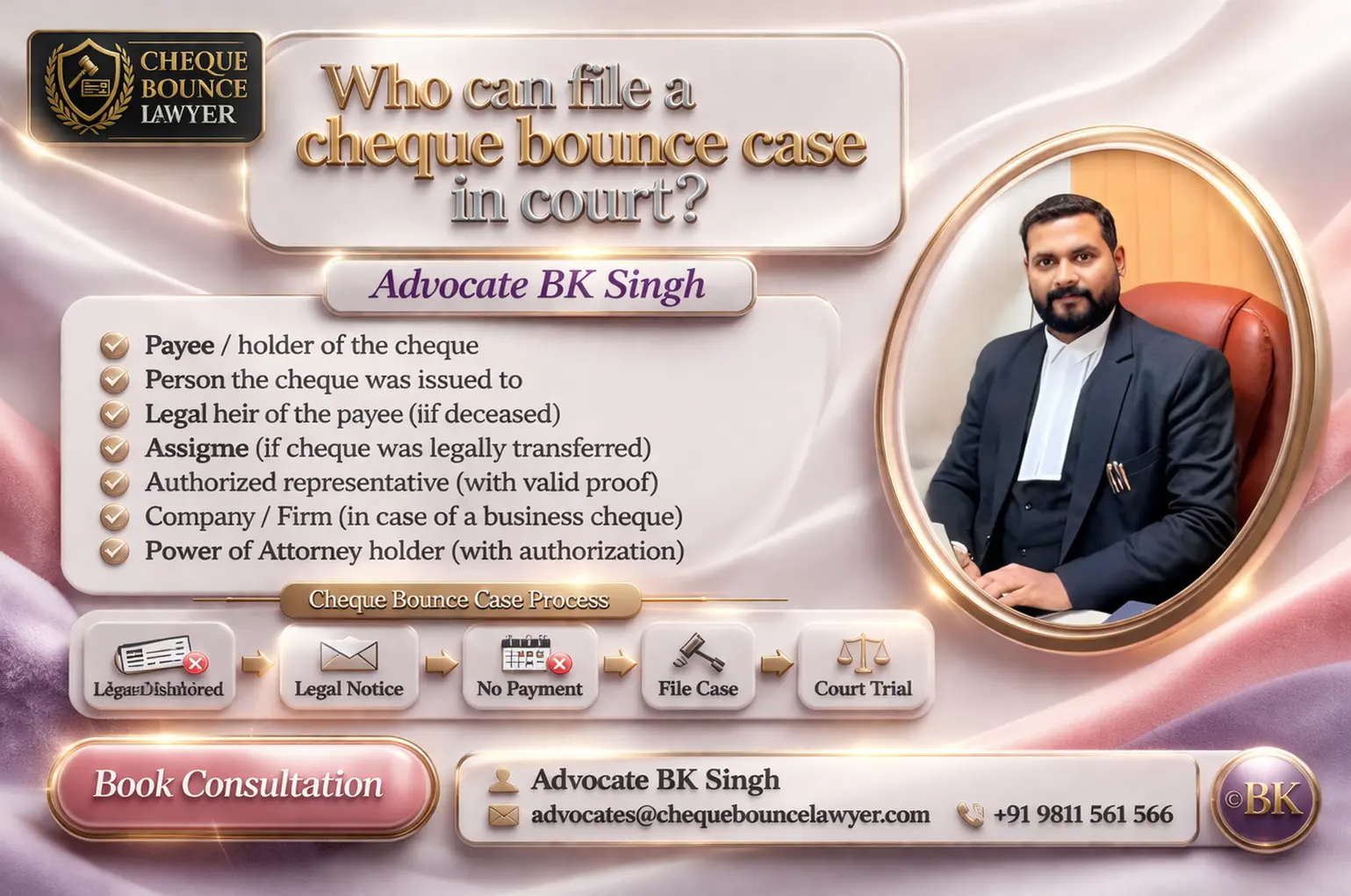
In India, a case about a bounced Cheque does not start with the person who feels financially hurt. The law makes this right very clear and limited. Section 142 of the Negotiable Instruments Act says that the complaint must be in writing and must be made by the payee or the holder of the Cheque in due course. Section 138 only applies if the Cheque was written for a debt or obligation that can be legally enforced, the Cheque was not honored, a written demand notice was sent within the legal time frame, and payment is still not made within fifteen days of receiving that notice. That one simple rule clears up most of the confusion in the real world. Usually, the person whose name is on the Cheque has the first right to file. The person who became the holder in due course may also file if the Cheque was properly endorsed and transferred. But a friend, family member, broker, employee, or business partner can't just start the case in their own name unless the law sees the complainant as the payee or holder in due course and the complaint is set up that way. This is why a lot of people go to Cheque Bounce Lawyer and Advocate BK Singh before sending a notice or going to court, especially when the amount is important for keeping the family or business running smoothly. The payee is the first and most obvious person who can file a complaint about a bounced Cheque. In real life, the payee is the person or group that the Cheque was written for. The person who got the Cheque is usually the one who should complain if a customer wrote a Cheque to a supplier, landlord, consultant, lender, or service provider. This is important because courts do not see Section 138 as a way for anyone involved in the deal to get their money back. The right begins with the Cheque and the legally binding obligation that comes with it. This often happens with personal loans, property token payments, contractor payments, school fee refunds, and promises to pay back money between family members. For small businesses, it shows up in things like vendor dues, unpaid bills, dealership payments, and settlements that are due after a certain date and are backed by security. If the Cheque names you or your business as the payee, you are usually the right person to file the complaint after following the legal notice process. That sounds simple, but a lot of cases fall apart because people think that just having a money dispute is enough to file, which isn't true without proper ownership of the Cheque and compliance. In everyday Indian disputes, the status of the payee becomes important in simple but important ways. For example, if a trader in Delhi sells goods to a store and gets a Cheque in the name of the trader's business. The owner of the business is the one who is supposed to pay. For example, if a tuition center gets a Cheque in the name of the school or a contractor gets it in the name of the company. In those cases, the court first looks at who signed the Cheque and whether that person or business is responsible for the debt or liability that the Cheque was meant to pay off. This is why paperwork is just as important as feelings. A lot of people say that the money was theirs in substance, but the Cheque was written in someone else's name or the name of another business for convenience. That can cause problems that could have been avoided later. Advocate BK Singh often tells clients through Cheque Bounce Lawyer to make sure that the notice, bank memo, invoice trail, ledger, and complainant name all match up from the start. A strong case for dishonoring a Cheque isn't just about proving that it wasn't paid. It's also about proving that the right person showed up in court with the right papers and at the right time. The law also recognizes the holder in due course as a second type. In general, this means a person who accepted the Cheque as payment before it was due and had no reason to think that the person who gave it to them had a problem with the title. The Act makes such a holder legally important, and Section 142 makes it clear that the holder can file a complaint in the same way as the payee. That is helpful in business situations where negotiable instruments move through endorsement and legal commercial transfer. This is easier to understand with a real-life example. Let's say a wholesaler gets a Cheque from a retailer and properly endorses it as part of their normal business to pay off a debt to another supplier. If the endorsed holder meets the legal requirements to be a holder in due course, that person can file a complaint when the Cheque is not honored. But just having it isn't enough. Just handling the Cheque, keeping it safe, or being involved in the deal doesn't mean that someone is a holder in due course. Courts want a legal title, a fair price, and a clear chain. A company can file a cheque bounce case, but the complaint should be in the name of the company if it is the one that received the money. The Supreme Court has said again that Section 142's requirement is met when the complaint is in the name of the payee. If the payee is a company, the complaint should be filed in the company's name. The Court also said that an employee or even a non-employee with the right paperwork, like a resolution or power of attorney, can represent the company. This same practical approach helps companies and organized businesses protect their receivables without getting confused about the rules. If the Cheque belongs to a small manufacturing unit, medical distributor, coaching institute, or construction company, the complaint should not look like a personal dispute. This is one of the most common technical errors that happen in cheque bounce lawsuits. Before the first filing, Cheque Bounce Lawyer and Advocate BK Singh usually focus on getting the complainant's description right. This is because one mistake in the process can waste months of time and put unnecessary stress on working capital. Yes, a person with power of attorney or an authorized representative can file or verify a Cheque bounce complaint, but the law requires more than just a signature. The Supreme Court has made it clear that it is legal to file a Section 138 complaint through a power of attorney. The court also said that the person who holds the power of attorney can depose and verify the complaint as long as they were there as an agent of the payee or holder in due course or have enough knowledge of the transaction and the complaint makes the right claims about that knowledge. This is very important for older parents, business owners who travel a lot, companies that do business in more than one city, and women who handle financial claims through trusted family members or authorized staff. The law lets people have lawyers, but it doesn't let someone who doesn't know what they're doing face a serious prosecution. The person who signs and appears should know the loan, invoice, settlement, supply, or repayment history that goes with the Cheque. That's why it's important to be careful when you write. A poorly chosen representative can cause problems with evidence later, even if the claim itself is strong. A bounced Cheque by itself does not automatically lead to a court case. Section 138 lays out a sequence that must be followed. The Cheque must be presented within its validity period, and the payee or holder must send a written demand notice within thirty days of finding out that the bank has dishonored it. The drawer must then fail to make payment within fifteen days of receiving that notice. The complaint can only be filed once the cause of action has matured. This is where a lot of honest claimants lose their drive. They either wait too long after the return memo, send an incomplete notice, or file too early, before the fifteen-day period is up. For people with jobs who depend on a bounced repayment Cheque and for small businesses that depend on customer payments, delays can be bad in two ways: first, they cost money, and second, they slow down the process. Advocate BK Singh often sees the timeline as the most important part of the case because even a valid complaint about a bounced Cheque can be hurt if the legal steps aren't followed closely. Section 142 also tells you where to file the case. A complaint under Section 138 can be heard by either a Metropolitan Magistrate or a First Class Judicial Magistrate. The law also says that if the Cheque is delivered for collection through an account, the jurisdiction is usually where the payee or holder in due course keeps the account. If the Cheque is presented in a different way than through an account, the jurisdiction is linked to the drawee bank branch where the drawer keeps the account. This rule about jurisdiction is important in real life because people often get Cheque in one city, deposit them in another, and run their businesses from a third. A trader in Ghaziabad, a service provider in Noida, or a distributor in Pune should not guess the forum based on what they hear or what is easy for them. Filing in the wrong court can slow down recovery and cause new technical problems. A focused cheque bounce lawyer helps figure out the right forum based on the bank branch, the way the case is presented, and the history of complaints before the case goes to the scrutiny stage. The biggest mistake people make when it comes to bounced Cheque is thinking that the dishonor memo will win the case on its own. In fact, the complainant's legal standing, the notice timeline, the name of the payee, the name of the complainant, the authority letter, and the supporting documents all matter. Section 138 cases seem simple because they only involve one Cheque, but in court they often depend on whether the right person filed at the right time and with the right legal basis. That's why the clarity of the procedure often determines how fast and strong the complaint is. For Indian families and small businesses, a bounced Cheque is rarely just a problem with a piece of paper. It could mean that a payment to a store is blocked, a salary adjustment is delayed, a property commitment has failed, a loan repayment promise has been broken, or a cash flow gap that makes life difficult. The best thing to do is to think of the cheque, return memo, notice, and filing as one long legal chain. When Cheque Bounce Lawyer and Advocate BK Singh get involved early, clients usually get not only better paperwork but also a clearer plan on whether to prosecute, negotiate, settle, or take other steps to recover, depending on the facts. I wasn't sure if I could file the case myself because the Cheque was made out to my business and not to me personally. Advocate BK Singh calmly explained the difference, fixed the notice approach, and made the whole thing feel a lot less scary. The clarity was what I liked best. I never felt like I was being pushed or tricked. The Cheque Bounce Lawyer team was patient and used common sense to deal with the situation. Our family had lent money to a relative, and when the Cheque bounced, everyone was upset and giving different advice. Advocate BK Singh didn't make a big deal out of it. He just looked over the papers, told us who could file, and told us what we should do first. That solid advice kept us from making mistakes. I felt like I was being supported and respected the whole time. I had already wasted too much time trying to get paid as a small business owner. The legal advice was clear and helpful for business, which helped me. The office told me about the notice period, the filing stage, and the document chain in a way that made sense to me. Cheque Bounce Lawyer made me feel good about finally doing the right thing instead of just acting out of anger. I called Advocate BK Singh after another lawyer turned down my first draft of a notice because it was weak and incomplete. From the start, it was clear that the two groups were going about things in different ways. Instead of just brushing it off, he looked at the Cheque, return memo, and transaction history all at once. I thought that someone had finally taken the facts into account. The advice was honest, careful, and very comforting. I wasn't sure if I should file personally or in the name of my business because my company got a Cheque that bounced. That one problem had stopped everything for weeks. Advocate BK Singh quickly made things clear and helped us with court strategy and authority documentation. After that, the process seemed more organized. This kind of legal clarity makes a big difference for any business that has to deal with bounced Cheque. Yes, most of the time, because the law says that the payee or holder must file the complaint in due course. The right usually starts with the Cheque being in your name or your business name. The holder in due course may also file if it has been legally endorsed and transferred. Normally, a family member can't file in their own name just because they know the facts. But the law may allow that arrangement in the right case if the complaint is properly filed in the name of the payee and a person who is authorized to represent the complainant and knows what they are doing shows up. Yes. The complaint should be filed in the name of the company if it is the one that is being paid. An authorized employee or even a non-employee may then be able to speak for the company. Yes, a person with power of attorney can file and Cheque the complaint if it is written correctly and the representative knows about the transaction or acted as the complainant's agent in it. Courts don't like representatives who are mechanical or don't know what they're doing. A holder in due course is someone who took the Cheque for payment before it was due and had no reason to think that the previous holder's title was wrong. That person can also file the complaint under Section 142. No. First, within thirty days of getting dishonor information from the bank, a written demand notice must be sent. After that, the drawer has fifteen days to pay after getting the notice. The complaint doesn't become valid until that payment window closes. Under Section 138, the complaint must be filed within one month of the date the cause of action arises. The law also lets the court take notice after that time if there is a good reason for the delay. A Metropolitan Magistrate or a First Class Judicial Magistrate hears a complaint about a bounced Cheque under Section 138. Usually, the rules in Section 142 about where the Cheque was collected or presented decide where the bank has jurisdiction. Not always. Section 138 is linked to a legally binding debt or obligation, as well as proper presentation, notice, non-payment within fifteen days, and timely filing. Even if the Cheque bounced, a weak transaction history can still be a problem. Because standing, notice timing, complainant name, authority documents, and court jurisdiction can all have an impact on the case before any evidence is presented. Early legal review helps stop mistakes that turn into technical objections later.Who can file a cheque bounce case in court
1. Who has the first legal right to file a case of a bounced Cheque?
2. What does "payee" mean in real life when Cheque bounce?
3. When a holder in due course can file a complaint
4. Can a business, firm, or partnership file a case for a bounced Cheque?
5. Can someone with a power of attorney or an authorized representative file?
6. When does the right to file actually come up in court?
7. Which court can hear the complaint about a bounced Cheque?
8. Why the right filing strategy is more important than people think
Delhi's Ritesh Malhotra
Jaipur's Meenakshi Sharma
Sajid Khan, from Lucknow
Chandigarh's Neha Arora
Mumbai's Vikram Deshpande
Q1. Can only the person whose name is on the Cheque file the case?
Q2. Can a family member file a case for me if my Cheque bounces?
Question 3. Can a business file a complaint about a bounced Cheque?
Q4. Can someone with a power of attorney file the complaint?
Q5. In a case of a bounced Cheque, what does it mean to be a holder in due course?
Q6. Can I file the case right away after the Cheque bounces?
Q7. How long do you have to file the complaint in court?
Q8. What court deals with a complaint about a bounced Cheque?
Question 9. Is every bounced Cheque enough to file a police report?
Q10. Why should I talk to a lawyer about a bounced Cheque before I file?
There's no reason for concern. There is no difficult-to-understand legalese.
Someone who has helped many people with the same problems gives you clear, honest advice. We want to make the legal process easy to understand and use for everyone.