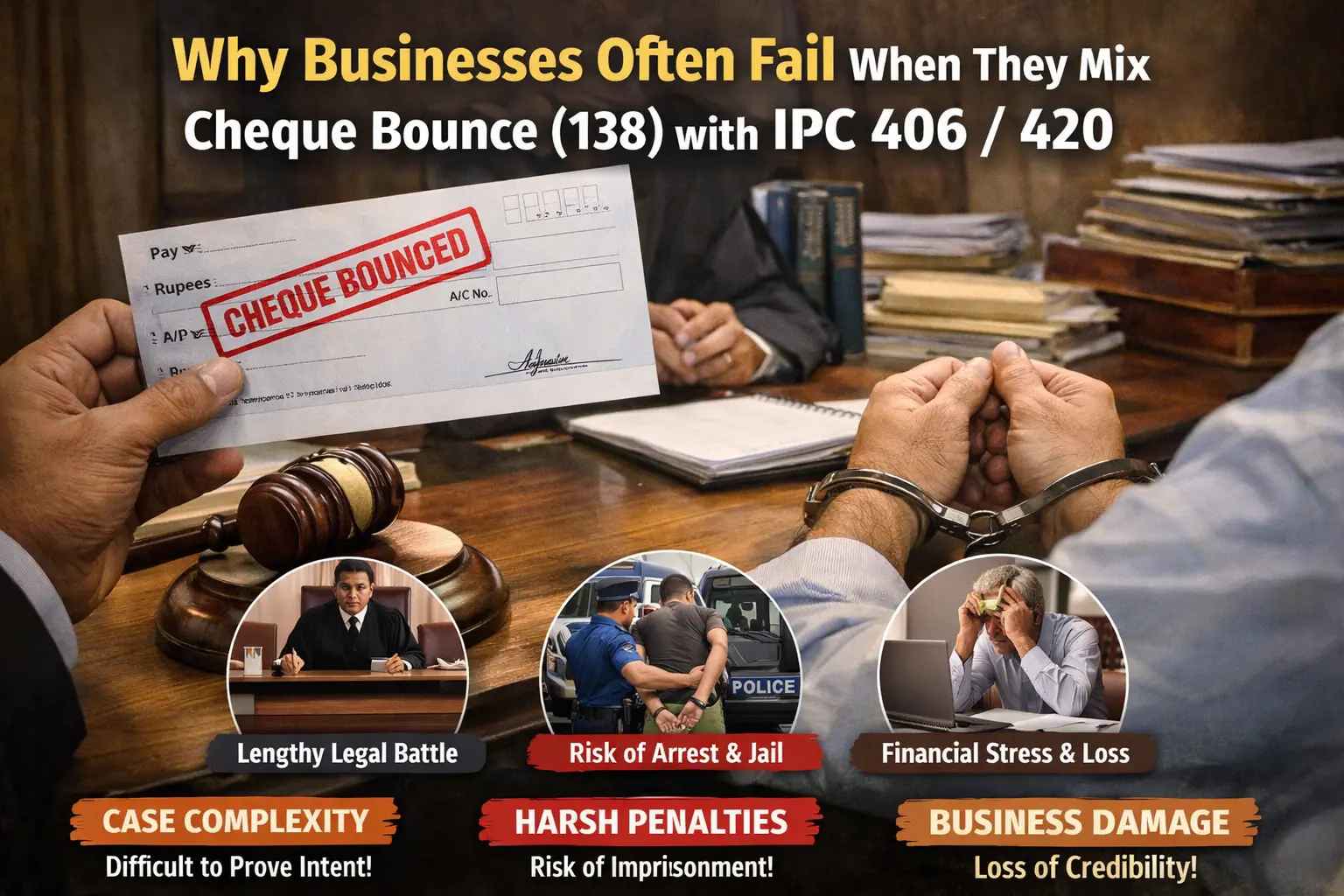
Why Mixing Cheque Bounce (138) with IPC 406/420 Can Cause Businesses to Fail
When a business is trying to recover, a bounced Cheque can feel like a direct attack on trust, cash flow, and survival. A lot of owners file everything at once because they think that more sections will mean more pressure and faster payment. That's why searches like "cheque bounce case with FIR, 138 and 420 together," "IPC 406 with cheque bounce," and "cheating case for bounced cheque" are still popular among MSMEs and traders.
Things are different in real life. When Section 138 NI Act is mixed up with IPC 406 and IPC 420 without care, a lot of cases get weaker, take longer, and are easier to fight. Advocate BK Singh leads Cheque Bounce Lawyer, which helps businesses pick a legal path so that the recovery case stays enforceable and doesn't fall apart because of strategy mistakes, false claims, or technical gaps that could have been avoided.
1. Why Mixing Sections Feels Strong but Often Doesn't Work
Adding IPC 406 and IPC 420 will scare businesses and force them to settle, especially when payments are late and communication stops. In real life, charging too much without clear evidence can make the other side defensive, and the fight turns into a long criminal battle instead of a way to get back on track.
When the legal story seems too big, it makes people want to make counterclaims and challenges right away, like quashing petitions, jurisdiction objections, and claims that the case is only civil. Cheque Bounce Lawyer and Advocate BK Singh work hard to make the case look credible, focused, and legally sound so that the court takes it seriously from the first hearing.
2. The NI Act's Section 138 has its own rules and structure.
Section 138 is more than just a complaint; it is a strict set of rules that govern things like issuing Cheque, sending return memos, giving statutory notices, and mapping out liability. Courts want clear information about debt, timing, and compliance. Any extra confusion can make the 138 complaint less strong.
When a business files IPC 406 or IPC 420 without getting the facts straight, the focus shifts from who is responsible for the Cheque to who had the intention. Advocate BK Singh keeps the 138 track clean where it fits best because a strong 138 case is usually worth more in a settlement than a messy fight with a lot of sections.
3. IPC 420 requires a clear demonstration of "dishonest intention." From the Start
IPC 420 doesn't work for every unpaid bill or broken promise. The main question is what the person meant to do at the time of the transaction. Many courts see it as a business dispute if the deal went through normally, goods were delivered, and the disagreement later arose over payment, unless there are clear signs of cheating.
Businesses often fail because they can't prove that the buyer planned to cheat from the start. Cheque Bounce Lawyer helps clients avoid weak cheating claims that are challenged right away. Advocate BK Singh builds the strongest legal case based on documents, behavior, and business reality.
4. IPC 406 Needs Clear Proof of Entrustment and Misappropriation
IPC 406 applies when someone is given property or money and then steals it without permission. A lot of business deals are sale and purchase contracts, not trust relationships. So, adding 406 without thinking can look like pressure tactics instead of a legal accusation.
Without entrustment, the other party has a strong defense that the criminal case is a misuse of process. Advocate BK Singh, through Cheque Bounce Lawyer, protects people who file complaints by making sure that the sections of the case stay true to the facts so that it doesn't lose credibility in court.
5. The Biggest Loss Is Strategic Because Courts Notice "Pressure Filing"
When the facts aren't very different, a combined 138 with 406/420 filing can look like a pressure toolkit to courts and police. Once that impression is made, it is harder to keep things moving smoothly, and the case can get stuck in technical hearings and delays.
For MSMEs, delays mean more than just time; they also mean cash flow problems, stressed vendors, and unstable businesses. Cheque Bounce Lawyer is all about keeping things clean in court so that real recovery can happen. Advocate BK Singh puts enforceable results ahead of loud legal filings.
6. Mixing paths can cause delays and problems with the process.
Section 138 follows a set legal path, but IPC FIR cases go through the police process, different investigation angles, and different court rhythms. If not planned well, parallel actions can lead to statements that don't match up, timelines that don't match up, and multiple forums that waste time and money.
When legal costs go up but recovery stays the same, businesses go out of business. Advocate BK Singh helps clients avoid procedural confusion by choosing the right forum strategy and making sure that all of the paperwork is the same. This keeps the focus on liability and recovery leverage.
7. Real-life business situations where mixed filing hurts the case
A supplier gets a bounced Cheque from a buyer after delivering goods and immediately files 138 plus 420. But later emails show that the buyer asked for new terms because the market crashed. The accused says it's a business dispute and that the cheating claim is exaggerated, which lowers the value of the settlement.
Another company files 406 for breach of trust over an unpaid invoice, but they can't show that they were given the money; they can only show sale invoices and delivery challans. The defense says that the criminal parts are being used wrong, and the complainant loses time that could have helped the 138 track. A cheque bounce lawyer plans the approach so that damage that could have been avoided doesn't happen.
8. How Cheque Bounce Lawyer and Advocate BK Singh Help Businesses Get Back on Their Feet
Proof, legal fit, and credibility, not anger, are what make a strong recovery case. The best strategy is the one that stands up to challenges, puts pressure on the other side to settle legally, and keeps the complainant's image clean in court.
Advocate BK Singh leads Cheque Bounce Lawyer, which helps businesses by figuring out who is responsible, making sure the paperwork is strong, and choosing the right sections based on the facts. The focus is practical for small businesses and middle-class traders because they need results, not endless lawsuits and damage to their reputation.
Reviews from Clients
*****
Kapoor Neeraj
My buyer stopped paying, and I was ready to file everything together, but Cheque Bounce Lawyer told me why a clean 138 route would be better. Advocate BK Singh kept the strategy on track, which made me feel less stressed because the case finally felt solid.
*****
Shweta Arora
People told me to add IPC 420, but the facts weren't clear, and I was afraid the case would get messy. Cheque Bounce Lawyer helped me keep it real, and Advocate BK Singh helped me write it with strong business sense.
*****
Faizan Ahmed
Our small business was losing money because payments were late and Cheque bounced. Cheque Bounce Lawyer set up the case correctly, and Advocate BK Singh made sure we didn't weaken it by making false claims. The outcome was real relief and more power in negotiations.
*****
Menon Prakash
I had papers, but my previous approach was harsh and unclear, which caused a delay. Cheque Bounce Lawyer fixed the direction, and Advocate BK Singh's clear writing made the case look professional. I felt safe because the plan became clear and realistic.
*****
Aarti Singh
I wanted to get better quickly, not have to fight for a long time on many forums. Cheque Bounce Lawyer helped me understand how dangerous it is to mix 138 with the wrong IPC sections, and Advocate BK Singh kept the case on track. The pressure became legal and worked.
?FAQs
Q1. Can I file both Section 138 and IPC 420 for a bounced Cheque?
It depends on the facts, but IPC 420 needs clear dishonest intent from the start. Weak cheating claims can make them less credible and open them up to early challenges.
Q2. Is IPC 406 relevant in a case of an unpaid invoice or a bounced Cheque?
IPC 406 requires entrustment and dishonest misappropriation, so it may not apply to standard sale-purchase disputes unless the relationship clearly shows entrustment.
Q3. Why do people quickly challenge cases that combine 138 and 406/420?
When the accusations seem exaggerated or the facts don't fit the sections, the accused often file quashing petitions or say that the criminal process is being misused.
Q4: Does filing more sections put more pressure on businesses to recover?
If not legally supported, it can sometimes make things more difficult and take longer. On the other hand, a strong 138 case with clear proof can often lead to a better settlement value.
Q5. What is the most common mistake businesses make when they try to bounce Cheque?
Mixing up criminal sections without matching facts makes things inconsistent and gives the defense a strong case that it's a civil dispute.
Q6. Can IPC 420 treat a business disagreement as cheating?
Only when there is proof that the person who entered into the deal had dishonest intentions, not just because the payment was delayed or disputed later.
Q7. What papers make a cheque bounce case stronger for MSMEs?
Invoices, proof of delivery, account statements, written acknowledgments, Cheque details, return memos, and a history of consistent communication are all important records.
Q8. Does combining FIR and 138 complaints make it more expensive for small businesses to hire lawyers?
Yes, parallel actions can make hearings, paperwork, and procedures more complicated, which can raise costs and take more time without any guarantee of a benefit.
Q9. What do courts think about "pressure filing" in recovery disputes?
Courts usually like allegations that are legally sound, and claims of crimes that are too big can hurt the complainant's credibility and slow the case down.
Q10. Why should you choose Cheque Bounce Lawyer and Advocate BK Singh for strategy?
Cheque Bounce Lawyer focuses on making sure that recovery plans are legally sound, and Advocate BK Singh helps cases by clearly mapping out liability and giving practical court direction.
There's no reason for concern. There is no difficult-to-understand legalese.
Someone who has helped many people with the same problems gives you clear, honest advice. We want to make the legal process easy to understand and use for everyone.