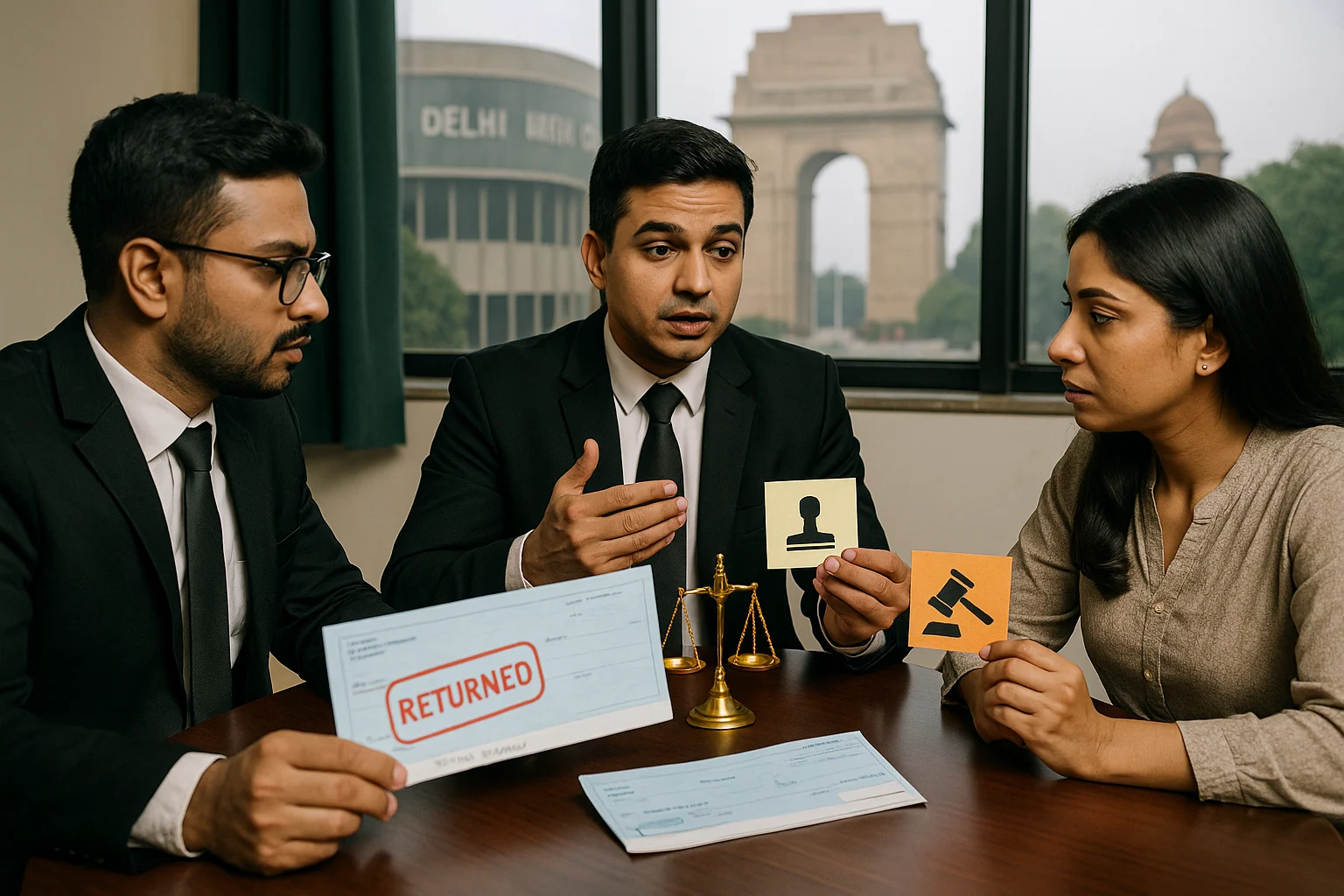
Best Legal Options for Dishonored Checks in Delhi (Section 138 NI Act)
In Delhi, when a check bounces, it can be because there isn't enough money in the account, the account is closed, or the signature doesn't match. This can cause cash flow problems, damage business relationships, and even stop payroll or vendor payments. Section 138 of the Negotiable Instruments Act, 1881 gives a quick, criminal remedy in addition to civil recovery, but the results depend on the timing, paperwork, and strategy.
Cheque Bounce Lawyer, led by Advocate BK Singh, helps middle-class people and small businesses turn a bounced check into a legally binding result. We do this by sending timely notices, writing good complaints, holding summary trials, giving interim compensation, and settling or compounding when it really helps your case.
Quick Summary: What the Law Says
Criminal remedy: Section 138 NI Act (dishonour of cheque), which can lead to a fine and/or jail time, plus a way to settle.
Civil remedy: A separate civil suit for recovery (summary suit or commercial suit, as needed).
Interim reliefs: During the trial, courts can give interim compensation of up to 20% of the check amount (Section 143A).
Appeal deposits: In appeals by the accused, the courts may order a minimum deposit of up to 20% of the fine or compensation (Section 148).
Territorial jurisdiction: After the change, jurisdiction usually lies where the payee's bank branch is located (where the check is presented for collection).
The bottom line is that you should file correctly and on time. This will give you more power in negotiations and make it more likely that you will get your money back.
The Right Timeline for the Law (Don't Miss These Dates)
Received a bank memo saying the check was not paid. Keep the envelope, ATM slip, SMS, and email triggers safe along with the return memo.
Demand Notice (within 30 days): You must send a legal notice to the drawer within 30 days of getting the bank's memo.
15 Days to Pay: The drawer has 15 days to pay after receiving notice.
Cause of Action: If payment is not made, the cause of action begins on the 16th day.
File a complaint (within 30 days of that): File the 138 complaint with the right Delhi court (Magistrate) and include all the necessary documents and an affidavit.
A lot of the time, skipping these steps kills good cases. We keep a close eye on them for you.
Why: It's a quick way to get things done, it's supervised by the court, and you might be able to get temporary compensation and compounding.
What we do: Write the notice and complaint, file the pre-summoning affidavit, guide the summons and bailable warrants when necessary, and plan the evidence and cross-examination.
2) Civil Recovery (At the Same Time or After)
Why: It makes sure the final money order is correct, especially for big amounts or more than one check.
What we do: Look over the summary suit or commercial suit, add bank accounts and assets when we can, and carry out the decree.
3) Temporary Payment (S. 143A)
Why: Money help during the trial; encourages a fair settlement.
How: Ask for up to 20% of the check amount at the right time and make your prima facie case clear.
4) Mediation/Compounding
Why: Many cases settle, and the law encourages this.
How: We talk about realistic terms, like a lump sum or scheduled payments, and include default clauses. We also record the settlement in court so it can be enforced.
5) Club Multiple Checks (If Connected)
Why: to be more efficient, to have a consistent strategy, and to cut down on unnecessary steps.
How: File and argue in a way that makes it clear to the court what the one transaction was.
6) Plan for an appeal and execution
Why: The S.148 deposit can protect you if the other side appeals, and after the order is carried out, the paper decree becomes money.
How: We ask for timely deposits, and in execution we look for attachment, garnishee, or warrant when we can.
What we do in real-life situations in Delhi and how we do it
SME Vendor Payment Stuck: A number of checks bounce after the holiday season. We file 138 complaints, ask for 143A interim compensation, and, if the value is high, we also ask for parallel civil recovery. This often leads to a structured settlement that is recorded in court.
Freelancer/Consultant Fees: One check for the last milestone bounces. We make sure to give proper notice, file a complaint, and use summary trial dynamics to get full and final payment.
Security Deposit Check: A bounced "security refund" check ends a fight between a landlord and a tenant. We map out the facts (like the end of the lease or the inspection report), then send a notice and a complaint, which often leads to a court-backed settlement.
Loan Repayment Check: Personal and business loan checks bounce; the person who wrote the check says they are having trouble. We get people into school, fight false defenses, and negotiate front-loaded payments with strong consequences for not paying.
Things You Will Need
Original check(s) and bank return memo(s)
Engagement agreement, invoices, and purchase orders, as well as WhatsApp and email conversations
Copy of the demand notice, proof of delivery (speed post, courier, or email that was received)
Proof of service (tracking report or acknowledgment)
Documents of authority (if you are filing for a business or company)
Affidavit and complaint written to meet court standards
Why you should hire Cheque Bounce Lawyer (Advocate BK Singh)
Notice and Filing Discipline: Every date is recorded, and no deadlines are missed.
Delhi Practice Familiarity: how to handle jurisdiction, how to format court documents, and how to use the right annexures.
Negotiation that Keeps You Safe: Settlements with default clauses, post-dated checks/NEFT mandates, and consent terms that are filed in court.
Stage-wise fees and realistic timelines that work for small and medium-sized businesses; we know how cash flow works.
Clear communication: No surprises; updates after important steps.
With Our Team, Step by Step
Case Audit (48 hours): Check memos, chats, and invoices; make sure the limit is clear.
Demand Notice: Write, send, and keep records of service.
Filing a complaint: an affidavit that is ready for court, exhibits, and mapping of the jurisdiction.
Hearing Strategy: Call witnesses, present evidence, and cross-examine; ask for temporary compensation.
Settlement/Compounding (if possible): Get terms that will actually pay.
Judgment and Execution: Turn orders into recoveries.
Rakesh Arora
"My store was stuck because a big buyer's check bounced." The Cheque Bounce Lawyer filed quickly, and we were able to have serious settlement talks within two days. Advocate BK Singh made sure the payments were safe.
Sanya Malik
"As a freelancer, I was afraid of the costs of going to court. The team made it practical and kept it stage-wise. There are no more excuses for my client to pay their debts.
Abdul Rahim
"One distributor's checks bounced multiple times. The company combined the strategy and pushed for temporary payment. "We got better faster than we thought."
Priyanka and Dev
"Check for the security deposit bounced while moving into the house." They took care of the notice, the filing, and the final settlement in a professional and quiet way.
Manjeet Singh
"I was sick of hearing 'payment next week.'" The other side paid after the complaint was filed, and the court recorded the payment schedule. "Just results, no drama."
?FAQs
Q1. What does Section 138 of the Indian Penal Code say about bouncing checks?
Issuing a check that is not honored for a legally enforceable debt or liability can lead to criminal charges under Section 138 of the NI Act, as well as a fine or compounding.
Q2. How long do you have to send a legal notice?
Within 30 days of getting the bank return memo. The drawer then has 15 days to pay.
Q3. Where do I file a case for a bounced check in Delhi?
According to the rules of the jurisdiction after the amendment, this is usually where the payee's bank branch is located (where the check was presented).
Q4: Can I ask for interest and costs?
Yes, courts can give money or a fine. In civil recovery, you can ask for interest and costs based on the facts or the contract.
Q5. What if the person who is accused offers to settle later?
The law supports compounding. We make sure that terms are written down, have a deadline, and can be enforced in court.
Q6. Are digital records like emails and WhatsApp useful?
Yes, as long as it's relevant and kept in good condition. Keep the originals and don't change them.
Q7. Can businesses and LLPs file cases for bounced checks?
Yes. File through a representative who has the right board or partner permission.
Q8. How long does it take for a Delhi cheque bounce case to be resolved?
It depends on how busy the court is and how the parties act. The goal of the summary trial mechanism is to be quick, and interim compensation can be requested right away.
Q9. Can I file both civil and criminal complaints at the same time?
Yes. You can file both a criminal complaint and a civil suit for recovery at the same time.
Q10: Do I need the original check?
There's no reason for concern. There is no difficult-to-understand legalese.
Someone who has helped many people with the same problems gives you clear, honest advice. We want to make the legal process easy to understand and use for everyone.