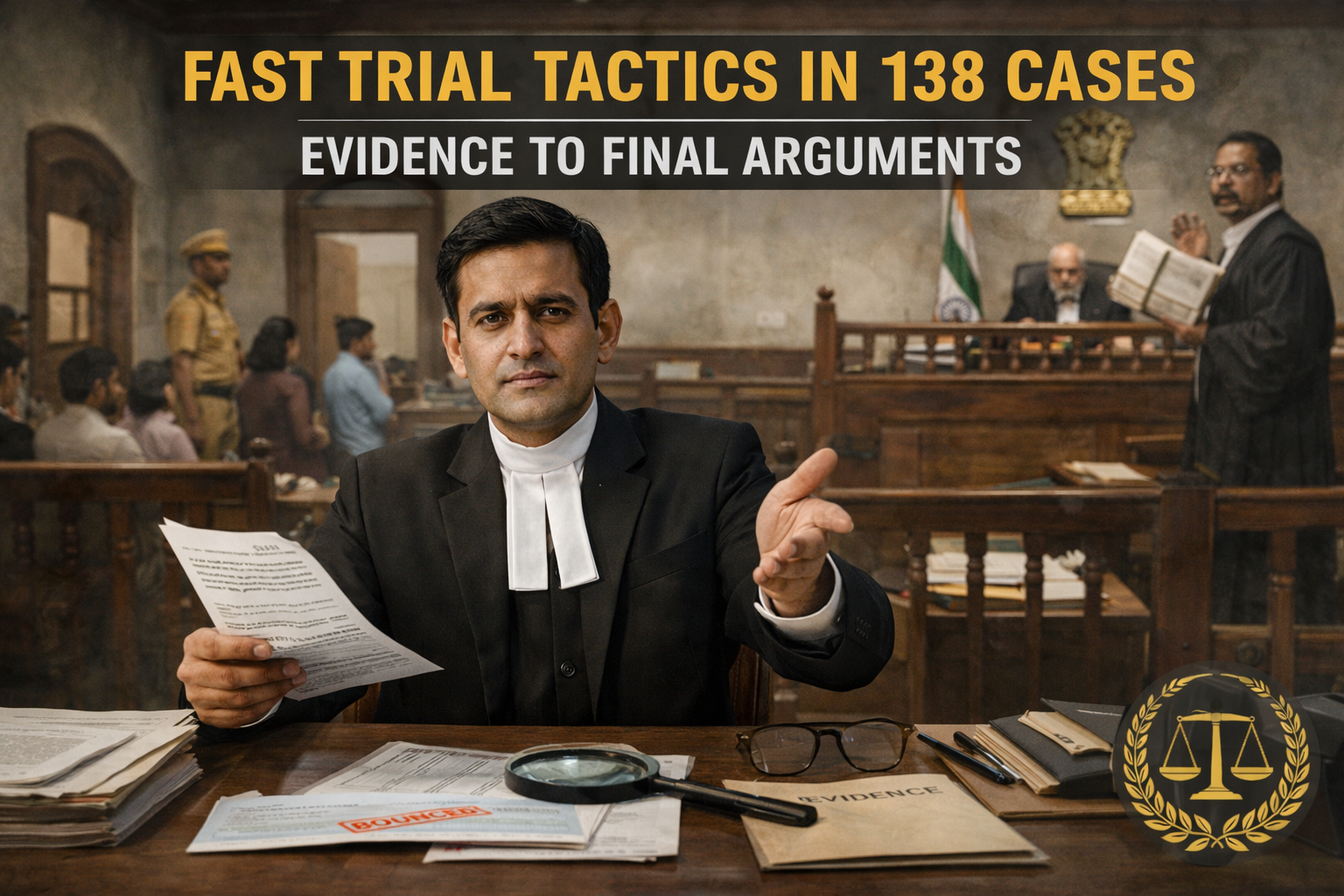
Quick Trial Strategies in 138 Cases: Proof to Closing Arguments
Section 138 of the Negotiable Instruments Act mandates that cases concerning bounced cheque should be expeditious and concise. However, due to weak files, missed deadlines, or improperly organized evidence, many cases become stuck in reality. There is no magic to a "fast trial"; it's just a smart plan from the start.
At Cheque Bounce Lawyer, Advocate BK Singh focuses on practical trial tactics that help middle-class complainants and small businesses move the case faster from evidence stage to final arguments—without unnecessary dates, confusion, or avoidable objections.
1. The fast trial starts on the first day, not in court.
A quick Section 138 case starts before you file. The court process goes more smoothly and the defense has fewer chances to delay if your notice, dates, and documents are all correct and consistent.
People who file quickly with incomplete papers cause most of the delays. The Cheque Bounce Lawyer makes sure that the legal notice, cheque details, bank memo, and proof of transaction all match up perfectly.
2. Papers That Can Make or Break a 138 Case
In cases of bounced cheque , the judge looks for a simple chain of events: liability, the cheque, dishonor, notice, and non-payment. The case moves quickly when this chain is clear.
Have the important things ready: a copy of the cheque, a return memo, a bank slip, a legal notice, proof of delivery, and proof of debt (an invoice, ledger, loan transfer, or settlement note). Advocate BK Singh keeps the file "ready to decide."
3. Cases of Stop Payment Need Smart Evidence, Not Panic
When the return memo says "Stop Payment," a lot of clients get worried. But the main question is still whether there was a debt that could be enforced in court and whether the cheque was written for it.
To keep the trial moving quickly, your proof should clearly show the real transaction, such as payment records, messages of receipt, invoices, or terms of settlement. This will stop the defense from making the case longer.
4. Signature Admission Can Make the Whole Trial Shorter
If the accused admits to signing the cheque, the case gets stronger because the law favors the person who filed the complaint. This helps cut down on fights that don't need to happen.
Locking this admission in early is a quick way to focus only on liability and notice compliance. The Cheque Bounce Lawyer makes plans and questions to avoid wasting time.
5. Writing a legal notice that stops future objections
A weak notice causes a big delay. The accused can challenge technical points if the amount is wrong, the demand is unclear, the details are missing, or the address is wrong.
Advocate BK Singh writes notices with clear language and the right time frame so that the case doesn't get stuck in "notice disputes" and can move on to evidence and arguments.
6. Affidavit Evidence That Saves Time in Court
Affidavit evidence is a powerful way to quickly finish the evidence stage when the complainant's evidence is clear and backed up by the right documents.
The trick is easy: don't write an affidavit that is too long and emotional. Write a short, factual affidavit that is linked to documents. This will keep cross-examination short and to the point.
7. Cross-Examination Control Speeds Up The Case
When cross-examination turns into unrelated stories about business politics, family fights, quality disputes, old payments, and false accusations, cases move slowly.
Cheque Bounce Lawyer limits cross-examination to the most important points, such as issuing a cheque, liability, dishonour, notice service, and payment default. This stops the defense from making things even more confusing.
8. Be careful when using digital proof like WhatsApp.
WhatsApp messages, emails, and texts can help your case, especially if they show that the other person knows about it, promises to pay, or talks about settling. But random screenshots can annoy the court and make things take longer.
Only show chats that are relevant, have a date flow, and a clear purpose. Advocate BK Singh uses digital evidence in a clean, simple, and court-friendly way.
9. Mistakes That Make 138 Cases Last for Years
Most long cases have simple mistakes, like not having the originals, not being clear about the proof of the transaction, giving the wrong address, telling a story that doesn't make sense, or filing late after the deadline.
If you stay away from these from the start, the case will move faster on its own. Cheque Bounce Lawyer helps clients fix the file before it turns into a "slow case."
10. A settlement plan that keeps you safe from a second default
Many people who are accused only offer to settle to buy time. If the terms of the settlement aren't strong, the complainant has to wait longer for the case to be over.
A quick and safe settlement means clear payment dates, a default clause, and a written promise. Advocate BK Singh sets up the settlement so that it ends things instead of starting new problems.
Reviews from Clients
*****
Aakash Gupta
The Cheque Bounce Lawyer had a clear plan for my Section 138 case, which reduced my stress about the money that was stuck. Advocate BK Singh made sure the file was strong and the dates were important.
*****
Meera Joshi
The team made everything clear and walked me through each step. The case moved faster than I thought it would because they did a good job of getting the papers ready.
*****
Khan Imran
My business's cash flow was stopped because a cheque bounced. The Cheque Bounce Lawyer organized the evidence well and pushed the case forward in a focused way.
*****
Sonal Malhotra
The other side tried to make excuses like "stop payment," but Advocate BK Singh didn't let them. I felt safe and supported the whole time.
*****
Vikram Nair
No empty promises, just a plan that works. The method was professional, and the case stayed on track without wasting time.
?FAQs
Q1. Does Section 138 also cover stop payments?
Yes, it can be covered if the cheque was written for a debt that can be enforced by law and the legal deadlines are met.
Q2. What is the main reason why cases of bounced cheque take so long?
Some of the main reasons are wrong notices, missing documents, inconsistent stories, and cross-examinations that don't focus.
Q3. How important is the legal notice in a 138 case?
Extremely important. A strong notice cuts down on technical objections and helps the court move more quickly.
Q4. Can a case about a bounced cheque be settled after it has been filed?
Yes, a settlement can happen at any time, but the terms must be written down correctly to avoid a second default.
Q5. What proof do you need to show liability in Section 138?
Invoices, ledgers, bank transfers, loan proof, settlement notes, or written acknowledgments can all help show liability.
Q6. Does signing the admission help the person who made the complaint?
Yes. When a signature is accepted, legal assumptions become stronger and the trial may be shorter.
Q7: Can WhatsApp chats be used as evidence in cases of bounced cheque?
Yes, chats can help with acknowledgment and promise to pay if they are relevant and well-presented.
Q8. How long does it usually take to settle a Section 138 case?
A well-prepared case usually moves faster, but it depends on the court's workload and strategy.
Q9: Can I get money back if a cheque bounces?
Depending on the facts, courts can give money to people. Good documentation increases the chances of getting paid.
Q10: Why should you hire Cheque Bounce Lawyer and Advocate BK Singh?
Because the focus is on clean filing, strong evidence, and trial strategies that cut down on delays.
There's no reason for concern. There is no difficult-to-understand legalese.
Someone who has helped many people with the same problems gives you clear, honest advice. We want to make the legal process easy to understand and use for everyone.