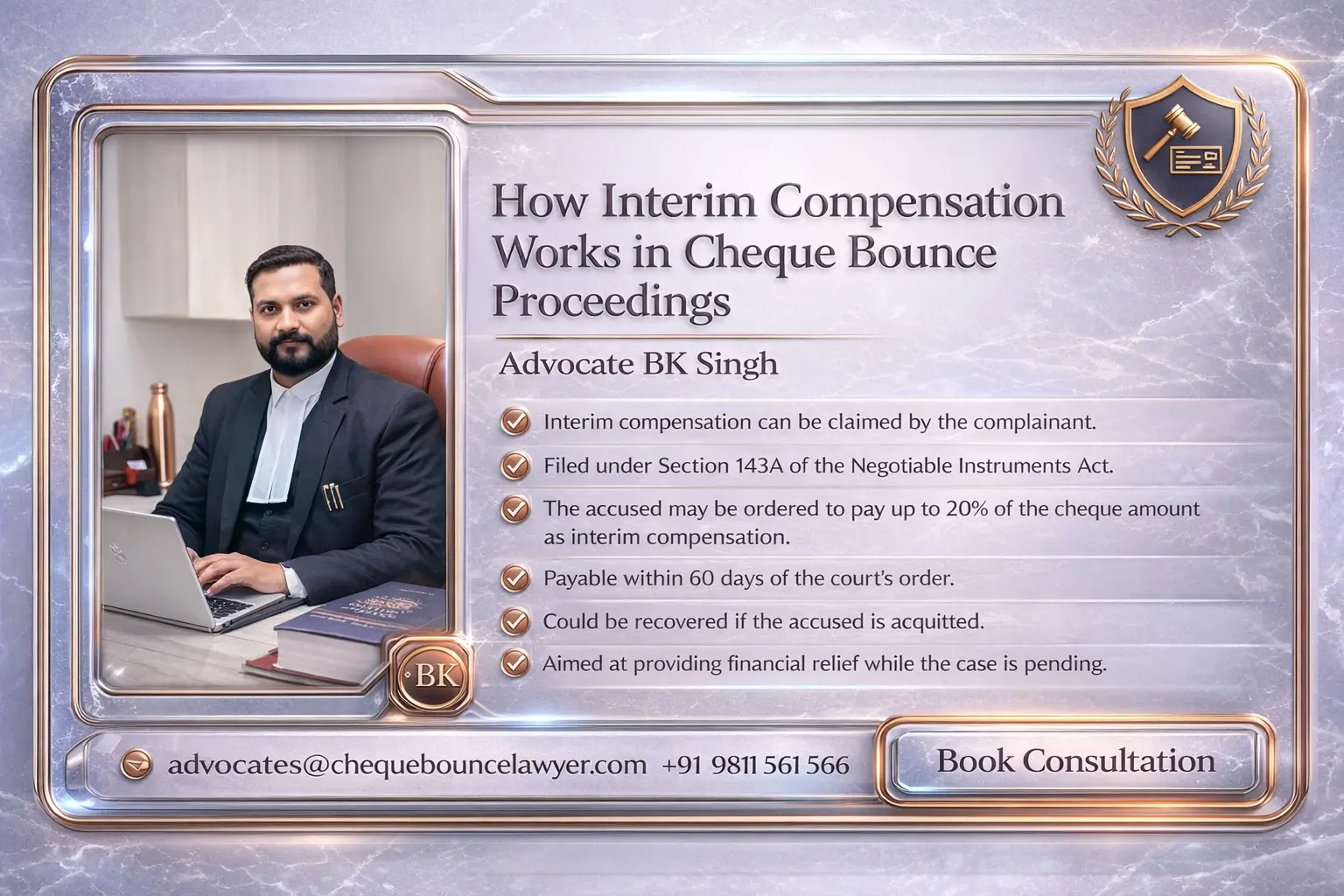
How Interim Compensation Works in Cheque Bounce Proceedings
Most people believe that a bounced cheque case under Section 138 of the Negotiable Instruments Act will take a long time and that their money will be stuck until the final decision. That's why the idea of interim compensation is important. Interim compensation is a form of early relief that can be ordered in certain cases of bounced cheques. In these cases, the court tells the person who bounced the cheque to pay part of the amount during the case itself. This provision can ease the stress for middle-class families and small business owners because it gives them some recovery before the case is over. People go to Cheque Bounce Lawyer because interim compensation isn't automatic or guaranteed, and you can't just ask for it and get it. It needs to be filed correctly, at the right time, with clear paperwork and a courtroom strategy that stays the same from day one. Advocate BK Singh and the Cheque Bounce Lawyer team usually break down interim compensation into simple terms, explaining what it is, when it can be asked for, and how to use it responsibly without hurting the main case.
In real life, bounced cheque disputes often hurt the most where it matters most: daily cash flow. A kirana store owner might be waiting for payment from a wholesaler, a small contractor might be waiting for a cheque after finishing work on a site, a tuition center might be waiting for fee installments, or a supplier might be stuck because a distributor's post-dated cheque bounced. The bank memo may say the account is closed, the payment has stopped, the signature is different, or there aren't enough funds. Stress starts right away, and people start to wonder, "When will I get my money?" Advocate BK Singh often tells clients that interim compensation can be like early pressure and early relief, but only if the case is built correctly and the court is convinced.
1. What does "interim compensation" mean in a Section 138 case?
Interim compensation is a court-ordered payment that is made while a cheque bounce case is still going on, before the final decision. The goal is to stop the accused from using delay tactics too much and to give the complainant some relief early on. It doesn't change the final decision. This is a temporary direction that could change later based on the outcome of the case. Cheque Bounce Lawyer goes into great detail about this because a lot of people think that interim compensation means full recovery. No, it isn't. It is usually a small part of the cheque amount, and it acts as a pressure point to get people to pay on time and stop them from putting things off. Advocate BK Singh keeps the expectations realistic and the strategy in mind.
2. When the Court Can Look at Temporary Compensation
Interim compensation is usually looked at when the court has taken notice of the case, the accused has entered the process, and the case has reached a point where the court can judge how strong the complaint is. The complainant's file must be clean, the timeline must be correct, and the legal steps like filing and giving notice must be properly recorded. It is harder to justify interim compensation if there are gaps in your file. This is why Cheque Bounce Lawyer puts a lot of emphasis on keeping records and following a schedule. Advocate BK Singh often tells clients that they can only get help quickly if their paperwork is perfect from the start.
3. Why Interim Compensation is Important for Small Businesses and Middle-Class Families
If you work for a salary, a bounced cheque could mean that your rent is late, your EMIs are stressful, or your family's savings are messed up. One late payment can throw off a small business's payments to suppliers, employees, GST cycles, and stock purchases. Interim compensation can help you recover during the case instead of just at the end. When a bounced check delays payments, a Cheque Bounce Lawyer frequently helps clients who need to borrow money. Advocate BK Singh uses interim compensation arguments when they make sense to protect the client's cash flow and bargaining power.
4. How Interim Compensation Changes the Case: A Real-Life Example
Picture a small factory in Faridabad that sells goods to a dealer and gets a cheque for Rs 6 lakhs. The cheque doesn't go through. The dealer keeps making excuses and putting things off. The maker files a proper Section 138 complaint with all the necessary paperwork, including proof of delivery and invoices. If the court orders interim compensation, even a small amount paid early changes things. The manufacturer can pay workers, keep production going, and negotiate a settlement from a strong position. Many of these cases result in the accused person becoming more determined to repay the debt. The Cheque Bounce Lawyer sees the provision as a useful way to get money back, not as a legal decoration. Advocate BK Singh says that interim compensation is also a change in the way the accused thinks, because the case stops feeling like a harmless delay game.
5. What the Complainant Needs to Do to Get More Interim Compensation
First, make sure you keep the original cheque copy, return memo, bank statement entry, and deposit slip safe. Second, keep records of the original transaction, such as an invoice, an agreement, proof of a loan, a ledger, proof of delivery, an acknowledgment, and regular communication. Third, make sure that the notice is written correctly and sent with clean records. Fourth, file the complaint in the right place and include a timeline chart. Cheque Bounce Lawyer makes files that look like a court-ready package so the judge understands the case is clear. Advocate BK Singh Advocate's main goal is to make things clear, since interim relief depends on how quickly the court can understand the story without getting confused.
6. What the Accused Should Know About Temporary Compensation
When people hear about interim compensation, they often panic, but panic makes things worse. Ignoring the notice is the first mistake. The second mistake is sending messages that admit fault without careful consideration. The third is going to court without a plan for how to defend yourself. When the court thinks the complaint has a prima facie basis, it may order interim compensation. This means that the accused needs to be realistic. If there is a real disagreement, partial payment has already been made, goods have been returned, or a cheque has been given as security without any liability, these points must be backed up with documents and brought up in the right way. Cheque Bounce Lawyer assists clients facing accusations in constructing a robust defense and considers settlements when appropriate. Advocate BK Singh often tells clients who have been accused to stay out of fights based on their egos because practical closure is better for their reputation and their wallet.
7. What are the consequences of paying or not paying interim compensation?
If the court orders and pays interim compensation, it shows that the court is taking the case very seriously. It also makes it more likely that the case will settle because both sides can see that it is moving forward with consequences. If interim compensation is ordered and the accused still doesn't pay, it can put more pressure on them and make the case more complicated for them in court. That's why both sides need to see the interim compensation stage as a big deal. Cheque Bounce Lawyer makes plans around this milestone, whether the client is a complainant trying to get their money back or an accused person trying to stay safe. Advocate BK Singh makes sure that the next steps are always the same, because being inconsistent hurts credibility in court.
8. How interim compensation helps with mediation and settlement
Interim compensation often pushes people to settle or mediate their disagreements because the accused knows that putting it off will cost them money. For people who are complaining, interim compensation makes them less desperate and gives them more power in negotiations. For people who are accused, it gives them a reason to work out a reasonable payment plan or a one-time settlement instead of risking more pressure. After an interim compensation direction, many practical settlements happen because both sides think the case has reached a serious point. A Cheque Bounce Lawyer writes settlement terms that stop a second default and make sure closure happens at the right time. Advocate BK Singh keeps the settlement legal, not emotional.
Reviews from Clients
*****
Mehta Rakesh
I live in Ahmedabad, and my customer kept putting off paying after a cheque bounced. The case was handled well by Cheque Bounce Lawyer, and Advocate BK Singh pushed the interim compensation strategy in a way that brought relief quickly.
*****
Nupur Sharma
I live in Lucknow, and I was worried because my savings were stuck. Advocate BK Singh explained interim compensation in a way that made sense, and Cheque Bounce Lawyer made me feel in charge of the case.
*****
Imran Khan
I live in Hyderabad, and my client stopped payment after sending a cheque . Cheque Bounce Lawyer put together a strong case, and Advocate BK Singh Advocate used the pressure of the interim stage to help the case move toward a settlement.
*****
Sangeeta Iyer
My case was emotionally sensitive, and I'm from Kochi. Advocate BK Singh was polite but firm, and Cheque Bounce Lawyer made sure that everything was filed correctly so that relief could come quickly.
*****
Kunal Verma
In a dispute over a bounced cheque , I, living in Delhi, faced false accusations. Cheque Bounce Lawyer helped me get my papers ready, and Advocate BK Singh Advocate told me how to handle interim compensation arguments fairly in court.
?FAQs
Q1. In a Section 138 cheque bounce case, what is interim compensation?
It is an early stage payment direction that lets the court ask the accused to pay part of the cheque amount during the case, before the final decision.
Q2. Is interim compensation always given in cases of bounced cheque ?
No. It depends on how far along the case is, how strong the file is, and how the court sees the facts and documents.
Q3. How much temporary pay can be ordered?
It is usually only a part of the cheque amount, not the whole thing. The exact amount depends on the law and the judge's decision in that case.
Q4. Does getting interim compensation mean that the person who complained will win for sure?
No. The final outcome depends on the evidence, cross-examination, and the facts as a whole. Interim compensation is a first step, not a final decision.
Q5. Can temporary payments help with a settlement?
Yes. It makes things more serious and cuts down on stalling tactics, which often leads to a settlement or mediation with realistic payment terms.
Q6. What papers do you need to get interim compensation?
You need to provide a copy of the cheque, a return memo, a bank statement entry, a notice copy with proof of delivery, and proof of the debt, which can include an invoice, agreement, ledger, or acknowledgment.
Q7. What should the person who is accused do if they want interim compensation?
Don't forget about the process. If there is a real disagreement, a payment problem, a security cheque issue, or a service problem, get ready to defend yourself in writing.
Q8. Can interim compensation make it harder for small business owners who don't pay their debts?
Yes, because it makes the delay less useful. It helps people negotiate more realistically and reach a deal more quickly when liability is clear.
Q9. What could happen if you don't take interim compensation seriously?
For people who complain, a weak file can mean that they don't get help right away. For the accused, not following the rules can make things more difficult and put more legal pressure on them.
Q10. What does a lawyer do to help with an interim compensation strategy?
A lawyer makes sure that the timelines, evidence, drafting, and courtroom narrative are all the same so that the court can fairly and logically consider early relief.
There's no reason for concern. There is no difficult-to-understand legalese.
Someone who has helped many people with the same problems gives you clear, honest advice. We want to make the legal process easy to understand and use for everyone.