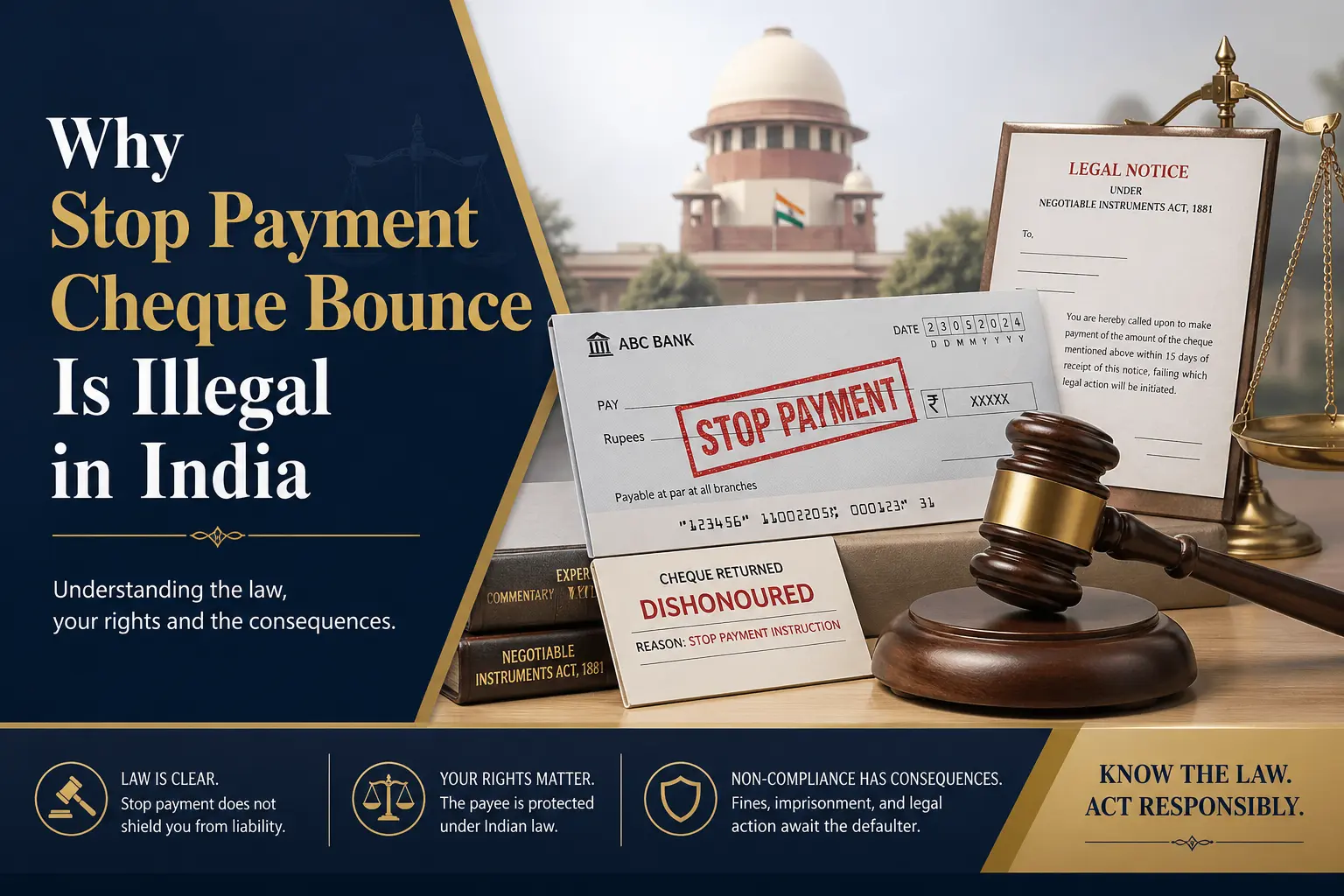
Cheque Bounce Lawyer Guide A cheque is not just a piece of paper. In Indian business life, family dealings, property transactions, loan repayments, security deposits, service payments and settlements, a cheque often carries trust. That is why many people get shocked when a cheque is returned with the bank remark “payment stopped by drawer.” The drawer may say, “I only stopped the cheque, I did not bounce it because of low balance.” The receiver may feel cheated because the cheque was given against money, goods, services, settlement, advance, rent, business dues or some other liability. The legal position is clearer than many people think. A cheque bounce due to stop payment can attract Section 138 of the Negotiable Instruments Act, 1881, if the cheque was issued towards a legally enforceable debt or liability and the statutory requirements are met. The Supreme Court has repeatedly treated stop payment instructions as capable of attracting Section 138, subject to the accused person’s right to raise a proper defence. That is why the question why stop payment cheque bounce is illegal matters so much. People often assume that stopping payment is a safe shortcut. It is not. A stop payment instruction may be valid in some genuine situations, but it does not automatically save the drawer from criminal proceedings under Section 138. For a complainant, delay can weaken the case. For an accused person, casual replies and poor documentation can make the matter worse. In both situations, the right legal response starts with understanding the difference between a genuine stop payment dispute and a stop payment cheque bounce case under the NI Act. Stop payment cheque bounce cases are common in Delhi, New Delhi, Ghaziabad, Noida, Greater Noida, Gurugram, Faridabad, Meerut, Lucknow, Mumbai, Pune, Bengaluru, Hyderabad, Chennai, Kolkata, Jaipur, Ahmedabad and other commercial centres because cheques still remain part of business and settlement culture. Even in the UPI age, many people use cheques for rent deposits, loan settlements, business supply payments, consultancy fees, property token money, dealership payments, employee dues, personal borrowings and post-dated instalment commitments. The problem starts when the drawer gives a cheque, later issues stop payment instructions to the bank, and then refuses to clear the amount. A returned cheque with the remark “payment stopped by drawer” can damage trust immediately. The payee may face cash-flow pressure. A small business may struggle to pay vendors. A landlord may lose rental security. A service provider may feel used. A family member may face embarrassment after helping someone financially. For the drawer, the risk is also serious. A stop payment cheque dishonour case may lead to a legal notice, criminal complaint, court summons, settlement pressure, trial, compensation exposure and reputational issues. Section 138 is not treated as a routine civil recovery matter. It is a cheque dishonour offence with a specific statutory route. People in Delhi NCR often search for a cheque bounce lawyer in Delhi, Ghaziabad, Noida or Gurugram after receiving a legal notice, summons or bank return memo. Many wait until the 15-day notice period has already expired. That delay can be costly. A stop payment cheque bounce means the drawer gave a cheque and later instructed the bank not to honour it. If that cheque was issued against a legally enforceable debt or liability, and the payee follows the Section 138 notice and complaint process, the drawer may face criminal cheque bounce proceedings. The central issue is simple: Was the cheque issued for a real legal liability, or was there a genuine reason to stop payment? Many drawers think that only “insufficient funds” cases fall under Section 138. That is a common misunderstanding. Courts have held that stop payment instructions do not automatically remove the case from Section 138. A drawer cannot escape legal consequences merely by telling the bank to stop the cheque after issuing it. At the same time, every stop payment cheque dishonour case does not automatically end in conviction. The accused can show that there was no legally enforceable debt, the cheque was misused, payment was already made, goods were not supplied, the cheque was given only as security, or some other valid defence exists. The defence must be supported by material, not just words. That balance is important. The law protects cheque credibility, but it also allows a genuine drawer to contest false or exaggerated claims. Section 138 of the Negotiable Instruments Act, 1881 deals with dishonour of cheques for insufficiency of funds or where the amount exceeds the arrangement with the bank. The section also requires that the cheque must be linked to a legally enforceable debt or liability. For a cheque bounce case for stop payment to proceed, these broad legal conditions generally matter: Section 138 also provides punishment that may extend to two years, or fine that may extend to twice the cheque amount, or both. This does not mean every case will result in maximum punishment. Courts examine facts, evidence, conduct, payment history and settlement possibilities. Section 139 creates a presumption in favour of the holder of the cheque. In plain language, the court starts with a presumption that the cheque was received for discharge of debt or liability, unless the accused proves the contrary. That presumption is powerful, but not final. The accused can rebut it through documents, circumstances, cross-examination and probable defence. The Supreme Court has treated stop payment dishonour as capable of attracting Section 138. In Laxmi Dyechem, the Court referred to earlier decisions and explained that “payment stopped” is not outside Section 138 merely because the bank memo does not say “funds insufficient.” The Court also recognised that a drawer may still raise a bona fide defence, especially where sufficient funds existed and payment was stopped for valid causes. So the legal answer is not “stop payment always means conviction.” The correct answer is: stop payment can attract Section 138, and the result depends on whether the complainant proves the statutory foundation and whether the accused rebuts the legal presumption. Section 142 provides that a Section 138 complaint is made by the payee or holder in due course, and no court inferior to a Metropolitan Magistrate or Judicial Magistrate First Class can try the offence. Jurisdiction is also tied to the bank branch rules mentioned in Section 142. In practical terms, cheque bounce cases may be filed before criminal courts dealing with NI Act complaints, depending on where the cheque was deposited and the statutory jurisdiction rule. In Delhi NCR, that may involve courts in Delhi, Ghaziabad, Noida, Greater Noida, Gurugram or Faridabad, depending on the facts. For a complainant, proper jurisdiction matters from day one. For an accused, territorial jurisdiction objections should not be raised casually; they must be legally examined. A party facing such an issue can consider guidance on territorial jurisdiction objections in cheque bounce cases before taking a position. This topic matters for both sides: the person who received the dishonoured cheque and the person whose cheque got returned after stop payment instructions. A supplier who delivered goods and received a stopped cheque needs to know how quickly to send the legal notice. A landlord who accepted a cheque for arrears or security refund adjustment may need clarity on whether the cheque represents a legally enforceable amount. A borrower who issued a settlement cheque and later stopped payment may need urgent advice before replying to the notice. Business owners face this problem frequently. One party gives post-dated cheques against invoices, a settlement schedule or credit supply. Later, after receiving goods or benefit, payment is stopped. The complainant then has to decide whether to pursue recovery, settlement or a cheque bounce complaint. Individuals also face it in personal loan matters. A friend or relative may issue a cheque after borrowing money. Once the cheque is deposited, the drawer stops payment and starts giving excuses. Many such matters become emotionally heavy because the dispute is not only about money. It is about trust. Accused persons need guidance too. Sometimes a cheque is genuinely stopped because the underlying transaction failed, goods were defective, services were not provided, or the cheque was never meant to be presented. In such situations, silence is dangerous. A weak reply can harm the defence later. If your matter is already at the filing stage, you may review professional help for cheque bounce case filing instead of relying on informal advice. A stop payment cheque bounce case usually begins with the bank return memo and moves through notice, waiting period, complaint, summons, appearance, evidence, defence and final resolution. The exact route varies by facts, but the statutory windows should be taken seriously. The payee deposits the cheque. The bank returns it unpaid with a memo stating the reason. In stop payment cases, the usual remark is “payment stopped by drawer” or similar wording. That memo is important evidence. The payee should preserve the original cheque copy, bank memo, deposit slip, transaction documents and communication trail. Screenshots alone are not enough if better documents exist. The payee must issue a written demand notice within 30 days from receiving information from the bank about the cheque return. The notice should demand payment of the cheque amount and identify the cheque, bank, date, amount, dishonour reason and liability background. A vague notice can create disputes. A notice that says too much without proper basis can also create problems. Drafting requires care. For this stage, many people look for a proper stop payment cheque legal notice approach because the notice becomes the foundation for the complaint. After the drawer receives the notice, the law gives a 15-day period to make payment. If the drawer pays the cheque amount within that period, prosecution under Section 138 may not proceed in the same way because the statutory cause of action does not mature. This is the drawer’s safest decision window. Many people waste it by sending emotional replies or making vague promises. A practical drawer should either pay, settle properly, or send a legally reasoned reply based on documents. If the drawer fails to pay within the statutory period, the complainant may file a complaint within the prescribed limitation before the competent court. The complaint usually includes the cheque, return memo, legal notice, postal proof, tracking details, transaction documents and supporting affidavit. Where the complainant needs structured assistance, the service page on cheque bounce complaint under Section 138 may be relevant. Once the court takes cognizance, summons may be issued to the accused. The accused must appear, seek bail as required, understand the allegations and prepare a defence. A casual statement like “I stopped payment because I wanted to” is usually not enough. The defence may involve absence of legally enforceable debt, misuse of cheque, payment already made, defective goods, failed transaction, security cheque facts, limitation issue, jurisdiction issue or defects in notice. Cheque bounce matters often move between evidence and settlement discussions. Many courts encourage settlement or compounding where parties are willing. Still, settlement should be documented carefully. A poor settlement record can create another dispute later. For parties who want to resolve without prolonged trial, settlement and mediation in cheque bounce matters may be a practical route. Good cheque bounce cases are built on documents. Memory fades. Messages get deleted. Bank records remain. A small point from practice: many accused persons prepare their defence only after summons. That is late. The reply to notice often becomes the first serious record of defence. Draft it carefully. The limitation structure in Section 138 matters because cheque bounce law works through strict statutory windows. These timelines must be applied to the facts. Date of cheque, date of deposit, bank memo date, notice date, postal date, delivery date and final filing date should be checked carefully. Practical delays also matter. Courts may take time in scrutiny, summons, appearance and evidence. Still, the complainant should not delay the statutory notice. The accused should not ignore the notice assuming “court will take years.” That thinking often creates bigger trouble. In Delhi NCR, court workload can vary from district to district. A case in Tis Hazari, Saket, Karkardooma, Patiala House, Rohini, Dwarka, Ghaziabad, Gautam Budh Nagar or Gurugram may move differently depending on listing, service of summons and settlement conduct. For people who cannot visit the lawyer physically at the first stage, online video consultation for cheque bounce cases can help in checking deadlines before they expire. Many drawers think, “I told my bank to stop payment, so I am safe.” That is legally risky. Stop payment can still attract Section 138 if the cheque was linked to enforceable liability. A Section 138 notice is not ordinary correspondence. It creates a statutory payment window. Silence can harm the drawer’s practical position. Angry replies, allegations without proof and casual denials can weaken the defence. A reply should be factual, precise and supported by documents. Complainants sometimes wait too long after receiving the bank memo. If limitation is missed, the case may require delay explanation and may become more difficult. The cheque is important, but the transaction behind it matters too. Loan records, invoices, ledger entries, settlement notes and written communications can strengthen the case. Security cheque cases are fact-sensitive. A cheque called “security” may still attract Section 138 if liability had crystallised by the date of presentation. Jurisdiction errors can waste time. The bank branch and presentation route should be checked before filing. Companies must ensure proper authorisation for filing. A missing or defective authorisation can create avoidable objections. Cash payments or informal part-payments without receipt can create future disputes. Every settlement step should be recorded. Both complainant and accused should take advice early. By the time summons arrives, the first legal opportunity may already be lost. A cheque bounce due to stop payment can create legal, financial and reputational risk. For the complainant, ignoring the matter may mean losing the statutory remedy under Section 138 because limitation windows are strict. A civil recovery route may still exist in some cases, but it may not carry the same pressure as a cheque dishonour complaint. For the drawer, ignoring notice can lead to criminal complaint, summons, bail requirement, court appearance and possible trial. If the drawer is a business owner, director or partner, the dispute may affect market reputation and credit relationships. In company cases, Section 141 issues may also arise depending on who was responsible for the conduct of business. Family pressure can also become real. Many cheque cases involve relatives, neighbours, business friends or local market contacts. Once court notices start reaching home or office, the dispute becomes public enough to cause embarrassment. Financially, delay can increase settlement pressure. A drawer who could have resolved the matter during the 15-day window may later face litigation cost, interest demands, compensation discussions and repeated court dates. For complainants, delay can send the wrong signal. The drawer may transfer business, change address, create false stories or take advantage of weak documentation. Fast, calm action is usually better than anger. You should consult a cheque bounce lawyer quickly if the bank memo says “payment stopped by drawer,” if the cheque amount is substantial, if the transaction involves business invoices, if the drawer is avoiding calls, or if the 30-day notice period is running. A drawer should seek legal advice immediately after receiving a stop payment cheque notice. Do not wait for summons if you have a genuine defence. The notice reply can shape the defence record. Complainants should consult a lawyer before sending notice, not after. The notice should match the transaction and the evidence. It should not exaggerate facts or include inconsistent claims. Accused persons should consult a lawyer if: For location-specific assistance, you can check help for cheque bounce lawyers in Ghaziabad, cheque bounce lawyers in Noida, or cheque bounce lawyers in Gurugram, depending on your case location and jurisdiction. Cheque Bounce Lawyer focuses on practical legal support for cheque dishonour matters, including stop payment cheque bounce cases, Section 138 notices, complaint filing, accused defence, jurisdiction objections, summons-stage representation and settlement discussions. Advocate BK Singh assists clients in understanding whether the case is fit for legal notice, complaint, defence reply, settlement or contest. The aim is not to create unnecessary litigation. The aim is to take the correct legal route based on documents, dates and liability. For complainants, the work usually starts with checking the cheque, memo, limitation, liability documents and notice draft. For accused persons, the first task is to examine the notice, cheque background, bank records and possible defence. Clients can explore talk to a lawyer for urgent guidance or use the contact page to share basic case details. For people comparing services, the legal services page gives a broader view of available cheque bounce assistance. Yes, a stop payment cheque bounce can attract Section 138 NI Act if the cheque was issued for a legally enforceable debt or liability and the payee follows the statutory notice and complaint process. Stop payment is not an automatic escape from cheque bounce liability. It becomes illegal because the drawer issued a cheque representing payment and then prevented its honouring despite an enforceable liability. The law treats cheque credibility seriously. If statutory conditions are satisfied, stopping payment can lead to Section 138 proceedings. Yes. Courts have accepted that a cheque returned with “payment stopped by drawer” can fall under Section 138. The accused can still defend the case by showing a valid reason, absence of liability or other legally acceptable defence. The payee must send a written demand notice within 30 days from receiving bank information about dishonour. The notice should demand the cheque amount and mention cheque details, bank memo, liability background and payment requirement. If the drawer pays the cheque amount within 15 days from receipt of the legal notice, the statutory offence under Section 138 may not mature in the same way. Settlement terms should still be documented properly. Yes. The accused can raise defences such as no legally enforceable debt, cheque misuse, payment already made, failed transaction, defective goods or security cheque facts. The defence should be supported by documents and circumstances. A security cheque may attract Section 138 if liability had become due and enforceable when the cheque was presented. The word “security” alone does not decide the case. Courts examine the real transaction. Section 138 provides punishment that may extend to two years, or fine up to twice the cheque amount, or both. Actual outcome depends on facts, evidence, conduct, settlement and court findings. Yes. Many cheque bounce matters are settled or compounded. Settlement should clearly record the amount, dates, mode of payment, default clause and case withdrawal or compounding terms. It is strongly advisable. A complainant needs a legally correct notice within limitation. An accused person needs a proper reply if there is a defence. Poor drafting at the notice stage can affect the case later. A stop payment instruction may look simple at the bank counter, but legally it can create serious consequences. If the cheque was issued for a genuine debt or liability, and the drawer stops payment without clearing the amount, Section 138 NI Act can come into play. For complainants, the most important step is timely action. Preserve the bank memo, send a proper notice and file within limitation if payment is not made. For accused persons, the safest step is not silence. If you have a genuine defence, put it on record carefully and preserve supporting documents. If payment is due, settlement at the right time may save money, time and stress. For guidance on a stop payment cheque bounce case, Cheque Bounce Lawyer and Advocate BK Singh can assist with notice, complaint, defence review, jurisdiction issues and settlement options based on your documents and stage of the matter. This article is for general information only and does not constitute legal advice; consult a qualified lawyer for advice on your specific facts.Why Stop Payment Cheque Bounce Is Illegal in India
Why This Issue Matters in India, Delhi NCR and Major Cities in 2026
Quick Facts Box
Understanding the Core Legal Issue
The Legal Framework: Section 138 Stop Payment Cheque Bounce
How Section 138 Applies
Legal Requirement Practical Meaning Cheque issued by drawer The accused must have drawn the cheque from an account maintained by them Debt or liability The cheque should relate to a legally enforceable debt or obligation Cheque presented within validity The cheque must be deposited within its validity period Dishonour memo The bank must return it unpaid, such as “payment stopped by drawer” Legal notice The payee must send a written demand notice within the statutory period Non-payment after notice The drawer must fail to pay within the notice window Complaint filing The payee must file the complaint before the competent Magistrate within limitation Section 139 Presumption
Supreme Court Position on Stop Payment
Jurisdiction and Court
Who Needs This Guidance?
What Is the Step-by-Step Legal Process After Stop Payment Cheque Bounce?
First Stage: Cheque Return Memo
Second Stage: Legal Notice
Third Stage: Fifteen-Day Payment Window
Fourth Stage: Complaint Before Magistrate
Fifth Stage: Summons, Appearance and Defence
Sixth Stage: Evidence and Settlement
Documents and Evidence Checklist
For the complainant, the following documents usually matter:
For the accused, the defence file should be equally organised:
Timelines, Practical Delays and Decision Windows
Stage Broad Time Position Cheque presentation Within validity period of the cheque Demand notice Within 30 days from information of dishonour Drawer’s payment window 15 days from receipt of notice Complaint filing Generally within one month after cause of action arises Delay condonation Possible only where court accepts sufficient cause Common Mistakes People Make in Stop Payment Cheque Bounce Cases
Assuming stop payment is always safe
Ignoring the legal notice
Sending an emotional reply
Missing the 30-day notice period
Not proving the underlying liability
Treating a security cheque casually
Filing in the wrong court
Poor company authorisation
Making undocumented settlement payments
Waiting for summons before legal advice
Risks of Ignoring a Stop Payment Cheque Dishonour Matter
When Should You Consult a Lawyer?
How Cheque Bounce Lawyer Can Help
Frequently Asked Questions
1. Is stop payment cheque bounce an offence in India?
2. Why is stop payment cheque bounce illegal?
3. Can cheque returned “payment stopped by drawer” attract Section 138?
4. What notice is required in a stop payment cheque case?
5. What happens if the drawer pays after receiving notice?
6. Can the accused defend a stop payment cheque bounce case?
7. Is a security cheque covered under Section 138?
8. What is the punishment for stop payment cheque bounce?
9. Can a stop payment cheque bounce case be settled?
10. Do I need a lawyer for a stop payment cheque notice?
Final Thoughts
Disclaimer
Author Bio for Advocate BK Singh
There's no reason for concern. There is no difficult-to-understand legalese.
Someone who has helped many people with the same problems gives you clear, honest advice. We want to make the legal process easy to understand and use for everyone.