The Most Important Legal Parts of Cheque Bounce Cases in India (NI Act 138 Explained)
For most people in India, a bounced cheque is more than just a technical problem; it's a moment of panic. A supplier doesn't get paid on time, a small business owner's working capital is frozen, or a middle-class lender sees a hard-earned loan amount stuck because a cheque bounced. Questions like "What is Section 138 NI Act?" start to show up in Google searches very quickly."Which parts of the law apply to cases of bounced cheque in India?""Punishment for bouncing a cheque," "Time limit for bouncing a cheque case,"
The people who are doing these searches want to know how strong the law really is and what to do if a cheque isn't honored. The Negotiable Instruments Act of 1881, especially Section 138 NI Act and other related sections like Sections 139, 141, 142, 143, 143A, 145, 147, and 148, mostly govern cases of bounced cheque in India. If both the complainants and the accused people understand these sections well, they will know their rights, the risks they face, and the choices they have.
This is where a specialized law firm like Cheque Bounce Lawyer, run by Advocate BK Singh, comes in handy. The firm helps people, traders, and small businesses with cheque bounce and NI Act lawsuits by making sure they use the right legal sections in the right way, whether they are filing a complaint or defending a case.
Understanding Section 138 of the NI Act: The Most Important Part of Cheque Bounce Law
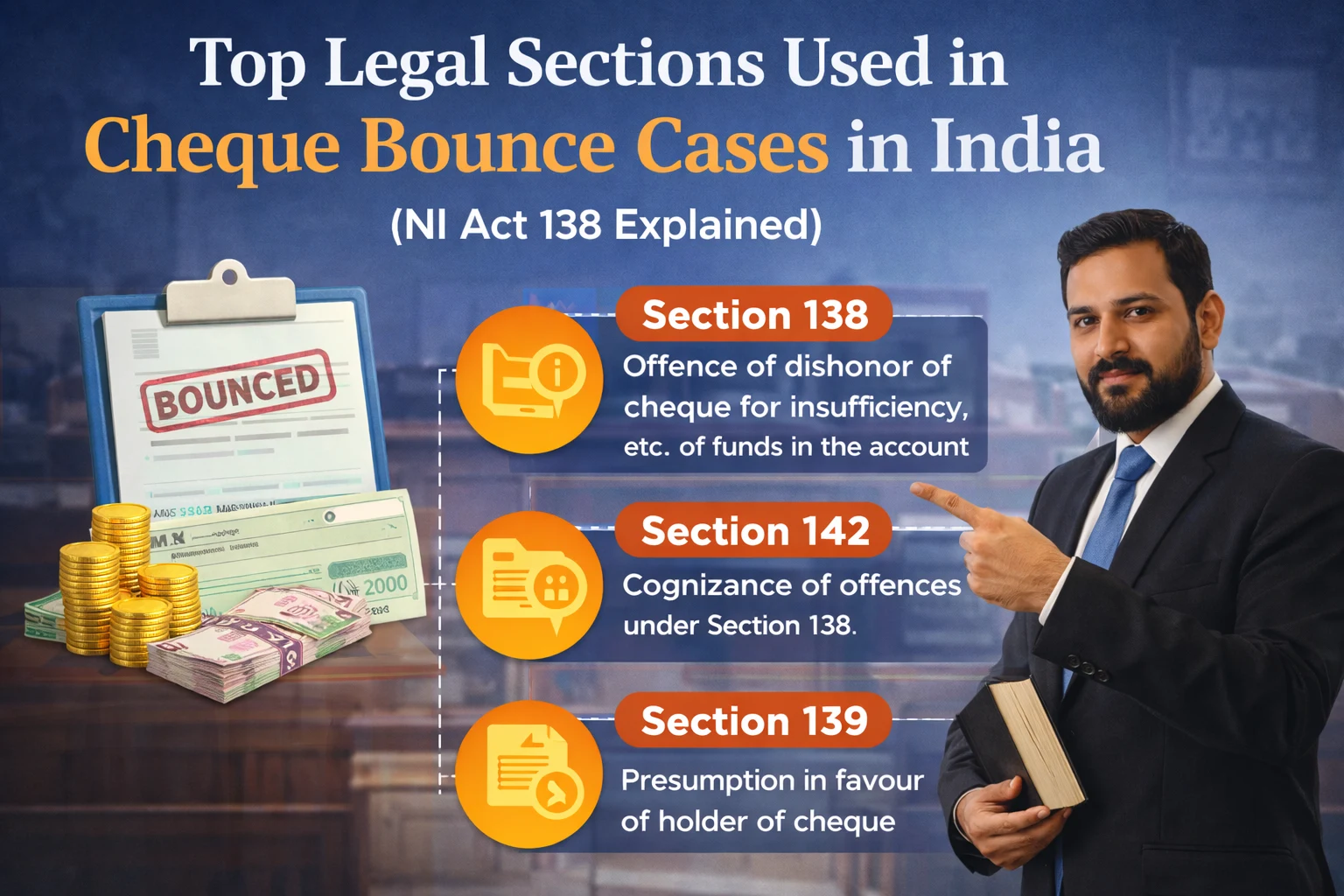
In India, Section 138 of the Negotiable Instruments Act is the most important part of cases involving bounced cheque. In simple terms, it means that if a cheque issued to pay a legally enforceable debt or liability is not honored because there isn't enough money in the account or because it goes over the agreement with the bank, and certain conditions are met, the person who wrote the cheque can be charged with a crime.
Not every dishonour is a crime under the law. For Section 138 to apply, the cheque must have been written for a debt that already exists or can be legally collected. It must be presented within its validity period, which is usually three months from the date on the cheque, but this can be shortened by RBI directions. If the bank returns the cheque unpaid, the payee or holder in due course must send a legal notice within the time limit set by law (usually thirty days from receiving the bank's notice) asking for payment of the cheque amount. If the drawer doesn't pay within fifteen days of getting this notice, the cause of action arises, and a criminal complaint can be filed with the right court within the next month.
This strict step-by-step framework means that even a small mistake in the wording or timelines can hurt a case. That's why a lot of middle-class people and small businesses now choose to have their legal notices and complaints written by professionals like Cheque Bounce Lawyer. Advocate BK Singh's team makes sure that every requirement of Section 138 is met and clearly shown on record.
Section 139 of the NI Act: The Payee is Presumed to Be Right
Section 139 of India's cheque bounce law is one of its strongest parts. It automatically favors the person who has the cheque. It says that the court will assume that the cheque was received to pay off a debt or obligation unless there is proof to the contrary.
The law assumes that the cheque was written for a legally binding obligation as soon as you can show that the person who wrote it has not paid it. The accused must then prove this presumption wrong by giving a likely defense, such as showing that the cheque was given as security, that there was no real liability, or that the amount is too high.
This assumption makes Section 138 a very useful tool for real creditors, vendors, landlords, and small business owners. It means that the law is on your side if you file a complaint. If you are accused, you can't just deny everything; you have to give a believable reason backed up by facts or circumstances. Cheque Bounce Lawyer uses Section 139 in smart ways to make strong complaints and smart defenses when they are needed.
Section 141 of the NI Act: Companies and Directors Who Bounce cheque
Most of the time, companies, partnerships, or other business entities are involved in cheque bounce disputes, not people. If the person who wrote the cheque is a company or firm instead of just one person, Section 141 explains how liability works.
If a company commits an offense under Section 138, this section says that not only the company but also the people who were in charge of running the business at the time of the offense can be held responsible. This includes managing directors, full-time directors, and sometimes authorized signatories or key officers. But just being a director doesn't mean they're guilty; the complaint needs to say exactly what they did and what they were responsible for.
This part is very important for people who are complaining about companies that don't pay their bills on time. It lets them go after not only the "paper entity" but also the people who made the decisions. For directors and partners, it's just as important because a poorly written complaint can bring even sleeping or non-executive directors into criminal proceedings. Advocate BK Singh and his team at Cheque Bounce Lawyer make sure that Section 141 is used correctly by holding responsible people accountable when necessary and questioning vague or careless arraignment when innocent directors have been wrongly named.
Who Can File a Cheque Bounce Case Under Section 142 of the NI Act
Section 142 talks about how to deal with crimes that involve bouncing cheque. It says who can file the complaint, when they can do it, and where they can do it.
Only the payee or holder in due course (or someone they have given permission to) can file a complaint under Section 138 in writing. It has to be filed within the time limit that starts on the day the cause of action happens (usually fifteen days after the drawer gets the notice). A Judicial Magistrate of the First Class or a Metropolitan Magistrate is usually the court that can hear the case. Changes to territorial jurisdiction made by amendments and Supreme Court decisions have also been important. These changes focus on where the payee's bank is located or where the cheque is presented.
These details can be hard to understand for regular customers, but they are very important. Filing in the wrong court or missing a deadline can make a strong case technically weak. Before filing or defending a complaint under Section 142, a Cheque Bounce Lawyer carefully cheque these things so that procedural mistakes don't get in the way of substantive justice.
Section 143 and 143A of the NI Act: Quickness and Temporary Payment
Section 143 gives Magistrates the power to handle cheque bounce cases in a summary way, as much as possible, to speed up the process. The goal is for cases of cheque dishonor not to take as long as long trials but to be handled quickly and well, with hearings every day when possible.
Later, Section 143A was added to give courts the power to give the complainant temporary compensation at the beginning of the case, in some cases, up to a certain percentage of the cheque amount. This part understands that real creditors often have big cash flow problems when cheque bounce and cases take years to settle. The law tries to make things a little more fair for people who have already been hurt by allowing interim relief.
These sections are a lifeline for small businesses and lenders in the middle class. Advocate BK Singh often uses Section 143A to ask for interim compensation in the right cases through Cheque Bounce Lawyer. He also gives accused people realistic advice about the risks and responsibilities that come with fighting cases in this legal environment.
Section 145 of the NI Act: Evidence by Affidavit
There can be a lot of paperwork and formalities in cases of bounced cheque. Section 145 lets the complainant's evidence be given on an affidavit to make things easier and faster. The complainant doesn't have to tell the whole story in court; they can file a detailed affidavit and documents, and the court can use that as their main examination.
This saves time and makes trials run more smoothly. This also means that the quality of the drafting is very important. A poorly written affidavit can make a strong case weaker, but a clear and precise affidavit backed up by bank memos, notices, postal records, and account statements can make a very strong case. Law firms like Cheque Bounce Lawyer make sure that Section 145 is used correctly to tell the complainant's story strongly and without any delays.
Sections 147 and 148 of the NI Act: Deposits and Compounding in Appeals
Cheque bounce crimes are technically crimes, but they are really just about money and business relationships. Section 147 says that offenses under the NI Act can be compounded, which means that the parties can agree to settle and end the case with the court's permission. Compounding can take place at different points in the process, such as before, during, or even after the trial.
Section 148 also gives appellate courts the power to tell the person who is appealing a conviction under Section 138 to pay a certain percentage of the fine or compensation amount while the appeal is going on. This stops convicted drawers from using appeals to keep the complainant waiting while they pay.
In real life, a lot of cases of bounced cheque end in negotiated settlements and more bounced cheque. Cheque Bounce Lawyer often uses Sections 147 and 148 to find practical solutions. For example, they might pressure stubborn drawers to pay by sending them deposit orders, or they might tell complainants to accept reasonable settlements instead of chasing uncertain litigation for years.
How These Legal Sections Are Good for Small Businesses and Middle-Class People
A bounced cheque can feel like a personal and financial betrayal for a middle-class family that lent money to a relative or friend, a shop owner who took a cheque from a customer, a small manufacturer who sells goods on credit, or a service provider who relies on post-dated cheque. The legal parts of the NI Act—138, 139, 141, 142, 143, 143A, 145, 147, and 148—are like a structured toolkit for dealing with that betrayal.
If used correctly, these rules let a person who is complaining send a formal legal notice, file a time-limited criminal complaint, rely on presumptions in their favor, ask for faster trials, seek interim compensation, and ultimately push for a conviction or settlement. On the other hand, someone who is wrongfully accused or who has a real dispute can use the same law to raise defenses, question jurisdiction, question presumptions with evidence, and negotiate fair terms.
Advocate BK Singh's Cheque Bounce Lawyer works to make this legal toolkit available to everyone. The company listens to the story behind the cheque, looks at the papers with a practical eye, and then decides which parts to use, in what order, and with what plan. The goal is always the same: to turn fear and confusion into a clear legal plan that protects rights, gets back what is owed, and, if possible, brings relationships and business back into balance.
Part 1: Five Reviews from Clients
Rohit Sharma from Delhi
"I own a small printing business, and three cheque from a regular client bounced back to back." Cheque Bounce Lawyer and Advocate BK Singh took care of my notices and 138 cases with great care. In the end, we were able to get back almost all of the money through a court settlement.
Anita Verma lives in Ghaziabad.
"I lent money to a family friend, but he kept making excuses after his cheque bounced." The Cheque Bounce Lawyer team wrote a strong notice and complaint that finally made him take the matter seriously and pay off the debts. This was a huge relief for my family.
Imran Ali from Lucknow
"As a trader, I used to ignore legal options and just fight with buyers who didn't pay." When a big cheque bounced, I called Cheque Bounce Lawyer. They clearly explained the NI Act sections and their strategy, which helped me quickly come to an agreement on terms I could accept.
Kavita Nair from Bengaluru
"My cheque for my consulting fee bounced twice, and the client stopped answering my calls." Advocate BK Singh's office made sure that all the papers for Sections 138 and 139 were correct. As soon as the summons were served, the client quickly came forward to pay and end the case.
Ahmedabad's Sanjay Patel
"I was wrongly accused of being a director in a company's cheque bounce case, even though I wasn't in charge of day-to-day operations. Cheque Bounce Lawyer helped me use Section 141 to prove that I wasn't responsible for the transaction, and the case against me was dropped, which saved my reputation.
Part 2: 10 SEO-Friendly Questions and Answers
Q1. In cases of bounced cheque, what is Section 138 NI Act?
Section 138 of the Negotiable Instruments Act makes it a crime to dishonor a cheque for not having enough money or going over the limit. This happens when the cheque is written for a legally enforceable debt, presented on time, dishonored, and the person who wrote it doesn't pay within fifteen days of getting a valid legal notice. If all of these things are true and the complaint is filed within the time limit, the drawer could go to trial and be found guilty.
Q2. What are the most important laws in India that deal with bounced cheque?
The main parts are Section 138 (the crime of dishonoring a cheque), Section 139 (the presumption in favor of the holder), Section 141 (the crimes of companies and the vicarious liability of directors), Section 142 (who can file and where), Section 143 and 143A (summary trial and interim compensation), Section 145 (evidence by affidavit), Section 147 (compounding of the crime), and Section 148 (deposit in appeal). These are the main laws that govern cheque bounce lawsuits in India.
Q3. What is the punishment for bouncing a cheque under Section 138 of the NI Act?
Under Section 138 of the NI Act, the punishment can be jail time, a fine of up to twice the amount of the cheque, or both. It all depends on the facts and the judge's discretion. In practice, courts are putting more and more emphasis on paying the complainant, and they often suggest settlement or compounding. However, they also punish people who are dishonest on purpose or do it again.
Q4. How long do you have to file a case in India if a cheque bounces?
The time limit is figured out in steps. You must show the cheque within the time it is valid. After dishonour, the payee has a short time (usually thirty days) to send a legal notice. If the drawer doesn't pay within 15 days of getting the notice, a cause of action arises. In most cases, the complaint under Section 138 must be filed within one month of that date. In some cases, courts may allow delays, but it is always safer to stick to deadlines.
Q5. Who can file a complaint under Section 138 of the NI Act?
The payee or the holder of the cheque can file a complaint, or they can have someone else do it for them. Section 142 of the NI Act says that the complaint must be in writing and made by the right person within the time limit. Authorized signatories or officers can file the complaint for companies or firms if they have the right to do so.
Q6. How does Section 139 of the NI Act help people who complain about bounced cheque?
Section 139 assumes that the cheque was written to pay off a debt or obligation, so the person making the complaint doesn't have to prove that the obligation existed in the first place. Once the basic parts are shown—drawing the cheque, presenting it, dishonoring it, and giving notice—the accused must then prove this presumption wrong by giving a likely defense through cross-examination or evidence.
Q7. Can you file a case against company directors personally for a bounced cheque?
Yes, under Section 141 of the NI Act, if a company writes a bad cheque, the people who were in charge of running the business at the time can be charged with the crime along with the company. But the complaint must include specific accusations that show how each director or officer was to blame. Courts do not support vague or automatic arraignment of every director.
Q8. Can you settle or reach an agreement in a case of a bounced cheque?
Section 147 of the NI Act says that cheque bounce offenses can be settled. This means that the case can be settled and closed at different points in the process if both the complainant and the accused agree and the court gives its permission. A lot of arguments are settled this way, especially when the person who is accused is willing to pay the cheque amount plus reasonable costs or interest.
Q9. What does Section 143A of the NI Act say about interim compensation?
In some cases, like when the defendant says they are not guilty or in a summary trial, Section 143A lets the court order the defendant to pay the complainant interim compensation up to a certain percentage of the cheque amount while the case is still going on. This rule is meant to give the complainant some immediate help and stop people from using silly defenses and delaying tactics.
Q10. What can Cheque Bounce Lawyer and Advocate BK Singh do to help with a case of a bounced cheque?
Cheque Bounce Lawyer, led by Advocate BK Singh, helps people who have been wronged by writing legally sound notices, filing well-structured Section 138 complaints, using presumptions and interim compensation provisions effectively, and negotiating reasonable settlements when necessary. The company also defends people who have been accused of crimes by fighting weak complaints, questioning the improper arraignment of directors, and using NI Act provisions in smart ways. Their main goal is to protect the interests of middle-class people, traders, and small businesses that are most hurt by bounced cheque.
There's no reason for concern. There is no difficult-to-understand legalese.
Someone who has helped many people with the same problems gives you clear, honest advice. We want to make the legal process easy to understand and use for everyone.