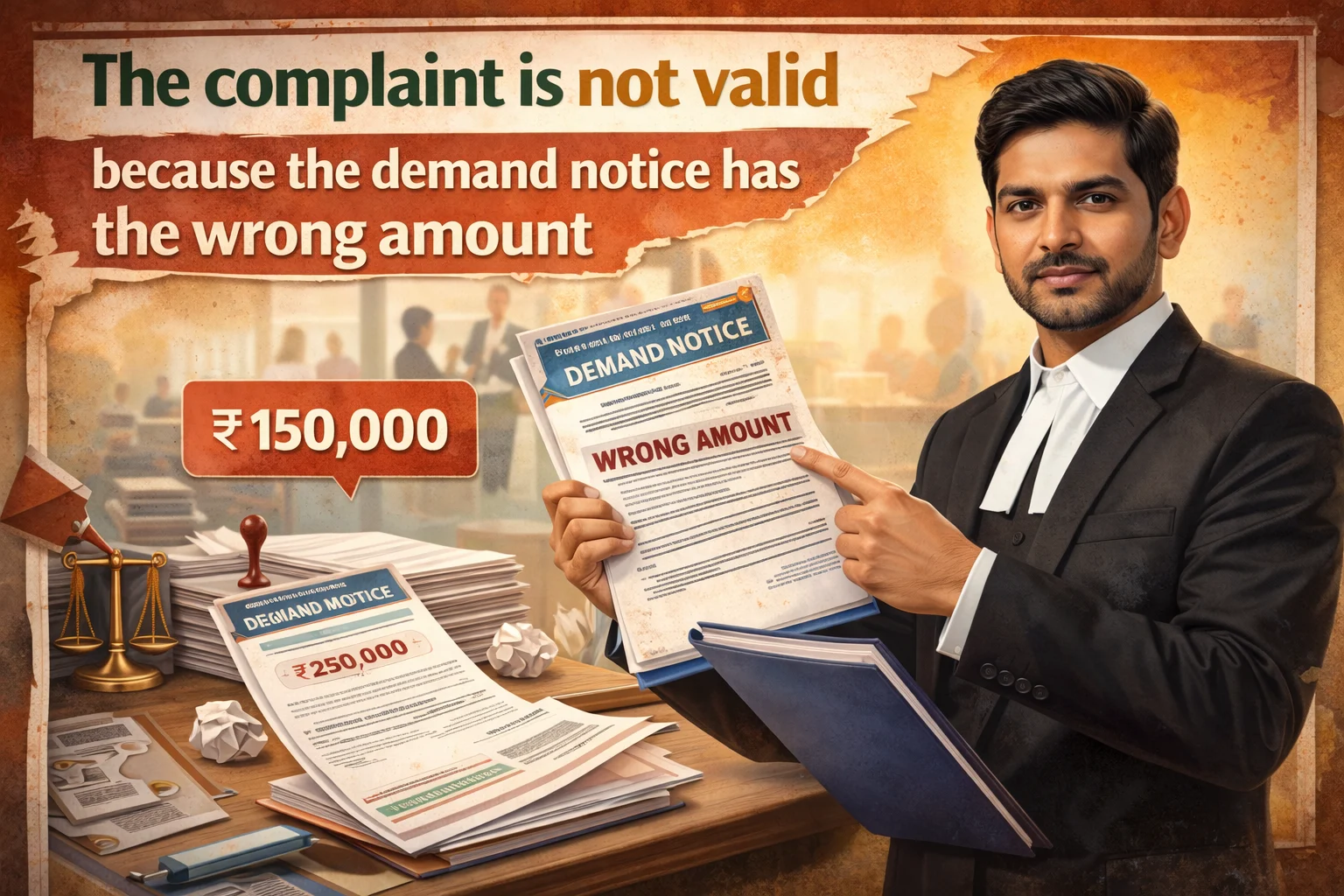
SC: The complaint is not valid because the demand notice has the wrong amount.
In a lot of cases where a cheque bounces, the fight isn't just about whether the cheque bounced; it's also about whether the legal basis was set up correctly. A Section 138 case under the Negotiable Instruments Act starts with a statutory demand notice. The Supreme Court has made it clear many times that this notice is not just a formality. If the notice asks for the wrong amount or doesn't clearly ask for the cheque amount, the complaint could fail right away because a necessary condition isn't met.
This is a very real problem for middle-class families and small businesses because payments often come in mixed forms, such as part payments, multiple invoices, old debts, interest claims, late fee disputes, and security cheque. A single drafting error can turn a strong case for recovery into a technical dismissal or give the accused party a clean defense even if they are liable. The law firm Cheque Bounce Lawyer, led by Advocate BK Singh, focuses on legally sound notice strategy so that cases don't fall apart because of mistakes that could have been avoided.
1. What does the Supreme Court mean by "wrong amount" in a demand notice?
A "wrong amount" problem usually happens when the notice doesn't clearly ask for the "said amount" of the cheque, but instead asks for a different lump sum that includes other claims. The Supreme Court has said that an omnibus demand is not valid if the statutory notice does not clearly ask for the cheque amount. This is because the law says that the person who receives the notice must have a proper chance to pay the cheque amount.
This means that notices mentioning costs or interest can still be valid. The main problem is being clear and being able to separate things. If the notice clearly states the amount of the cheque and lists other claims separately, courts have accepted that the statutory demand requirement is still met. This is because the drawer can understand what they need to pay to avoid prosecution.
2. Why a Section 138 complaint can fail if the demand amount is wrong
Section 138 is a strict process: the notice is a necessary step, not just a pretty one. If the notice doesn't ask for the right amount of the cheque, the drawer loses the specific chance that the law is meant to give, and the prosecution can be challenged as not maintainable.
This is a big risk for businesses with a lot of receivables because accounts teams prepare legal data and only one number is taken from a ledger summary instead of the exact cheque instrument. For people, it happens when family loans, committee money, or friendly loans are added to old debts, creating a demand that doesn't match the value of the cheque. This mismatch can then be used as a defense weapon.
3. When notices are still valid even if they mention extra amounts
Courts have recognized that payees often ask for interest, legal fees, or other costs. The Supreme Court has said that a notice is not automatically invalid just because it talks about extra amounts, as long as the legal demand for the cheque amount is clear and the extra part can be separated from the main demand.
In other words, the notice needs to sound like a legal document, not like a bank statement. If the notice clearly asks for the cheque amount as the main payment and says that the other amounts are separate claims, the notice is usually stronger. When the notice only asks for a total and not the cheque amount, things worsen.
4. Real-life examples of when small businesses often make this mistake
In MSME supply disputes, a buyer may send multiple cheque for different deliveries, and the seller may send one notice asking for the total amount owed. If the notice doesn't clearly ask for the amount of each cheque or asks for a total that doesn't match the returned instrument, the case is open to a technical challenge early on.
In service contracts, builders, vendors, and agencies often add late fees, penalties, GST differences, and interest on the contract. When a legal notice asks for an account total instead of the value of a cheque, the accused side says that the notice doesn't follow the law. Courts pay close attention to the language of the notice because Section 138 is a criminal law.
5. How does a Cheque Bounce Lawyer ensure that notices are legally valid and enforceable?
Advocate BK Singh's approach at Cheque Bounce Lawyer is based on paperwork and the court. The plan is to keep the statutory demand legally clean by treating the amount of the cheque as the main statutory figure and handling any other claims carefully so that the notice can be defended and the complaint can be maintained if litigation becomes necessary.
This is very important for middle-class lenders and small and medium-sized businesses (SMEs) that can't afford to go through the legal process over and over again. A well-structured notice lowers the chances of getting thrown out, cuts down on adjournment fights over technicalities, and keeps the pressure on negotiations realistic because the other side knows the file is put together with legal discipline, not guesswork.
6. The "wrong amount" defense is a valuable argument for the accused side.
If you get a notice that asks for more than the cheque amount or is written as a single demand without clearly asking for the cheque value, it can be a strong defense point. The accused side usually says that the statutory condition isn't met, so the complaint can't go forward. This argument is especially true when the notice isn't clear about what payment would have stopped the prosecution.
That being said, how strong the defense is depends on how the notice is worded. The court might consider the notice to be valid if it clearly asks for a certain amount of money and the rest is clearly extra. That's why the outcome of a case often depends on how the notice is read line by line, not on what was said later in court. Before choosing the best courtroom strategy, Cheque Bounce Lawyer carefully looks at this.
7. How this affects settlements and the outcomes of business recovery
In a lot of cases, the notice stage is where recovery really happens because the parties start talking once they see how serious the legal situation is. If the notice is wrong, the other side can delay because they know the complaint can be attacked on maintainability. For MSMEs, that delay can mean stress on working capital, inventory that isn't moving, and cash cycles that aren't working.
For families in the middle class, a weak notice can add to the emotional stress: visits from the other side, police threats, and endless stories of "we'll pay later." A legally correct notice helps settle faster because it makes the legal consequences and payment target clear, and it protects the complainant from being fired for no good reason. Advocate BK Singh is interested in results that are real and on paper.
8. Why clients choose Cheque Bounce Lawyer and Advocate BK Singh
Timing, wording, and proof are what win cheque bounce cases, not aggression. Advocate BK Singh and the Cheque Bounce Lawyer team take a practical approach to litigation. They make sure that all laws are followed, that all paperwork is in order, and that they have a plan that balances the speed of recovery with legal safety.
The support is meant to help businesses protect their receivables and give them more power in negotiations without making mistakes in the process. The support is meant to help people lower their stress levels and protect their dignity while following the right legal path. The goal is clear: no technical gaps, no unnecessary firing, and a strong path to recovery or closure.
Reviews from Clients
*****
Amit Khanna, Delhi: The Cheque Bounce Lawyer helped me when I was about to file blindly because my notice draft had a number mistake. Advocate BK Singh changed the plan, and my case was settled quickly because the other side saw that the notice and file were solid.
*****
Neha Kapoor
I was dealing with a supplier who didn't pay me, and I needed a way to do it that was safe from the law, not drama. Cheque Bounce Lawyer made the notice issue clear, and Advocate BK Singh handled it professionally, which made me feel better and more in charge.
*****
Sandeep Iyer
Our MSME had a lot of cheque, and the accounts team made a combined demand that could have gone wrong. Cheque Bounce Lawyer wrote the notice in the right way, and Advocate BK Singh's approach kept us in a good position to recover.
*****
Farah Siddiqui
I got a demand notice with amounts that didn't make sense, and I felt like I had to pay right away. The Cheque Bounce Lawyer looked over it, and Advocate BK Singh calmly guided the defense. The case was settled without any unnecessary court panic.
*****
Rajesh Bansal
I had a real business debt, but I was worried that the case would be thrown out because of technical issues. Cheque Bounce Lawyer made sure the notice was correct, and Advocate BK Singh's planning gave me the confidence to move toward a settlement.
?FAQs
Q1. What does "wrong amount in demand notice" mean in cases of bounced cheque ?
It usually means that the notice doesn't clearly ask for the amount of the cheque, but instead asks for a different or combined amount, which could lead to legal trouble.
Q2. Can a Section 138 complaint be thrown out just because the amount of notice is wrong?
Yes, if the notice doesn't meet the legal demand requirement, the complaint may not be able to be maintained.
Q3. Is a notice not valid if it includes interest and legal fees?
Not all the time. If the amount of the cheque demand is clear and other claims are separate, courts have said that notices are valid.
Q4. What if my notice asks for a total amount instead of a cheque amount?
That can be dangerous if the amount of the cheque is not clearly stated, because it makes things unclear and opens the door to technical challenges.
Q5. If the first notice is wrong, can the complainant send a new one?
It depends on the facts and the time limits. Timing under Section 138 is very important, so you should talk to a lawyer before you do anything.
Q6. How do courts make sure that the amount on the cheque is clear?
Courts read the notice as a whole and cheque to see if the drawer could understand how much money was needed for the law to be followed.
Q7. Is this issue more important in MSME disputes with multiple invoices?
Yes, because MSMEs often need consolidated ledgers, which is where mistakes in drafting notices happen.
Q8. If I get a notice with the wrong amount, should I ignore it?
Ignoring it could lead to other problems. It's safer to have it reviewed by a lawyer and then respond based on the facts and your strategy.
Q9. Can a notice of the wrong amount still lead to a settlement?
It can, but it makes it harder to negotiate. A legally correct notice usually makes the settlement more serious and faster.
Q10. Why should you contact Cheque Bounce Lawyer for a notice and complaint plan?
Cheque Bounce Lawyer and Advocate BK Singh make sure that the case doesn't fail because of avoidable mistakes by focusing on following the law, writing clearly, and being strict about proof.
There's no reason for concern. There is no difficult-to-understand legalese.
Someone who has helped many people with the same problems gives you clear, honest advice. We want to make the legal process easy to understand and use for everyone.