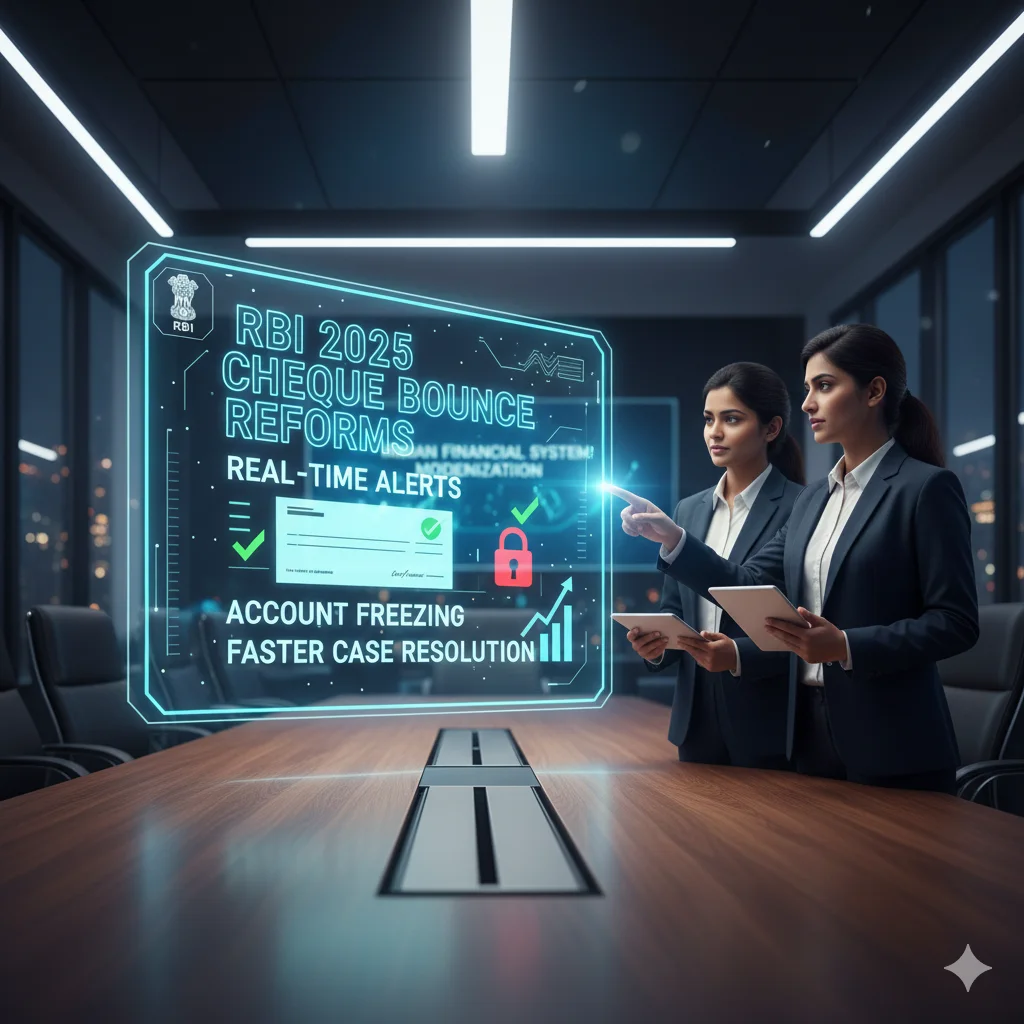
Real-time alerts, freezing accounts, and faster case resolution are all part of RBI's 2025 Cheque Bounce Reforms.
By 2025, you might be able to pay for most things with UPI, but cheques are still very much alive when it comes to security deposits, business credit, property deals, and other high-value transactions.
Sadly, the stress of a bounced check is also there.
For years, a bounced check meant:
Money stuck for months or years
Legal notices that are hard to understand
Under Section 138 of the Negotiable Instruments Act (NI Act), there are endless court dates.
The environment around bounced checks is finally changing in 2025.
In between:
RBI is pushing for faster dishonor notifications and real-time check clearing.
Stricter measures at the bank level, such as 24-hour bounce alerts and freezing accounts temporarily after repeated offenses,
With new Supreme Court rules to speed up Section 138 cases, Indian consumers and small businesses are getting a more tech-driven, organized, and time-limited check system.
In this article, I'll explain these changes in simple terms and talk about where a specialized law firm like cheque bounce lawyer led by Advocate BK Singh fits in, especially if you're a middle-class person or MSME who is worried about criminal liability or has had a cheque dishonored.
1. Why bouncing checks is still a big deal in 2025
Checks are still common for:
Rent and deposits for commercial leases that are flat
Credit limits for dealers and distributors
Checks that are dated after the loan or EMI
Safety in business partnerships and franchise deals
When a check doesn't go through:
The payee loses time and trust
The drawer could go to jail for up to two years or pay a fine that is twice the amount of the check, or both.
Courts are overwhelmed. As of 2024, millions of cheque cases were still open across India, and in some big cities, they make up almost half of all criminal cases pending in trial courts.
The Supreme Court has now publicly called this a "cheque bounce crisis" and given a detailed plan to clear the backlog and speed up the process.
The RBI's side of the reform is different. It looks at how quickly checks move through the banking system and how quickly both sides get the right information.
2. RBI's goal for 2025: faster check clearing and information about dishonored checks in real time
The RBI's Payments Vision and 2025 rollouts are changing the way cheques are cleared from "1–3 working days" to an almost real-time experience during business hours.
Key parts, as reported:
Starting on October 4, 2025, banks will begin scanning checks all the time and settling them every hour. The full rollout is planned for early 2026.
Most checks should clear (or be returned) within hours, not days, by January 2026.
What this means in the real world
If you own a small business in Ludhiana, you don't have to wait 2–3 days to find out if your client's check will clear.
As a landlord in Delhi, you know the same day if the rent check is good or not.
For working-class families who use post-dated checks to pay for school fees or EMIs, the time of uncertainty gets shorter.
Faster clearing doesn't stop checks from bouncing, but it does lessen the damage by cutting down on the time you have to wait and giving you a clear "yes" or "no" the same day.
2.2 Alerts in real time for bounced checks
A number of 2025 explainers and banking updates talk about a common expectation:
Banks have to send SMS and email alerts within about 24 hours of a check being bounced to both:
the person who wrote the check (the drawer), and
the person who was supposed to get the money.
The alert usually says:
That the check has bounced
The precise cause (lack of funds, signature mismatch, expired check, closed account, etc.)
Why this is so important
According to Section 138 of the NI Act, your deadlines start on the day you get a notice from the bank that your check was not honored:
You have to send a legal notice to the drawer within 30 days of that notice.
The drawer has 15 days to pay after that.
You have 30 days after that to file a complaint in court if they don't pay.
In the past, a lot of payees missed these deadlines because:
They waited for the memo to come back in person, or
They missed a small text message from the bank in time.
Consistent real-time bounce alerts make it easier for a complainant to stay within the law and for a defense lawyer to check if the timeline was followed correctly.
This is where the cheque bounce lawyer, Advocate BK Singh, often comes in. They use bank alerts, emails, and statements to make a timeline that is accurate and can be used in court.
2.3 Freezing an account after several bounced checks
A lot of people are talking about how the "new cheque bounce rules 2025" will be stricter on people who do it all the time:
If a check from the same account bounces three times in a row, the bank may temporarily stop processing checks on that account, according to articles that summarize the rules for 2025.
This doesn't mean that every accidental bounce causes a freeze. Usually:
Banks look at patterns, intentions, and account history.
Freezing might only apply to issuing checks, not all digital operations.
The measure is framed as a way to manage risk and keep people in line, similar to how banks already freeze accounts that look like they belong to "money mules."
Effect on the real world
A builder who keeps sending bounced checks for flat refunds may suddenly have all of their check-writing privileges blocked, which will make them pay their bills more responsibly.
If a distributor keeps missing payments, their bank may flag the account and force them into a formal settlement.
For middle-class account holders who made a real mistake, quick action and clear communication are very important. Advocate BK Singh often tells these kinds of clients to:
How to make payments on time every time
How to talk to the payee before it turns into a full criminal complaint
And how to go to court for help when you need it, while showing good faith.
3. The Supreme Court's 2025 rules will help cases get resolved faster.
The Supreme Court's 2025 rules on Section 138 cases, not the RBI, are what drives "faster case resolution."
In the case of Sanjabij Tari v. Kishore S. Borcar & Anr. In 2025, the Court gave clear orders on how to deal with the huge number of cases of bounced checks:
Here are some important points:
Multiple-channel summons
Summons must be served not only through the usual court and postal methods, but also through dasti (by the complainant) and electronically, such as through email and WhatsApp, if the rules allow it.
Links to pay online in summons
Summons can have QR codes or UPI links so the person being accused can pay the check amount early. Courts are told to combine and close cases quickly when payment is made.
Summary trial and close watching
Before turning a summary trial into a long summons trial, trial courts must write down clear reasons.
Section 138 cases must have dashboards that show how long they have been pending, how many have been disposed of, how many have been compounded, and how many have been adjourned.
Promoting quick resolution
In many cases, the Court has lowered compounding costs to encourage people to settle and pay instead of going to jail.
At the same time, a number of articles are now talking about e-filing complaints, accepting digital evidence, and court-driven efforts to keep cheque cases moving on strict deadlines.
What this means for you
If you are the payee, your case should move faster, especially in big cities where special dashboards and evening courts are being looked into.
If you are the drawer, the courts will expect you to take settlement options seriously and act quickly.
These rules are used proactively by a specialist practice like cheque bounce lawyer:
For complainants: putting the case together so that it fits the fast-track framework, which includes clear digital records and a well-written summary.
For people who are accused: using QR-based payment options, compounding routes, and negotiated settlements to stay out of jail whenever possible under the law.
4. How these changes will affect people in the middle class and small businesses
Let's look at a few real-life situations in India.
Scenario 1: A flat owner in Ghaziabad
A retired couple in Ghaziabad gets a check for three months' rent from their tenant. The check bounces because there isn't enough money in the account.
They get an SMS alert within hours and can see the return memo on net banking with the new system.
They go to a lawyer who deals with bounced checks, and Advocate BK Singh helps them:
Send a legal notice on time,
Get proof of bank SMS/email,
And, if necessary, file a Section 138 complaint in a way that follows the Supreme Court's fast-track rules.
The tenant is now under a lot more pressure to pay their bills or settle quickly, instead of dragging the issue out for years.
Scenario 2: A small supplier in Jaipur
A small textile supplier in Jaipur sends ?15 lakh worth of goods to a chain store. The buyer's check bounces twice.
The supplier gets bounce alerts and reasons right away, so they can stop more deliveries.
The buyer's bank won't issue any more checks after the third bounce, according to its own policy for repeated bounces.
The supplier files the case correctly with the help of a check bounce lawyer and uses the most recent compounding rules to demand full payment plus reasonable costs, instead of only accepting payments over time.
Scenario 3: A salaried person in Bengaluru who is a guarantor
A Bengaluru IT worker with a salary gives a security cheque as a guarantee for a friend's business loan. When the loan goes bad, the lender gives the check, and it bounces.
The worker:
Sees the bounce alert right away,
Talks to Advocate BK Singh, who:
Looks into whether the guarantor has a legally enforceable liability,
Checks to see if the bank and NBFC have followed the rules set by the RBI and the NI Act,
And makes a plan for defense that could include contesting the debt, reaching a settlement, or using compounding provisions.
Real-time alerts and expert legal help work together to keep the situation from turning into a crisis that can't be handled.
5. How "cheque bounce lawyer" and Advocate BK Singh can help in this new system
The changes in 2025 actually make good legal strategy more important, not less.
Advocate BK Singh and his team at Cheque Bounce Lawyer usually help clients with:
Assessment before going to court
Checking bank alerts, return memos, and account statements
Confirming the time limits and whether the Section 138 requirements are met
Writing good legal notices
Clear narration of facts (dates, amounts, purpose)
Make the right legal demand within the time limits set by law
Tone adjusted: firm but willing to settle in a practical way when it makes sense.
Filing and handling Section 138 cases
Using the Supreme Court's 2025 format and summary for complaints
Using digital evidence like SMS, email, UPI screenshots, and ledger extracts
Helping clients choose between a summary trial, mediation, or compounding.
Defense and risk management for people who have been accused
Looking into whether the checks were security checks, debts that were too old to be paid, or checks that were given without any thought.
Giving advice on temporary compensation orders and making sure that payments are set up in a way that clients can handle.
Helping MSMEs and family businesses
Making sure that invoices and checks are handled the same way
Training internal accounts staff on how to handle RBI checks, alerts in real time, and keeping records.
The biggest benefit for middle-class Indians and small business owners is that they have more control and clarity. You don't have to go to the bank, the police station, and the court anymore. You have one legal team that knows both RBI's tech reforms and the NI Act's criminal procedures.
Reviews from Clients
*****
Kunal Sharma
"I had always heard scary stories about cases of bounced checks that lasted for years. I freaked out when my tenant's rent check bounced. The lawyer for the bounced check explained the new system that the RBI started, used the bank's SMS alerts and return memo, and wrote the notice the same day. The tenant paid off all of their debts and left without any problems within a month. Advocate BK Singh's calm advice kept me from going to court when I wasn't ready.
Kunal Sharma
"I had always heard scary stories about cases of bounced checks that lasted for years. I freaked out when my tenant's rent check bounced. The lawyer for the bounced check explained the new system that the RBI started, used the bank's SMS alerts and return memo, and wrote the notice the same day. The tenant paid off all of their debts and left without any problems within a month. Advocate BK Singh's calm advice kept me from going to court when I wasn't ready.
*****
Meera Nair
"A big business client kept putting off paying me by sending me checks that bounced twice. I was scared of the legal costs and emotionally drained. The people at cheque bounce lawyer told me about the new rules, such as how banks can freeze people who break the rules more than once. The company paid me the full amount plus interest before the first hearing once they saw that I had strong legal backing and a strong Section 138 case. That money meant the difference between life and death for my small business.
Meera Nair
"A big business client kept putting off paying me by sending me checks that bounced twice. I was scared of the legal costs and emotionally drained. The people at cheque bounce lawyer told me about the new rules, such as how banks can freeze people who break the rules more than once. The company paid me the full amount plus interest before the first hearing once they saw that I had strong legal backing and a strong Section 138 case. That money meant the difference between life and death for my small business.
*****
Arvind Jain
"I used to just tear up bounced checks because I thought 'court ka chakkar' wasn't worth it. I talked to Advocate BK Singh after reading about the changes that will happen in 2025. He looked over my bank alerts, bills, and WhatsApp chats before filing a complaint in the new fast-track format. The judge quickly pushed for a settlement based on the rules of the Supreme Court. The issue was settled in months, not years. "I wish I had gotten the right legal help sooner."
Arvind Jain
"I used to just tear up bounced checks because I thought 'court ka chakkar' wasn't worth it. I talked to Advocate BK Singh after reading about the changes that will happen in 2025. He looked over my bank alerts, bills, and WhatsApp chats before filing a complaint in the new fast-track format. The judge quickly pushed for a settlement based on the rules of the Supreme Court. The issue was settled in months, not years. "I wish I had gotten the right legal help sooner."
*****
Farah Khan
"A client wrote me a check for my design fees and then disappeared when it bounced. I felt like I had been cheated and embarrassed. They treated me like a "big client" at cheque bounce lawyer, not like a "small client." They told me about my rights, the deadlines, and how digital evidence like emails and bank SMS could help my case. Even though the amount wasn't very big by legal standards, they helped me get every rupee back through a court-backed settlement.
Farah Khan
"A client wrote me a check for my design fees and then disappeared when it bounced. I felt like I had been cheated and embarrassed. They treated me like a "big client" at cheque bounce lawyer, not like a "small client." They told me about my rights, the deadlines, and how digital evidence like emails and bank SMS could help my case. Even though the amount wasn't very big by legal standards, they helped me get every rupee back through a court-backed settlement.
*****
Suresh Patil
"One of my most important customers kept making excuses after his check bounced. I was already under a lot of pressure from my loans. A friend told me to go to Advocate BK Singh. He carefully looked over my papers, made sure the notice was within the time limit, and used the new court rules to push for early compounding. The person who is accused agreed to pay in two parts using the QR payment link that was included in the summons. "That case was handled well, so my trucks are still running."
Suresh Patil
"One of my most important customers kept making excuses after his check bounced. I was already under a lot of pressure from my loans. A friend told me to go to Advocate BK Singh. He carefully looked over my papers, made sure the notice was within the time limit, and used the new court rules to push for early compounding. The person who is accused agreed to pay in two parts using the QR payment link that was included in the summons. "That case was handled well, so my trucks are still running."
?FAQs
Q1. What are the easy-to-understand changes to RBI's 2025 cheque bounce rules?
RBI's changes to the ecosystem in 2025 are meant to speed up the clearing of checks and the flow of information, not change the basic criminal law. Now, checks are cleared or sent back much faster—often within hours—thanks to continuous scanning and near-real-time settlement, instead of 1 to 3 days earlier.
Q2. Are cases of bounced checks still crimes in 2025?
Yes. Section 138 of the NI Act says that it is still a crime to dishonor a check for not having enough money or for other similar reasons. The punishment can be up to two years in prison, a fine of up to twice the amount of the check, or both. No changes have made bouncing checks legal yet, but there are still policy debates going on.
Q3. What is the new rule about getting SMS alerts in real time when a check bounces?
When a check is not honored, banks are now required to send instant or within-24-hour SMS and email alerts to both the drawer and the payee, clearly stating the reason for the return. This is part of a larger set of banking changes for 2025 that are meant to make things more open and prompt.
Q4. Can my bank freeze my account if I keep bouncing checks?
A lot of articles about 2025 say that if a customer has three checks bounce in a row from the same account, the bank may temporarily freeze that customer's check operations as a punishment. The actual treatment depends on the bank's own rules and the RBI-compliant risk framework. It usually goes after people who keep doing the wrong thing, not people who make a mistake once.
Q5. Have the deadlines for filing complaints about bounced checks changed?
The legal framework is mostly the same: Send a legal notice within 30 days of getting the bank memo Allow 15 days for payment If you don't get paid, file the complaint within 30 days. Some people say that the windows should be longer or that you should be able to do things online, but the best thing to do is to stick to the original NI Act timelines unless Parliament changes the law.
Q6. What has the Supreme Court done to speed up the resolution of bounced check cases in 2025?
The Supreme Court gave detailed instructions in 2025 on how to deal with the huge backlog of Section 138 cases. Some important steps are: sending summons through multiple channels (like WhatsApp and email), including QR/UPI payment links in the summons, keeping a close eye on pending cases, and encouraging early compounding. These changes are meant to speed up the process and cut down on delays.
Q7. How do rules for clearing checks in real time help small businesses?
Small businesses benefit because they can tell much more quickly if a client's check has cleared. This helps you plan your cash flow, decide if you should ship more goods, and take legal action quickly if the check bounces. Real-time alerts and faster clearing mean less uncertainty and fewer surprises.
Q8. What kind of proof is now accepted in cases of bounced checks?
As long as they follow the Evidence Act's rules on electronic records, courts are more willing to accept digital evidence like bank SMS and email alerts, net-banking statements, scanned cheque images, WhatsApp messages, and online transaction history. Recent articles and Supreme Court orders strongly suggest that Section 138 cases should be handled in a way that uses technology.
Q9. If I pay the amount, can I stay out of jail for a bounced check?
Yes, in a lot of cases. The Supreme Court has said again that the main goal of cheque bounce cases is to make sure that payment is made. If the accused pays the check amount (usually with reasonable costs) and both sides agree to compound, the courts can close the case and the accused will not have to go to jail. Recent decisions show that a real compromise can even change a conviction in some cases.
Q10. Why should I hire a company like "cheque bounce lawyer" instead of a local lawyer?
Because writing a simple complaint is no longer the only thing you do in 2025. You need a person who: knows how RBI's real-time clearing and alert systems work, Knows the most recent Supreme Court rules about speeding up cases, Can properly handle digital evidence, and Has the skills to reach smart settlements or go to trial if necessary. Advocate BK Singh leads a focused practice called "cheque bounce lawyer." It combines knowledge of banking, criminal procedure, and practical strategy that is tailored to the needs of middle-class clients and small and medium-sized businesses.
There's no reason for concern. There is no difficult-to-understand legalese.
Someone who has helped many people with the same problems gives you clear, honest advice. We want to make the legal process easy to understand and use for everyone.