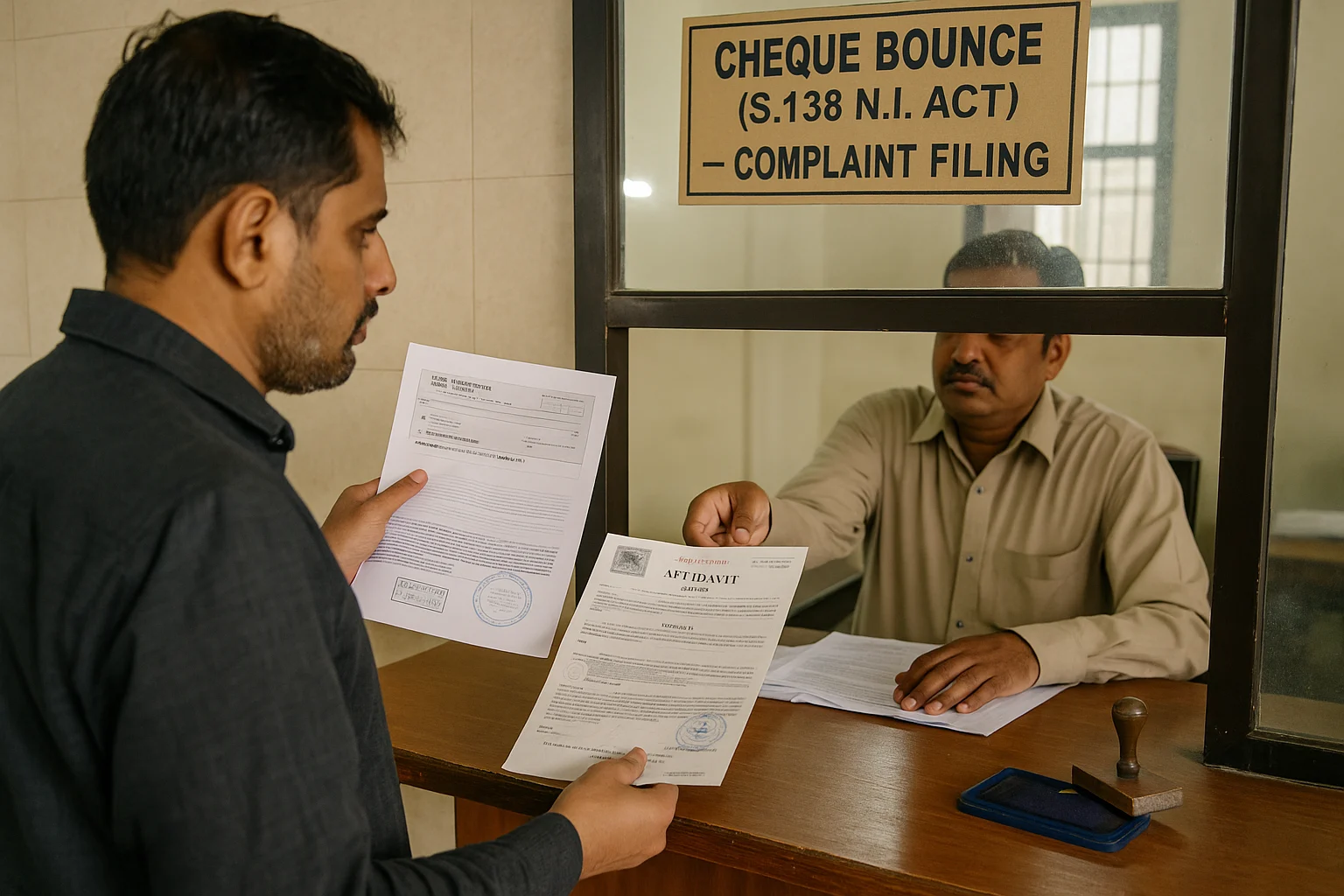
Can You Go to Court Without a Lawyer for a Cheque Bounce?
Yes, you can file a Section 138 Negotiable Instruments Act (NI Act) complaint on your own. Every year, thousands of people go to court in person. But the longer answer is more complicated. A cheque-bounce case is "summary" in theory, but it has strict technical steps and deadlines that can't be changed. A small mistake can set back months of work.
We help clients at Cheque Bounce Lawyer, led by Advocate BK Singh, decide whether to do it themselves with guided templates and checks or hire us to represent them when the stakes are high and time is of the essence.
What Section 138 Says (in Simple Terms)
Dishonour: Your bank returns the cheque unpaid (e.g., “insufficient funds,” “account blocked”).
Demand Notice: You must send a written legal notice within 30 days of receiving the bank’s return memo, demanding payment of the cheque amount.
15-Day Window: The drawer (the person who gave you the cheque) has 15 days from receipt of the notice to pay.
Cause of Action: If payment isn’t made within those 15 days, your cause of action begins on Day 16.
Filing Deadline: You must file the criminal complaint within one month from the date the cause of action arises (courts can condone delay for sufficient cause).
Jurisdiction: After the 2015 amendment, jurisdiction typically lies where your bank branch (where you presented the cheque) is located.
Interim Compensation: Courts may order the accused to deposit up to 20% of the cheque amount as interim compensation during trial (Section 143A). On appeal, a further minimum 20% deposit may be required (Section 148).
Tip: A cheque is generally valid for three months from its date. Present within validity.
Can You Do It Yourself? Absolutely Here’s the DIY Path
If you decide to file without a lawyer, follow a tight, document-first workflow:
Step 1: Collate Proof
Original cheque (or bank’s certified copy if retained), bank return memo, copy of legal notice, proof of dispatch (Speed Post/Registered AD/courier receipt, tracking report), and proof of service if available.
Supporting documents include proof of the loan or transaction, invoices, a ledger, WhatsApp or email confirmations, and any receipts for partial payments.
Step 2: Write the Complaint
Keep it in order: transaction - cheque - presentation - dishonour - demand notice - non-payment - prayer for conviction/compensation.
Include a list of witnesses (usually you as the complainant), a list of documents, and an affidavit of evidence (many courts accept pre-summoning evidence by affidavit).
Talk about interest and compensation, and ask for temporary compensation under Section 143A.
Step 3: Go to the Right Court
File in the Magistrate Court that has jurisdiction over the area where your bank branch is located.
More and more courts are letting people file online, but the formats can vary by state or district. Check the filing counter for the exact list of things you need to bring (ID proof, vakalatnama not needed if you show up in person, pagination, indexing, court fee, etc.).
Step 4: The Pre-Summoning Stage
You probably won't have to give a long written statement; an affidavit of evidence will do. If the Magistrate is happy, they may issue a process or summons to the accused.
Step 5: Trial and End
Summary trials under Section 138 should include cross-examination, defense evidence (if any), and arguments.
Courts can encourage mediation or compounding at any time, and many disputes are resolved with clear payment terms.
How to Choose Between Doing It Yourself and Hiring a Lawyer
DIY Might Work If:
The paperwork is clear, and the drawer's defense is weak.
The amount is small, and you are comfortable with dates, filings, and follow-ups.
You have followed all the timelines and used checked templates.
If you need to hire a lawyer,
The amount is big, or you think you might have a technical defense (like denying a signature, challenging authority, making a security check plea, disputing part-payment, or using multiple checks).
You need quick, enforceable settlement terms or temporary compensation orders.
The accused will probably delay or appeal, so you need a solid record.
Where Cheque Bounce Lawyer (Advocate BK Singh) Can Help
Check your notice, complaint, affidavit, and exhibits ahead of time so you don't miss a legal step.
Court strategy: temporary payment, themes for cross-examination, and anticipating common defenses.
Payment schedules, default triggers, and execution mechanisms that work for MSMEs and people are all part of settlement architecture.
Common Defenses You Should Expect (and How We Fight Back)
"Security check" argument: Use invoices, ledgers, emails, part-payments, and admissions to show who is really responsible.
"No legally enforceable debt" means that you have to show proof of consideration through bank transfers, GST invoices, or loan agreements.
"Signature/cheque not mine" Get a handwriting expert's opinion, look at bank records, use Section 139 presumption, and shift the burden back.
"Notice not received" means that you should keep track of the delivery. Courts accept deemed service as long as the dispatch is proven and the address is correct.
Partial payment after notice - Write down the amount; ask for a conviction or payment for the rest plus costs.
For people in the middle class and small businesses
Individuals: We care about speed, cost, and respect no endless delays.
For SMEs and MSMEs, we turn scattered proofs into a court-ready evidence pack and push for interim compensation or an early settlement so you can get your money back.
Advocate BK Singh at Cheque Bounce Lawyer combines courtroom discipline with business sense to give you choices that protect both your rights and your time.
Rajeev Malhotra
"I almost filed it myself, but I was worried about the deadlines. The Cheque Bounce Lawyer looked over my notice and complaint in two days. Advocate BK Singh got temporary compensation, and the case was settled through mediation.
Sana Parveen
"As a boutique owner, ?3.8 lakh stuck was hurting my cash flow." The team put together an evidence file using invoices and chats. We got a structured settlement with clear default clauses, and the money started to come in.
Arvind Desai
"The accused said it was a security check. Cheque Bounce Lawyer used our ledger and an email admission from earlier to tear down that defense. After that, there was a judgment and payment.
Meera and Karthik
"We filed pro se, but we had problems with the formatting." The company fixed our complaint, organized the exhibits, and made a case for Section 143A. The accused made a partial payment within weeks.
Nikhil Shetty
"Dates were killing me." Advocate BK Singh did the cross-examination and got us a better payout than we had hoped for. "Calm and professional."
Q1: Is it possible to file a check bounce case without a lawyer?
Ans. Yes. A lot of people who are suing do. Make sure you follow the notice (30 days), the 15-day payment window, and the filing within one month of the cause of action. Checklists and templates are useful.
Q2. How long do you have to send a legal notice after dishonor?
Answer: 30 days after getting the bank's return memo.
Q3. Where should I put the case?
Ans. In general, the place where your bank branch is located (where the check was presented) is where the check was written. This is the rule after 2015.
Q4. What happens if the drawer pays within 15 days of the notice?
Ans. The crime is not proven. Most of the time, that's where it ends. Accept payment in a way that can be verified and send a receipt.
Q5. Can the court give temporary compensation?
Ans. Yes. Section 143A says that courts can order the complainant to get up to 20% of the check amount as temporary compensation.
Q6. What if the person who is being accused says it was a "security check"?
Ans. Invoices, contracts, bank statements, and admissions can all show legally enforceable debt or liability. You are helped by Section 139; the accused must prove it wrong.
Q7: Is it okay to use WhatsApp or email as proof?
Answer: Yes, and a Section 65B certificate for electronic records when needed. If you can, keep metadata, screenshots, and server logs.
Q8. How long do Section 138 cases take?
Ans. They are summary matters, but the length of time depends on the docket and the behavior. A lot of people settle early through mediation or compounding, and good paperwork speeds things up.
Q9. What happens if I miss the one-month filing window after the 15-day period?
Ans. Courts may allow delays for good reason. Submit an application that explains why you are doing it and includes any supporting documents.
Q10. Is it safe to settle with a compoundable settlement?
Ans. Yes, if the draft is good. Use old milestones, default triggers, and a withdrawal plan that keeps your leverage until you actually get what you want.
There's no reason for concern. There is no difficult-to-understand legalese.
Someone who has helped many people with the same problems gives you clear, honest advice. We want to make the legal process easy to understand and use for everyone.